
A strong Party organization leads to sustainable business development.
(Baonghean) - During the past term, in the context of economic recession which directly impacted the business activities of enterprises, but with synchronized solutions in building Party organizations at the grassroots level in conjunction with production and business development, trust and a solid foundation have been created for enterprises to rise up and affirm their role and position…
(Baonghean) - During the past term, in the context of economic recession which directly impacted the business activities of enterprises, but with synchronized solutions in building Party organizations at the grassroots level in conjunction with production and business development, trust and a solid foundation have been created for enterprises to rise up and affirm their role and position…
Practical and sharing difficulties.
The Party Committee of the Nghe An Business Sector has 135 subordinate party committees and grassroots party branches, divided into 8 groups. During the past term, the Party Committee of the Nghe An Business Sector closely followed the policies of the Party and State, and the development process of enterprises, to promptly guide and lead grassroots units to proactively work with the Board of Directors and Management Board to innovate management and operational methods towards streamlining and efficiency, improving product quality, and simultaneously expanding markets and exploiting advantages for development...
Implementing the policy of "focusing on the grassroots," a prominent feature of the term, the Standing Committee of the Party Committee of the bloc acted as a "bridge," summarizing the difficulties and obstacles faced by businesses and proposing solutions to the Provincial Party Committee and the Provincial People's Committee for coordination among relevant departments. At the same time, the Standing Committee of the Party Committee of the bloc reviewed and planned the restructuring and consolidation of struggling grassroots party organizations according to the principle of "supporting what is weak in each unit," based on the following specific groups: grassroots party organizations facing particularly difficult circumstances requiring solutions regarding mechanisms and policies; groups facing difficulties in fulfilling political tasks; groups requesting transfer to local authorities; groups requesting consolidation in terms of organization and personnel; and groups to be merged into party committees.
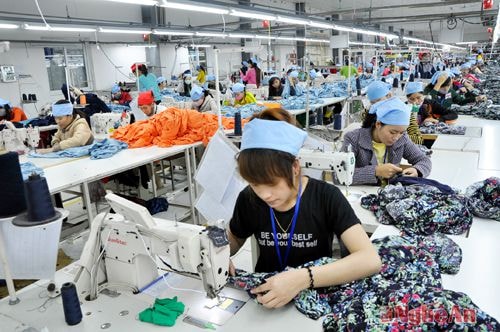 |
| Export garment production line at Nam Sung Vina Garment Factory (Dien Chau). Photo: HN |
For example, regarding groups needing solutions related to mechanisms and policies, such as outstanding social insurance debts at Nghe An Bridge and Road Construction Joint Stock Company, Investment & Construction Joint Stock Company 24, or Sea Dredging Company 2..., the Party Committee leaders chaired meetings with the participation of the Social Insurance agency and businesses with outstanding social insurance debts to discuss solutions and decisively direct implementation; or difficulties regarding land allocation for some businesses when expanding production and business premises... In this way, it not only helps higher-level Party officials understand the practical situation and share difficulties but also supports businesses in resolving arising problems.
Closely monitoring the grassroots level has helped resolve difficulties for businesses while simultaneously encouraging and motivating those operating efficiently. The role of the Party organization affirms its position and importance in fulfilling the unit's political tasks. Thanks to this, under the leadership of the Party Committee Standing Committee, the Party committees and grassroots branches of the affiliated enterprises have overcome difficulties and made significant contributions to the province's economy during the past term, affirming their extremely important position and role in the economy. In 2014, the entire bloc of enterprises achieved revenue of 28,055 billion VND, an increase of 63.64% compared to the beginning of the term; profit of 1,102 billion VND, an increase of 14.96%; and tax contributions to the state budget of 1,199 billion VND, an increase of 25.37%. Workers' incomes ranged from 2.2 to 11 million VND per month, an increase of 52.78% to 83.33%...
In 2015, the Party Committee of the Enterprise Bloc continued to choose the theme "Year for Enterprises in Nghe An Province," with the aim of continuing to promote sustainable development of enterprises in the era of integration. Comrade Vo Quoc Hung, Deputy Secretary of the Party Committee of the Bloc, affirmed: In the next term, the Party Committee will continue to identify specific goals and solutions, focusing on grassroots initiatives to support enterprises; while strengthening governance, innovating enterprises; and promoting joint ventures and partnerships based on maximizing the advantages of enterprises within the bloc... contributing positively to increased production and business efficiency, thereby enabling the enterprise community in the province to increasingly make a significant contribution to the province's economy.
Strengthening the Party's grassroots organization system.
While the business community, with its grassroots Party organizations under the Party committee of the bloc, strives to demonstrate its important role in the province's economy, private enterprises and foreign-invested enterprises are increasingly showing their strength, creating jobs, contributing to the budget, and especially aiming to establish Party organizations within this type of enterprise to guide and lead political tasks... The Standing Committee of the Provincial Party Committee issued Decision No. 5155-QD/TU promulgating the Project "Developing Party members and Party organizations in private enterprises and foreign-invested enterprises in Nghe An province, 2014-2020". This can be considered a crucial "breakthrough" for the Party to assume the function of leadership and development guidance in private and foreign-invested enterprises, an economic force that contributes nearly 80% of the budget annually and provides employment for thousands of workers. Local authorities will then develop implementation solutions based on the objectives, implementation roadmap of the project, and local conditions.
Quỳ Hợp currently has a large number of businesses, with 355 private enterprises in operation, of which 150 are headquartered within the district, and the remaining businesses are located outside the district. With this large workforce, the district was selected by the province as one of two pilot units to implement the project. Comrade Hà Văn Vịnh, Deputy Head of the Organization Department of the Quỳ Hợp District Party Committee, stated: “Following the project of the Provincial Party Standing Committee, the District Party Committee issued a Decision on the establishment of the Steering Committee and a Plan for implementation. Through this, the district conducted a survey and assigned specific plans for developing Party members, Party organizations, and mass organizations in private enterprises and foreign-invested enterprises (PEEs) in the district until 2020.” With this systematic approach, in 2014, Quỳ Hợp district developed 25 Party members who were workers in PEEs. Simultaneously, the quality of activities of Party organizations in various types of enterprises is being strengthened and improved. In particular, within the district, there is a Party branch with 15 members at the Yabashi Vietnam Limestone Mining Company, a 100% Japanese-owned enterprise.
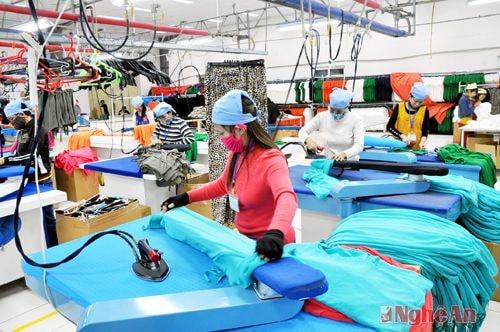 |
| Workers operating the production line at Nam Sung Vina factory. |
Overall, currently in the private enterprise and foreign-invested enterprise (FDI) sector of Quy Hop district, there are dozens of Party members working in private enterprises, including 15 Party members who are business owners and cooperative chairmen. These achievements serve as a foundation for the district to continue promoting Party member development and building grassroots Party organizations in the private enterprise and FDI sector. In an interview with us, Comrade Phan Dinh Dat, Deputy Secretary of the Quy Hop District Party Committee, stated: Party development and the establishment of grassroots Party organizations in private enterprises and FDI enterprises still face many difficulties. Therefore, in the coming time, the district will continue to promote various solutions to ensure that business owners understand the role and importance of Party organizations. The goal is to have over 50% of private enterprises and FDI enterprises within the district's planned area establish Party organizations by 2020.
In Nghi Loc district, one of the areas with industrial zones and economic zones, a large number of businesses have been attracted. To strengthen and enhance the role of grassroots Party organizations in non-state enterprises, in addition to implementing Decision No. 5155, Nghi Loc has also proactively developed, issued, and implemented Project No. 05-DA/HU on "Building and developing Party and mass organizations in non-state enterprises in the area during the period 2012-2017". Thanks to this proactive approach, the development of Party members and the strengthening of Party organizations in the area have seen positive changes.
Drawing inspiration from the exemplary model at the Party Branch of Binh Minh Trading and Service Company Limited, with its well-structured organization and activities, and the increasingly enhanced role of Party members and Party organizations, Nghi Loc has learned from this experience and replicated it throughout the district. This has been achieved through practical surveys and solutions tailored to specific units, such as establishing youth and women's organizations as a foundation for Party organizations. Examples include establishing a youth branch at Ho Chi Minh City Tien Phong Youth Plastic Company Limited and opening training courses for outstanding business owners to become Party members. Ms. Dinh Thi Tam, Deputy Secretary of the District Party Committee, emphasized: "Developing Party organizations in private enterprises requires focusing on recruiting qualified business owners into the Party. Only then can the Party organization develop steadily and play a pivotal role in leading the implementation of political tasks."
In Quynh Luu district, following the separation and establishment of Hoang Mai town, statistics show that there are currently 258 small and medium-sized enterprises, of which 201 are Party members who are employees of these enterprises but do not yet meet the conditions for establishing Party branches. This group is organized into 39 rural Party branches. Understanding this situation and with the efforts of the Steering Committee for the project, during the past term, the district has established a Party branch at Thanh Mai Co., Ltd. with 4 Party members, and is currently completing the procedures to establish a Party branch at Ho Hoan Cau Co., Ltd. The Quynh Luu District Party Committee also has a plan to establish and strengthen the core role of Party organizations in enterprises once they are established.
To date, the Provincial Party Committee's "Project on Developing Party Members and Organizations in Private and Foreign-Invested Enterprises in Nghe An Province from 2014 to 2020" is a significant milestone affirming the important role of Party organizations in enterprises in general, and in private and foreign-invested enterprises in particular. A strong Party organization within an enterprise means stability in production and business. This requires greater responsibility from the "owners"—directors and chairmen of the board of directors—in establishing Party organizations, joining the Party ranks, and playing a "core" role in guiding, directing, and steering the enterprise towards sustainable development.
Hong Son - Nhat Le


