
US President Obama begins his visit to Japan.
On April 23, US President Barack Obama arrived in Tokyo, Japan, the first stop on a four-country tour of East and Southeast Asia aimed at strengthening Washington's commitment to the region.
This is the first state visit by a U.S. president to Japan in 18 years.
According to the plan, President Obama will hold talks with Japanese Prime Minister Shinzo Abe on April 24th.
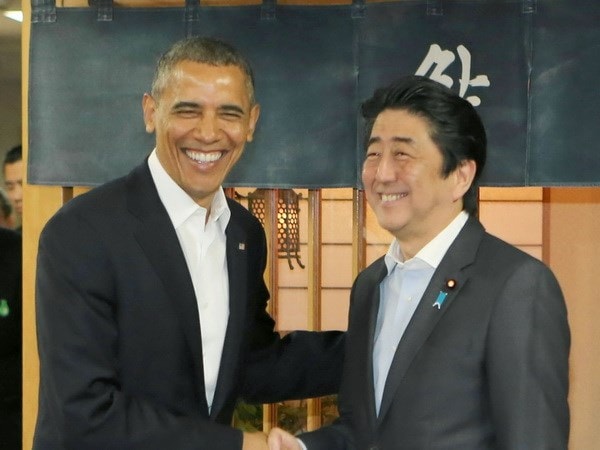 |
| President Barack Obama (left) shakes hands with Japanese Prime Minister Shinzo Abe in front of the Sukiyabashi Jiro sushi restaurant in Ginza district, Tokyo. (Source: VNA) |
It is expected that security and economic alliance agreements, including the ongoing negotiations on a free trade agreement – the Trans-Pacific Partnership (TPP) – will be the main topics of discussion during the meeting between the two leaders.
Additionally, Obama will also address the maritime dispute between Japan and China concerning the Senkaku Islands (called Diaoyu by China) in the East China Sea.
In a handwritten note published in Japan's Yomiuri Shinbun newspaper on April 23, President Obama stated: "The Senkaku Islands are under Japanese administration and therefore fall within the scope of protection under Article 5 of the U.S.-Japan Security and Cooperation Treaty."
Earlier, the US President also emphasized that the US opposes any unilateral action that undermines Japan's control over the Senkaku/Diaoyu Islands. This is the first time President Obama has clearly stated this issue.
The White House has stated that it will not take a position on the sovereignty of the Senkaku/Diaoyu Islands, but the protection of the archipelago is explicitly stated in the US-Japan security treaty.
Last month, US Defense Secretary Chuck Hagel also told Chinese Defense Minister Chang Wanquan that the US military has a duty to defend Japan, including the Senkaku/Diaoyu Islands.
In 2010, then-US Secretary of State Hillary Clinton also raised the role of the US-Japan security treaty and the Senkaku/Diaoyu issue during talks with her Japanese counterpart.
Following his visit to Japan, the US President will continue his tour to South Korea, Malaysia, and the Philippines.
According to VNA


