
What's new in the 2016 Toyota Innova in Vietnam?
Modern design improvements coupled with more features are the basis for Toyota's expectation that the Innova will retain its market share.
The Innova and Fortuner are two of Toyota's latest models to be updated in the Vietnamese market. The Japanese automaker kept the first generation Innova on the market for over 10 years, selling it by maximizing its advantages of durability, fuel efficiency, and low maintenance costs, which were highly valued by its existing customer base, mainly middle-aged and commercial customers.
Despite competitors like the Chevrolet Orlando, Kia Rondo, and Suzuki Ertiga, the Innova remains unrivaled, accounting for 80% of its segment sales. Without strong competition in the small MPV segment in the Asian market, the new generation Innova might have arrived later. The 2016 Innova features significant improvements that redefine the concept of a "purely passenger-carrying" family car.
The second generation adopts a new design language similar to the Fortuner and Hilux, two models sharing the same IMV global multi-purpose vehicle platform that Toyota has been developing since 2004.Projector headlights with LED daytime running lights; the V version also has LED low beam lights.The front design provides a unified look and enhances brand recognition.
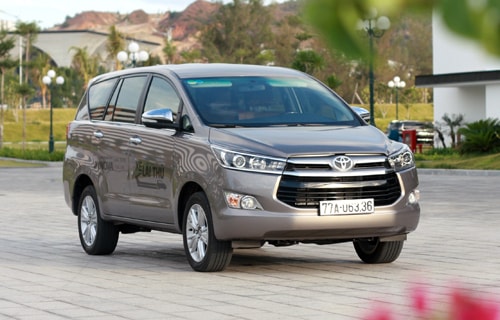 |
Toyota Innova 2016 in Vietnam. Photo: Duc Huy. |
The change in size contributed to the new look. XThe car is larger in all three dimensions: 150 mm longer, 70 mm wider, and 35 mm taller, while the wheelbase remains unchanged at 2,750 mm. The second generation looks more elongated and has a slightly sportier appearance.NThe exterior is neat, well-proportioned, and has more of an SUV feel, but it still has a distinctly Asian look and isn't truly groundbreaking.
Another benefit of the increased size is a much more spacious interior. The roof is 10 mm higher, and the distance between the front and rear seats is increased by 19 mm.Sitting in the back, even those who are 1.8 meters tall won't feel uncomfortable. On this V-series model, there are only two large, leather-upholstered seats that provide good back support and can slide up and down.
The second-row seating position is higher than the previous version, giving passengers the feeling of being the boss of a luxury car. Behind the first row of seats is a folding table for laptops, snacks, and drinks. With the same warm brown leather or fabric (E and G versions) upholstery, the interior space feels as warm as a family room.
The cabin design goes even further than the exterior. It's hard to imagine this interior belongs to a budget-friendly compact MPV. The dashboard extends horizontally, and the flowing curves are inspired by Lexus. Faux wood and silver metal accents are used sparingly.The plastic body panels feel sturdy and no longer flimsy like before.
On the V version, the steering wheel is wrapped in leather and wood, the seats are leather and electrically adjustable, and above the glove box is a small cooled compartment that can hold a few bottles of water, with the coolant coming from an additional air vent. The Innova is clearly geared towards families, with compartments and holders for water bottles throughout the vehicle, enough to hold up to 20 bottles.
Compared to the previous generation, the new Innova boasts significantly improved features. Toyota has discontinued the J trim level, and the E trim is now the lowest-priced option, targeting commercial customers. Even this version includes Bluetooth hands-free calling, a dual-zone manual air conditioning system, one-touch power windows on all doors, USB and AUX connectivity, a 6-speaker single-disc CD player, and HDMI/Wifi. The Japanese automaker states that taxi customers now have higher demands, making the limited features of the previous J trim level no longer suitable.
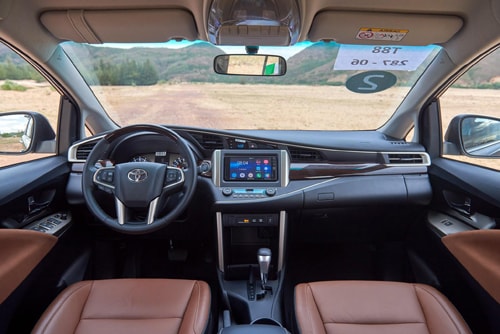 |
New Innova interior. Photo: Le Hung. |
Toyota knows how to create a reasonable price gap between versions. The G and E versions are even more impressively equipped than the E version. The V version features automatic climate control, automatic headlights (on/off and automatic headlight leveling), power-folding rearview mirrors, an Optitron digital instrument cluster, a 4.2-inch touchscreen central display with a button to rotate the screen outwards to reveal the CD and DVD slots – a rather sophisticated and rare design. The ceiling also includes adjustable blue curved LED interior lighting. The V version also has a card reader and voice control system.
These features are actually still fewer than its competitor, the Kia Rondo. The top-of-the-line Rondo has many more things like automatic wipers, dual-zone air conditioning, paddle shifters on the steering wheel, anti-glare rearview mirror, sunroof, 10-way power adjustable driver's seat, leg support... But if we look at Toyota's tradition of focusing on durability and fuel efficiency with fewer amenities, the new Innova is a completely different story.
The Japanese automaker knew it was time for a change. Older customers couldn't afford to buy more cars, while new customers demanded more options. To retain existing customers and attract new ones, the only way was to increase features and amenities alongside the already established, reliable brand image.
The second-generation Innova retains the same engine as 10 years ago, but has undergone significant refinements.The 2-liter, 4-cylinder engine, codenamed 1TR-FE, upgrades the variable valve timing technology from VVT-i to Dual VVT-i. It delivers 137 horsepower at 5,600 rpm and a maximum torque of 183 Nm at 4,000 rpm, equivalent to the previous version.
Toyota asserts that the focus is not on increasing engine power, but rather on smooth operation and fuel efficiency. The variable valve timing technology has been upgraded to a dual-type, meaning it intervenes at both the intake and exhaust ports, rather than just the intake port as before. The engine structure has also been improved, and a muffler has been added to the intake manifold to minimize noise.
The automatic transmission on the G and V models is a new 6-speed, replacing the previous 4-speed, thus expanding the range of gear ratios at the beginning and end of the range. The E model still uses a 5-speed manual transmission. The automatic transmission adds a sport shifting function, with the gear lever moving in a zig-zag pattern for a more engaging driving experience, rather than the straight-line shift of before.
Driving the Innova is revolutionary. Essentially, the two most noteworthy points are the surprisingly smooth ride and significantly improved sound insulation. The rear suspension features a multi-link 4-bar system with larger springs and an optimized layout to reduce road reaction.
Sitting in the 2015 version on a road full of potholes,A person nearly 1.8m tall might hit their head on the ceiling if sitting in the third row, but the 2016 version handles potholes more easily. On straight roads at high speeds, it even feels like a miniature Lexus.
Soundproofing panels are strategically placed throughout the vehicle, from the floor to the doors, roof, and hood. Wind noise is significantly reduced, and engine and undercarriage noise are also improved. However, the new engine sound, combined with the sealed insulation panels, creates a resonant space, resulting in a humming sound whenever the accelerator is fully pressed for a quick overtake.
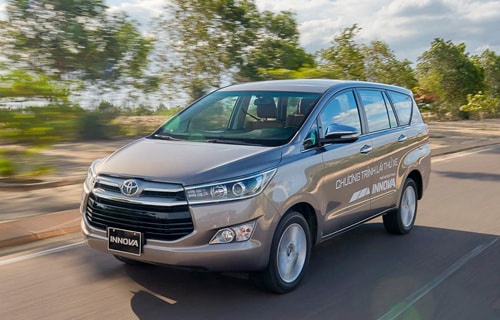 |
The new Innova is much smoother and has better sound insulation than its predecessor. Photo: Le Hung. |
Sitting behind the wheel of the new Innova is made even more enjoyable with the two buttons for Eco Mode and Power Mode. The 5-speed manual transmission version has the same gearbox and engine power, so there isn't much improvement in acceleration. These two driving modes only add a little more excitement, as is typical of manual transmissions where shifting gears largely depends on the driver.
On the G and V models equipped with a 6-speed automatic transmission, things are more noticeable. When driving normally, gear changes occur at around 2,500 rpm. Press the button.In Eco Mode, the car adjusts the air conditioning, engine, and transmission to minimize throttle response. Everything becomes sluggish, slow, and calm. The car shifts gears earlier, at around 2,000 rpm, making it harder to overtake quickly; at this point, you have to switch to sport mode.
Power Mode, on the other hand, makes the engine rev loudly and shifts gears at as high as 3,000 rpm. However, unlike typical Sport modes, Power Mode only adds a little extra power and excitement, because ultimately, fuel efficiency is the goal. The sport mode (S +/-) of the transmission is essentially a gear limiter. If set to S3, the car will only run in a maximum of 3rd gear. At low speeds, the driver can push the gear lever to display S6, but the car is actually only running in S3 or S4.
The power steering is still hydraulic but improved to be slightly lighter and smoother. However, at high speeds, due to the hydraulic nature and high oil pressure, the steering becomes lighter and the play increases, reducing the responsiveness of steering on the road surface when cornering. At a steady speed of 90-100 km/h, the MPV feels comfortable and stable, with the engine revs around 2,300-2,500 rpm. The Innova feels like a middle-aged man who has just rejuvenated himself; the accelerator and brake pedals are responsive and firm enough to provide a harmonious feel with the steering wheel.
The Innova's safety technology includes standard ABS, EBD, and BA on all three versions. The V version adds electronic stability control (VSC), hill-start assist (HAC), and a continuously flashing emergency brake warning light to alert vehicles behind. All three models have rear parking sensors, although even the top-of-the-line V version lacks a rearview camera. The E and G versions have 3 airbags, while the V version has 7 airbags.
Launched in the latter half of July, the new model brought surprises even to Toyota Vietnam itself. Typically, when a new generation is launched, the old generation sells slower, but both the old and new versions of the Innova recorded better-than-expected sales.The new Innova V, priced at nearly 1 billion VND, was initially expected to sell 30 units, but actual orders reached 100 units, accounting for 15% of total sales.
Innova is now approaching the market with a different mindset, a transformation of a strong contender. The E version is priced at...The E and G versions are priced at 793 million, 859 million, and the V at 995 million. The E and G versions remain the two main models for Innova's sales, while the V aims to elevate the segment. With its size, features, and price, the V is now no longer in the same league as other small MPVs.
Toyota also aims to make the Innova a new contender in the 1 billion VND car segment, competing with the trending C-segment crossovers like the CX-5 and CR-V. Innova's biggest advantage in this battle, besides its strong brand, is its 7-seat capacity, meeting the needs of transporting the whole family and carrying luggage. Toyota's target is 950 Innova units per month.
According to VNE
| RELATED NEWS |
|---|


