
Concerns shared with Da Lam
(Baonghean) - Knowing I was going to Da Lam weaving village, the officials of Da Son commune tried to dissuade me: the craft village is now in a "dying" phase, it's no longer as bustling and thriving as before. Despite saying that, Mr. Tran Van Dong - Chairman of the People's Committee of the commune - still sent someone to take me to the village. As soon as we reached the paved road at the beginning of the village, Mr. Hoa (an official from the commune's cultural committee) told me: When the weaving craft of Da Lam village was thriving, you could hear the clacking of looms as soon as you arrived at the beginning of the village; it was very lively, every household was involved in the craft, and everyone had work. The village road was always busy with trucks picking up goods and transporting them everywhere...
Beginning the story, Mr. Tran Dang Van, the village head, confided: "Why bother writing articles for journalists anymore? Currently, only one household in the village still practices bamboo fence weaving; the rest have switched to other professions to make a living. No one expected that the village's once thriving craft, which provided for daily expenses and children's education, would suddenly disappear, leaving everyone feeling disheartened." After a moment of reflection, Mr. Hai explained: "This village used to be called But Da village. After the August 1945 revolution, it was renamed Da Lam village. Our ancestors renamed the village Da Lam because it's located close to the Lam River. The river made transporting bamboo from the deep forest to the village convenient. From our ancestors' generation, the people here have known how to use bamboo to weave many everyday products to serve their needs." Decades ago, Vietnamese farmers commonly used bamboo panels to build their houses, and during harvest season, they used bamboo baskets to store rice, curtains to protect the porch from rain, and buckets for scooping water... all made from bamboo stalks. At that time, the people of Da Lam knew how to make these products and sold them to people from Dien Chau to Quynh Luu and Yen Thanh... Farmers back then couldn't build walls like they do now, so bamboo panels were in short supply, and the same was true for other items. When brick and tile kilns proliferated, and people started building walls, the people of Da Lam switched to weaving bamboo panels to protect bricks and tiles. At that time, every household and every person was involved in the craft. Every day, bamboo from the forest arrived in large quantities, creating a bustling scene of weaving, with people of all ages, from 10-year-olds to the elderly, everyone having work. The weaving was mostly light work, so children and the elderly could participate. In 2005, the village was recognized by the Provincial People's Committee as the Da Lam Bamboo Weaving Village. The villagers were overjoyed because the government invested in building a paved road leading to the village and provided them with low-interest loans. This boosted their morale, and the atmosphere of their craft activities became increasingly vibrant. With additional side jobs, every household had a steady daily income. However, in early 2010, the government issued a decision banning the production of bricks and tiles using traditional kilns, and the craft of weaving bamboo and rattan gradually lost its appeal, leaving many villagers unemployed. Unwilling to rely solely on their leased land, the people of Da Lam still tried to maintain their craft, with the younger generation finding alternative occupations.
In Da Lam, 100% of households are Catholic, and traditionally, they have relied primarily on supplementary occupations, with each person owning only 7 square meters of farmland. Now, the traditional weaving craft has disappeared, and people have turned to ceiling construction. Some households still practice weaving, producing items like water buckets and chicken cages. Ceiling construction is the most labor-intensive occupation. Currently, there are 10-15 contractors in the village who specialize in taking on construction projects. They invest in common types of wood, such as mahogany and teak, and hire local people as laborers. Men and boys are the main workers, while women work in sanding, a trade that provides employment for approximately 200 people in the village.
Crossing the dike along the Lam River, we arrived at the home of Mr. Tran Quoc Duc, the only person still practicing the craft of weaving bamboo mats. From the beginning of the alley, bundles of bamboo lay along the dike slope, and from the yard to the alley, the white color of the bamboo mats drying in the sun filled the air. Inside the shed, roofed with corrugated cement sheets, nearly 10 people were working on the various stages of producing the bamboo mats. When asked, Mr. Duc explained: "We buy fresh bamboo, measure it to the correct length, flatten it with a mallet, and then weave it into mats. Each mat is nearly 60 cm wide and over 3 meters long, woven in a single piece. Besides my wife and I, we hire six people from the neighborhood to work. In the past, we sold our products to brick and tile kilns in the province. Since the government banned manual brick kilns, besides Ha Tay and Hai Duong, some places still use manual kilns, and our products are sold there." Working diligently, when they have nearly 2,000 mats, they hire a truck to transport them to the warehouse. Each mat sells for 20,000 dong, and after deducting all expenses, they make a profit of about 3,000-4,000 dong. Mrs. Tran Thi Hoa, who weaves mats for Mr. Duc, said: "Since the village started the mat weaving craft, both my husband and I have been doing it. Thanks to this craft, we were able to raise three children and send them to school until they finished 12th grade. Now that our children are grown, I still work for Mr. Duc every day, earning per product, sometimes 100,000 dong, sometimes 120,000 dong. Thanks to this income, the family can make ends meet; without this side job, we would surely face many difficulties."
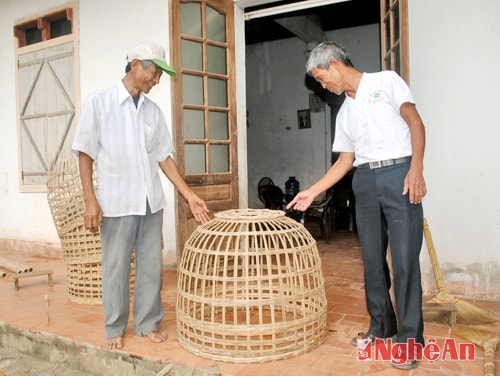 |
| Products from the Da Lam weaving village. |
Sitting next to Mrs. Hoa was Mrs. Nguyen Thi Vinh, over 70 years old. Mrs. Vinh is the mother of Mr. Tran Quoc Duc, the owner. Although no longer strong enough to weave, she still helps her son pick up leftover bamboo scraps, bundle them together, and save the ones used for crossbars, drying the rest for firewood. Mrs. Vinh mumbled: "Since I was young, I've known the craft of weaving. Now, even though I'm old and weak, and my children don't want me to do it, I still want to do it to keep myself occupied. Children over 10 years old can learn this craft, and the elderly can also help. When the weaving craft was thriving in the village, the atmosphere was lively and every household earned money daily. Hopefully, the Da Lam weaving village will be able to transition to other trades, creating jobs for the people."
I learned from Mr. Duc that the craft of weaving bamboo mats is not as elaborate or complicated as other traditional crafts. Fresh bamboo is bought, trimmed to the length of the mat, and flattened with a hammer or mallet; no polishing is needed. The weaving technique is simple: just a few strokes. The finished products are sold immediately; if left for too long, the mats will become moldy and customers will complain. If the mats become moldy, they are dried in the sun immediately. Ideally, the mats should be fresh for the longest lifespan.
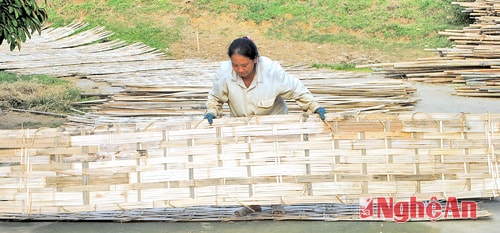 |
| The bamboo mats are sun-dried to prevent mold. |
Besides Mr. Duc's family, who still weave bamboo mats, several other households in the village maintain the craft of weaving everyday items such as water buckets, curtains, window screens, and cages for fighting roosters. These products don't sell well, but they are still available. Mr. Nguyen Cong Tinh, who specializes in weaving chicken cages, said that a simple fighting rooster cage, about 1 meter in diameter and 80 cm high, only requires two bamboo poles. Each day, Mr. Tinh weaves four cages, selling them to kiosks for 40,000 VND each, earning a profit of 25,000 VND after deducting expenses. The weaving craft is convenient because it can be done during leisure time. Therefore, it's not difficult to earn money during the off-season.
Looking back, the craft of weaving has truly created jobs and increased income for the people of Da Lam for generations. This proves that the people here are hardworking and diligent, producing products that are close to the needs of farmers. Therefore, when the weaving craft declines, the people of Da Lam feel a sense of loss, as if they have lost something of great value, both materially and spiritually. As evidence of this, the village headman stated that currently, only 6 out of 141 households in the village are poor, mainly those with special circumstances, such as illness, disease, and old age. This achievement is largely due to the supplementary occupation; farming only provides enough food to eat.
Having weathered many ups and downs, the traditional craft of weaving in Da Lam village is now in decline, leaving villagers struggling with unemployment during the agricultural off-season. The main reason is the disappearance of traditional brick and tile kilns. Another reason hindering the transition to other crafts is the modern lifestyle, with its cheaper and more convenient metal and plastic products like baskets and sieves, impacting the weaving craft. While there have been attempts to revive the craft, producing baskets and other similar items is proving difficult to compete in the market. The Da Lam weaving village needs a project to facilitate a suitable transition, encouraging and supporting villagers in preserving and promoting the cultural value of this traditional craft.
Xuan Hoang


