
Concerns about finding markets for tea plants.
(Baonghean) - Tea has become the main crop of Anh Son district. Along with this has led to the development of various service sectors, including the emergence of privately owned "mini" tea purchasing, production, and processing factories. However, this situation has given rise to several concerning issues.
According to Anh Son district's plan, the area for newly planted tea trees was to reach 500 hectares over five years (from 2010 to 2015). However, at this time, the total tea area in Anh Son has reached approximately 2,500 hectares, of which nearly 1,700 hectares are already in production. With an average yield of 12 tons/ha, Anh Son's fresh tea leaf production reaches about 20,000 tons/year. But the real issue of tea marketability remains a challenge for farmers and local authorities.
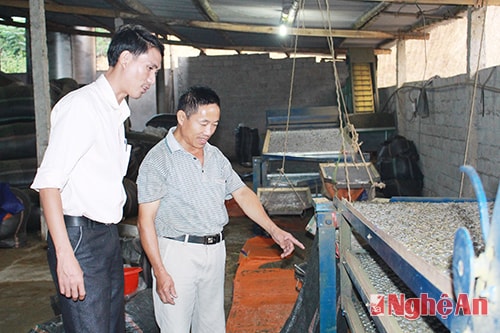 |
| Mr. Nguyen Trong Dao - owner of a private tea processing facility in Anh Son (right) introduces the tea production process. |
Accordingly, for a long time, Anh Son district has had three member units of the Nghe An Tea Investment and Development Company Limited (Nghe An Tea Company): Anh Son Tea Agricultural and Industrial Enterprise, Hung Son Tea Processing Enterprise, and Bai Phu Tea Processing Enterprise. These three units annually purchase and distribute only about 10,000 tons of fresh tea leaves from tea growers in the district, meaning they only address half of the total production. Recognizing this problem, some households in Anh Son district have boldly invested in and opened tea production and processing facilities, contributing to solving the problem of finding markets for tea growers. To date, there are 13 "mini" tea processing factories built by households in Anh Son district. Of these, Hung Son and Phuc Son communes each have 3 factories; Cam Son has 1 factory; Lang Son has 1 factory; and Long Son commune alone has 5 factories.
Following Mr. Nguyen Canh Dinh – a land administration officer of Long Son commune (Anh Son district) – we visited Hamlet 10. The tea processing factory of Mr. Pham Xuan Bach and Ms. Mai Thi Khue's family, which also serves as the "headquarters" of Kim Nhan Tea Joint Stock Company, covers approximately 600 square meters. When we arrived, five workers were operating machines for rolling and sorting tea. Ms. Mai Thi Khue said that her family's tea factory only started operating at the end of August this year with an investment of 1.3 billion VND. With a processing capacity of about 13 tons of fresh tea per day, the "mini" tea processing factory of Ms. Khue's family has produced about 30 tons of finished dried tea – equivalent to 120 tons of fresh tea purchased from tea growers. Ms. Khue explained that her family chose to invest in developing a tea processing factory because she used to be a worker at the Anh Son Tea Factory, so she has some experience in this field.
Furthermore, Long Son commune has now become one of the three key tea-growing areas in Anh Son district, making the development of accompanying services essential. This will both help solve the problem of finding markets for farmers and create favorable conditions for tea processing factories. It's a fact that the purchase price of tea by these "mini" factories is always higher than that of factories and enterprises belonging to the Nghe An Tea Company, and the quantity purchased is unlimited. For tea-growing households, this is a truly significant issue. Mr. Nguyen Sy Huy, a resident of Hamlet 8, Long Son commune (Anh Son district), said that his family currently has 3 hectares of tea ready for harvest, with an average yield of 15 tons/hectare/year; in seasons with favorable weather, the yield can reach 18 tons/hectare. Mr. Huy's biggest concern is the price of fresh tea leaves. This is because, in recent years, the market for tea has become clearly segmented.
Most tea growers are reluctant to sell their tea leaves to state-owned companies and enterprises as they did before. The reason is that the purchase price offered by these enterprises is always 3 to 4 times lower than that offered by private processing facilities. According to Mr. Nguyen Sy Huy, the Anh Son Agricultural and Industrial Enterprise is currently purchasing tea at 3,600 to 3,700 VND/kg of fresh tea, while private processing facilities offer 4,000 to 4,100 VND/kg. He calculated that if he sold 1 hectare of tea with a yield of 15 tons/year at the enterprise's price, he would lose 4.5 million VND, and 3 hectares would result in a loss of over 13.5 million VND. Mr. Huy also asserted that without the establishment of private factories, tea growers would be completely dependent on the purchasing units of the Nghe An Tea Investment and Development Company Limited.
In Anh Son district, Mr. Nguyen Trong Dao is one of the first to invest in a tea processing facility. He openly shared that, with a processing capacity of about 9 tons per day, his family's "mini" factory mainly processes two types of tea: finished dried tea buds and semi-finished tea (tea kernels). The tea products are mainly sold to several businesses in Hai Phong, Hanoi, and Lam Dong. From there, the tea is exported to markets in India, Kazakhstan, Portugal, Spain, etc. Currently, Mr. Dao's family tea processing facility provides employment for 20 local workers, with an average income of 4.5 million VND per month. "Our biggest challenge is capital. Currently, we urgently need the attention and support of relevant departments and levels to expand the factory's scale and contribute to solving the problem of finding markets for agricultural products," Mr. Dao shared.
Thus, the reality shows that private tea processing facilities are springing up and becoming quite "hot." Therefore, the most likely problem is the competition for buying and selling, negatively impacting the fresh tea products of tea growers. Besides, there is a high risk of imbalance in supply and demand. During the discussion, Ms. Vo Thi Hong Lam – Chairwoman of the Anh Son District People's Committee – also stated that the emergence of private tea processing factories has caused some local problems related to state administrative management, environmental issues, labor, employment, and taxation.
The Chairman of the People's Committee of Anh Son District also acknowledged that, in the current context, private tea purchasing and processing facilities have contributed significantly to solving the problem of finding markets for farmers. However, given that the Nghe An Tea Company's purchasing volume is insufficient, prices are low, and private facilities are not yet truly stable, Anh Son needs a capable investor to meet the objective requirements. Accordingly, Viet Phat Trading and Development Joint Stock Company is currently taking steps to apply for investment in building a factory for purchasing, producing, and processing Japanese green tea. According to initial commitments, if operational, this company will have a capacity of 20 tons of fresh tea per day; purchase at a price of over 5,000 VND/kg of fresh tea buds; and provide appropriate investment for tea-growing households.
Text and photos:Dao Tuan


