
Concerns about children's nutrition in mountainous areas.
In recent times, thanks to the attention and guidance of Party committees and local authorities, and the close coordination among departments, agencies, and organizations, nutritious meals in each family have always been emphasized, helping children develop physically, intellectually, and mentally. However, in reality, the disparity in nutritional intake between children in cities, rural areas, and mountainous regions remains very large.
(Baonghean.vn)In recent times, thanks to the attention and guidance of Party committees and local authorities, and the close coordination among departments, agencies, and organizations, nutritious meals in each family have always been emphasized, helping children develop physically, intellectually, and mentally. However, in reality, the disparity in nutritional intake between children in cities, rural areas, and mountainous regions remains very large.
Moong Van Ly (a Khmu ethnic minority) from Dai village, Que Son commune (Que Phong district) only gets one bowl of plain rice porridge each day at kindergarten. For Ly, that's happiness, because her three older siblings had to go to kindergarten hungry before.
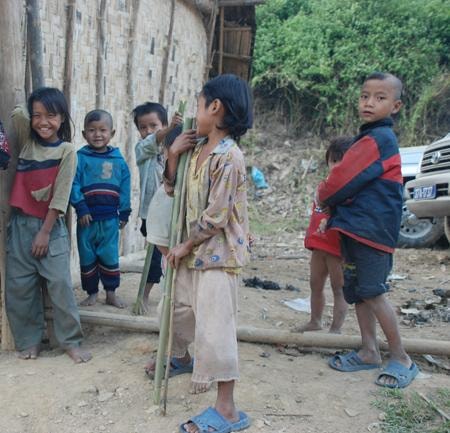
Children in mountainous areas urgently need the attention of relevant departments and agencies.
Due to insufficient nutrition, Ly often comes home with uneaten meals, making her very thin. Her family's meals consist only of a bowl of vegetable soup and a little dried fish, which they constantly share. Ms. Hanh (Ly's mother) said: "Occasionally we have a plate of fried eggs. We don't have a garden or land; life is mostly self-sufficient, so it's very hard. Just having enough to eat is good; getting enough nutrients is difficult, life is still so poor..." Besides gathering in the forest, Ms. Hanh and her husband also go to rivers and streams to catch fish to earn money for rice and cheap food like dried fish and peanuts. Almost everyone in Dai village shares the same poverty as Ly's family. Boarding students bring lunchboxes with rice and sesame salt to school, and occasionally a piece of fish sauce or an egg.
Mr. Nguyen Tien Dung, Chairman of the People's Committee of Que Son commune, said: Que Son commune has three remote villages facing great difficulties: Coc, Pieng Mon, and Dai villages. These villages are mainly inhabited by the Khmu ethnic group, with a poverty rate of nearly 90%. The reason is the lack of land for production; all three villages together have less than 10 hectares of rice paddies and have not been allocated land for reforestation. Every year, during the back-to-school season, the commune cooperates with schools to help families and students with pens and textbooks.
It's not just the Khơ Mú people in Quế Sơn who suffer from food and clothing shortages; most people in mountainous areas still face similar hardships. This is due to poor transportation, lack of services, distance from centers, and frequent natural disasters like floods. In Bảo Thắng commune (Kỳ Sơn district), I witnessed many families in Cà Da village who, despite having learned to cultivate vegetables and raise buffalo, cows, pigs, and chickens to increase their income, still face many difficulties and food shortages during the lean season because they have only recently switched to new farming methods.
According to a survey by the National Institute of Nutrition, the rate of underweight children aged 1 to 5 years in our province remains high compared to the national average (21.7%), and the rate of stunting in children under 5 years old is 32.9%, mainly in mountainous and rural areas. The districts with the highest rates of malnutrition are Con Cuong (30%); Tuong Duong (24%); Quy Chau (25%); Hung Nguyen (22.7%); Quy Hop (22%); and the districts of Anh Son, Nghi Loc, Nam Dan, Thanh Chuong, Yen Thanh, Do Luong, and Dien Chau (around 21%). Meanwhile, Vinh City has only 14.2%, and Cua Lo Town 15%. Some schools have seen the rate of malnutrition drop below 10%, such as Hoa Sen Kindergarten (Vinh City); Thai Hoa Town Kindergarten; Hung Nguyen Kindergarten; and Dien Chau Kindergarten.
The reason for the high rate of malnutrition in some localities is that the National Strategy on Nutrition and Prevention of Malnutrition in Mothers and Children is still lax, and many localities have not fully understood the National Strategy on nutrition and the work of preventing and combating malnutrition in mothers and children, thus failing to create a strong breakthrough.
Furthermore, inter-sectoral coordination remains largely superficial, failing to leverage the combined strength in the prevention and control of maternal and child malnutrition. The implementation of programs and projects supporting socio-economic development in key areas, especially remote and disadvantaged regions, has not fully addressed the difficult living conditions of the people. The main reason remains the extreme poverty of the people in mountainous areas; in many places, they lack sufficient food and clothing, and for many families, the dream of having three full meals a day is still a distant one.
Children in mountainous areas urgently need the attention and support of various departments and agencies. To achieve this, the entire society must get involved in discussing solutions and implementing policies to help these children. In the short term, this could include providing them with an extra egg or a banana during their school lunch.
Thu Huong


