
Concerns about a poor Lunar New Year
For every Vietnamese person, Tet (Lunar New Year) is a time for family reunions, celebrating New Year's Eve together, and sharing a farewell dinner to welcome the new year. Tet is a time for time off work, enjoying spring outings, and wearing the finest clothes. Therefore, no matter how difficult their circumstances, every family tries to buy a few kilograms of beef and pork for Tet so that "on the 30th day of the lunar month, meat can be hung in the house to welcome guests and for their children and grandchildren to share during the holiday."
The country has gone through many ups and downs, but the flavors of Tet, the beautiful customs, and even the anxieties that come with the arrival of spring remain the same. As people say, "Tet is just around the corner; children rejoice, but adults worry."
With each passing year, everyone seems to become more thoughtful.
Why has Tet (Vietnamese New Year) arrived earlier than usual in recent years? With more than a month until Tet, the festive atmosphere is already buzzing in supermarkets and markets. Retired people, with their meager pensions, are overwhelmed by the soaring prices at the market, and are forced to economize on their daily meals to prepare for Tet in advance, "every little bit helps." They replace chipped cups and plates, buy a dozen new bowls for guests, purchase vases for the altar, buy some sweets, ginger jam, a sweater for their mother in the countryside, and new clothes for their grandchildren... Then, by the 15th of the 12th lunar month, they're already worrying about pickled onions, eggplant, fish sauce, and salt. By the 26th or 27th of Tet, fearing rising meat prices, they hastily buy several kilograms of pork and beef for stewing. The aroma of Tet food thus permeates the poor alleyways and apartment complexes in the days before Tet, but by the 1st and 2nd of Tet, the hustle and bustle has subsided. As Tet (Lunar New Year) approaches, for city dwellers with modest incomes, it's a case of "everyone else has beer, but we have wine." How can they afford a decent meal for the year-end ancestral worship ceremony, with boiled chicken, pork sausage, and a bowl of vermicelli soup with offal for their ancestors? And how can they save a little money for their children's school year? As for the luxuries outside the supermarket and shops—foreign wines, peacock spring rolls, phoenix-shaped sausages, crystal, marble, golden lions, stone flowers... they can only admire them from afar.
For wealthy city dwellers, Tet (Lunar New Year) means driving around the market, scurrying up goods. They feel compelled to buy everything, from doormats and slippers to chairs, tables, shoe racks, and wine cabinets... Then there are teapots, flowers, sweets, cakes, and alcoholic beverages... the more connections they have, the more they buy. And it's not just for themselves; they also care for their relatives and family back home. Many people confide: "If I had the opportunity to earn more money and have more surplus, I would set aside a portion to buy Tet gifts and prepare for Tet for my relatives on both sides of the family." Ms. Ngoc, a business owner in Ha Huy Tap, said: "Ideally, to make things quicker and easier, I would give each family back home a few hundred thousand dong to help with Tet preparations. But how can I do that? It's a little hard work, but it brings affection and family." She personally bought fish sauce, MSG, wine, cakes, even instant noodles with pork sausage... dividing them into dozens of bags, then drove back to her hometown to give each family a large bag, receiving in return the overflowing love of her parents and relatives on both sides. She shared that for decades, no matter how busy she was, she always tried to prepare for Tet (Lunar New Year) for as many people as possible. Because of this, Tet became even warmer and more meaningful. Her hometown is Huong Khe, Ha Tinh province, which was recently submerged in floodwaters. She rushed back to help with relief efforts and this Tet she only hopes to return earlier.
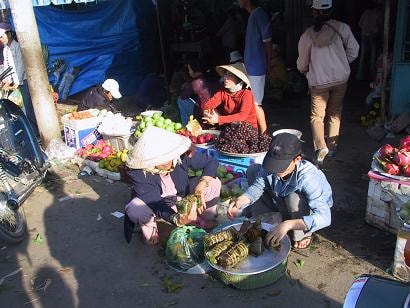
Illustrative image
The Lunar New Year is a whirlwind for traders. The New Year offers a chance for business owners to reap profits; hundreds sell, thousands buy, and everyone's goods sell out. Most small traders focus on selling, sometimes not rushing to prepare for the New Year until late on the 30th day of the lunar month. From the 10th day of the 12th lunar month, they import hundreds of kilograms of meat daily, storing it in the freezer to avoid high prices, then hire extra workers to grind, pound, package, and boil it all night. During Tet, pork sausage is a necessity. It's given as gifts, to relatives, and for weddings, making it very popular. A small sausage-making facility in Quan Bau employs 20 workers during Tet, grinding and packaging 400 to 500 kilograms of meat daily. During such a Tet, this facility earns tens of millions of dong in profit each day. My neighbor, Ms. Hue, sells pork year-round. During Tet (Vietnamese New Year), she wakes up at 2 AM to get as much stock as possible, hoping to sell more. Pork is in high demand during Tet; some families buy a few kilograms, others three or four, so she earns a decent income. But this year, she says pork prices are sky-high, butchers can't find pigs to slaughter, so she has to buy it from the market to resell. The already high prices have gone even higher. My neighbor, Ms. Huong, also sells pig offal year-round at a small market in the city. During Tet, her offal sales are slow because everyone is focused on beef and pork sausage... She only returns home on the afternoon of the 30th of Tet to prepare a simple Tet celebration for her family. Her husband is a construction worker, and their two children are in school. For her family, even a few kilograms of beef, a few kilograms of pork, and some cakes and sweets for the children to offer guests are a struggle. Her husband loves peach blossoms, and he thought they would be cheaper on the night of the 30th, but last year, there were no branches left, only dry firewood scattered along the roadside. For working-class families in suburban neighborhoods, exchanging envelopes of money as gifts during Tet (Lunar New Year) is still unfamiliar, while this "culture" is deeply ingrained in city life. But wealth comes with hardship. Each family, each person has their own worries: some worry about relatives, others about colleagues, some worry about Tet for workers, for the collective, for the poor, and the border guards worry about holding their posts on the nation's border... These countless worries are a flavor mixed in with the many flavors of traditional Tet. That flavor is tiring yet warm, and happy to be able to share the burdens and difficulties. So that everyone can have Tet!
This year, two consecutive historic floods have ravaged central Vietnam. Farmers in the region, toiling under the sun and rain, have had to swallow their tears as they watched their rice, corn, shrimp, fish, and homes being swept away by the floods. Many have lost everything, burdened with debt as the year ends and Tet approaches. Their main worry as Tet approaches is how to secure enough rice paddies for the spring planting season, and how to obtain sufficient seeds and fertilizer for the rice crop. Rice is the flower of Tet. Only after planting can they truly celebrate the New Year. This year, for many farmers in Nghe An province, across Nghi Loc, Hung Nguyen, Nam Dan, Quynh Luu...where the floodwaters have passed, there is a shortage of everything. The gray fields, left withered by the rising straw, are now bordered by widespread anxiety throughout the villages. The flocks of white egrets that once perched abundantly throughout Hung Lam and Hung Chau are nowhere to be seen. Looking out into the gardens and along the Lam Giang dike, the cabbage and sweet potato leaves have turned green on the flood-affected alluvial soil. But it's a "poor man's" vegetable; when farmers in Hung Nguyen, Nam Dan, and Nghi Loc manage to bring a basketful to the market, the price is only a few cents.
Our car drove from Dien Chau and Yen Thanh to Nghi Loc. The fields here were silent in winter, with only glimpses of people searching for crabs and shrimp. Ms. Le from Hamlet 7, Nghi Thach, wiped away tears as she recounted: "The floods washed away all the shrimp ponds, and two plots of green corn rotted and withered. The whole family focused on growing two plots of vegetables to sell. But even if the vegetables grew well, we couldn't sell them all by noon at the market. A single basket of vegetables only sold for less than twenty thousand dong. Every family suffered a crop failure, and the fields were desolate. Young people left for the South to work as laborers. Women went to Vinh to work as scrap collectors. I followed them, scavenging, but many people only earned a little over a day. And in Vinh, I felt overwhelmed by the many cars and tall buildings. Riding my rickety bicycle, wearing a worn-out shirt and torn gloves, I felt lost in the bustling, luxurious city of Vinh, even though Nghi Thach isn't that far from Vinh."
"Now there are plenty of goods, no need to worry about shortages, only about not having enough money to buy them," my uncle in the countryside said. His hair was streaked with gray, wrinkles were beginning to appear on his forehead, and the hardships were etched into the eyes of my aunt and other thin, familiar faces in the village... People in my village, like many other rural areas, lead simple lives, not striving for money or fame, yet still struggling to make ends meet. My uncle had to go to the city to work as a carpenter to support his two children through university. In the old days, when we were poor, during Tet (Lunar New Year), the villagers would slaughter pigs; now every household has a motorbike, but money for daily expenses is still "very scarce."
Many poor families still struggle to afford even a few kilograms of beef for their children to eat during Tet (Lunar New Year). Prices are skyrocketing while crops have failed, causing great anxiety for the poor. Meanwhile, in the cities, many people are getting rich very quickly. The gap between rich and poor is therefore widening.
The historic flood has passed, but its aftermath leaves behind anxieties and feelings of pity for the rural communities. I suddenly remembered Tú Xương's poem "Poor Tết": "Brothers, don't think my Tết is poor / Money in the storehouse hasn't been claimed yet / Chrysanthemum wine is being delivered but the delivery is delayed / Lotus tea borrowed but the price is still being demanded / Sugar cakes are about to be wrapped but the humidity is making them / Pork sausage is about to be spoiled by the sun...". The old anxieties of the poor when Tết and Spring arrived seem to linger here.
Chau Lan


