
Farm in the clouds...
Perhaps this is a unique farm model in Nghe An. With willpower and determination, a young Hmong man has built a prosperous farm on the rocky mountaintop of Pu Lan, shrouded in year-round mist, serving as an example for other Hmong people in Huoi Tu, Muong Long, and other remote areas of Ky Son district. That young man is Vu Ba Lenh from Huoi Giang village, Tay Son commune (Ky Son).
(Baonghean)Perhaps this is a unique farm model in Nghe An. With willpower and determination, a young Hmong man has built a prosperous farm on the rocky mountaintop of Pu Lan, shrouded in year-round mist, serving as an example for other Hmong people in Huoi Tu, Muong Long, and other remote areas of Ky Son district. That young man is Vu Ba Lenh from Huoi Giang village, Tay Son commune (Ky Son).
Vu Ba Lenh's farm is located atop Pu Lan mountain (1,400m above sea level). Someone who visited jokingly said: "To get to Lenh's farm, you have to push aside the clouds and cling to the rocks." Nature's geological formations have created a pristine and majestic Pu Lan, now further enhanced by the beautiful "fragrant flowers and sweet fruits" of the young Mong farmer, Vu Ba Lenh.
Vu Ba Lenh recalled the hardships of the past. In 2006, Lenh married a beautiful and virtuous woman named Xong Y Mo, and they lived in a small thatched hut on the mountainside. They toiled year-round, but poverty clung to them. Their livelihood depended on constantly clearing land, burning forests near and far to create fields. However, even the best land eventually became barren and depleted. They had to find a way to escape poverty. Lenh discussed with Y Mo the need to find land to build a farm model, to make the farm generate income and lift them out of poverty. But Tay Son's terrain was notoriously rugged, the most treacherous in Ky Son district. Tay Son had several "firsts": it was the highest-altitude commune, with the longest and most treacherous slopes (some slopes nearly 15 km long, climbing against the sky).
Despite the difficulties, Vu Ba Lenh persevered for nearly a year, climbing countless high mountain peaks to find a suitable place to build his farm. Lenh confided: "Sometimes, when I found a mountainside suitable for a farm, there was no water source, so I had to give up and look for another mountain." And finally, his perseverance helped him find Pu Lan...
After deciding to "start a business" in Pu Lan, Lenh went to the commune's People's Committee to request permission to build a farm. The commune leaders shook their heads in dismay, because everyone knew that to reach the summit of Pu Lan, one had to绕 around the mountain slopes, some sections with sheer cliffs, others with jagged valleys of sharp, jagged rocks like shark jaws—a single misstep would be fatal. But in the end, the commune leaders decided to let Lenh try his luck on Pu Lan. On the day Lenh went to Pu Lan to conquer the "great mountain of rocks," the villagers all thought he was crazy, wondering who would ever build a farm on such a towering rocky mountain peak. But Lenh had made up his mind, and no one could stop him. Lenh found a shortcut to the mountaintop. Standing on the mountaintop looking down, Lenh thought that to build a successful farm, he first had to open a road to Pu Lan. All day long, the locals saw Lềnh with his crowbar and hoe, chiseling and carving jagged rocks into "stone steps" to create a path up and down to the farm. The terrain of Pu Lan peak is steep, and heavy rains create many streams flowing down from the high mountains. Therefore, after demarcating the farm area of more than 6 hectares, Lềnh had to continue improving it, using crowbars to dig and pry rocks to create a deep ditch surrounding the farm to prevent landslides during heavy rains.
In the early days, to ensure food for his family, Lenh and his wife planted corn and rice in rocky crevices like other people in the rocky highlands of Ha Giang. The cliffs were slippery, and planting short-term crops in those tiny holes would sometimes be washed away by rain, forcing them to carry topsoil from elsewhere to replant. Every day, like a diligent bee, Lenh performed his familiar task of prying up rocks that were within his reach to create a level surface for building a house and constructing pens for raising goats and pigs… It's hard to believe that, using only human strength (because machinery cannot climb to the top of Pu Lan), Vu Ba Lenh has essentially transformed 6 hectares of farmland, mostly rocky mountains.
Navigating through the swirling mist, we visited Vu Ba Lenh's farm. The air was incredibly fresh, with clouds covering the entire farm. Lenh said: "The climate in Tay Son is quite similar to Muong Long; there are four seasons in a single day, sunny one moment and then fog and clouds the next. The peach blossoms here bloom even in summer." While we were admiring the clouds, Lenh called out loudly in the Mong language, and the pigs suddenly emerged from the rocky crevices. Lenh recounted: "In 2008, with a poverty reduction loan of over 5 million dong from the district, I only had enough to buy one sow and build a temporary pigsty. Now I have five sows, selling nearly 100 piglets annually. The pigs here roam freely in the 'rock farm.' Lenh has a special talent for training the pigs; they all come to eat when they hear their owner call." In 2009, with integrated government support from various funding sources including Program 135 and Program 30a, Lenh was able to raise two mother cows. Currently, he has increased his herd to 14 cows. To ensure a sufficient food supply for the herd, Lenh and his wife have planted 0.5 hectares of elephant grass on the mountainside. Thanks to proper care and regular vaccinations, the herd is thriving.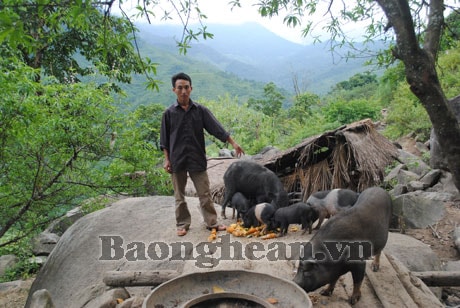
The piglet farming model of Mr. Vu Ba Lenh.
As evening approached, the sound of bells echoed, and Lenh's herd of cattle was making its way back to Pu Lan, each one with its sleek, golden coat, fat and healthy. Lenh led me to another rocky area and pointed, saying, "This area is steeper, and my wife and I have planned to raise goats here. We already have over 30 goats. In the damp, stream-side area, we've experimented with raising ducks, geese, and black chickens. This year, we expect to make a profit of nearly 200 million dong from selling cattle, pigs, corn, and cassava, after deducting expenses."
Lềnh confided: "My wife and I won't put that money into our stomachs, but will continue to invest in rebuilding the farm, such as renovating and building more pigpens, cow sheds, goat sheds, chicken coops... expanding the scale of planting elephant grass, corn, cassava, and even introducing plum trees. This area has quite a lot of natural 'rock peach' trees, with beautiful flowers and diverse branch shapes. Lềnh plans to propagate 'rock peach' trees to become a 'specialty' of Mong peaches to supply the Tet market in the lowlands."
As he saw me off down the mountain, Lenh held my hand, his rough, sturdy hand like a brick. Through the mist and clouds, I could still see Lenh conquering the "great rocky forest" of Pu Lan, making a living in his own homeland.
Van Truong


