
Leveraging external resources and unleashing internal strengths to build new rural areas.
(Baonghean) - In 2015, Nghe An province had 82 communes registered to achieve the new rural development (NRD) goals, with the majority (over 50 communes) located in the delta districts. Although the localities have set high goals, the difficulties and challenges ahead are considerable, as most communes are hampered by rigid criteria requiring significant resources. Finding ways for these localities to overcome these difficulties and achieve NRD goals on schedule is a problem that requires concerted effort and unity.
Many difficulties and challenges
Nghi Trung, one of the seven communes in Nghi Loc district registered to achieve the New Rural Area (NRA) status in 2015, faces challenges regarding environmental criteria and wastewater treatment due to its location on the outskirts of the town. Previously, the commune had to allocate 130-150 million VND annually for garbage collection and transportation to a central site; daily inspections were also necessary to detect violations, yet indiscriminate littering persisted, contributing to conflicts and disputes among the local population.
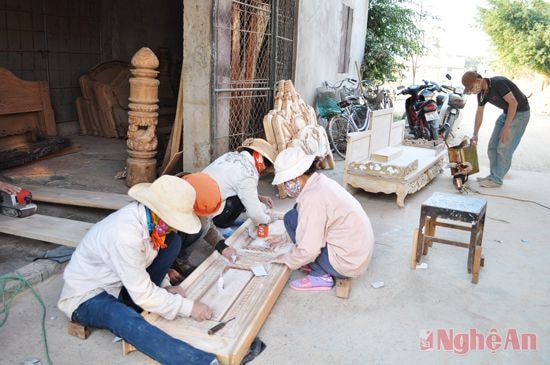 |
| Mr. Tran Xuan Quang's carpentry workshop, which also combines vocational training, located in Hamlet 4, Quynh Ba Commune (Quynh Luu District), provides employment for many workers. |
Mr. Tran Hai Duong, Vice Chairman of the People's Committee of Nghi Trung commune, confided: "When we started building the New Rural Area, discussing solutions to environmental problems, everyone thought it would be very difficult to implement." In reality, solving the environmental problem requires the commune to invest in a system for supplying clean water, treating waste and wastewater, and especially replanning cemeteries. These tasks are not simple, as they require changing the awareness and habits of the people… In addition, to implement infrastructure projects that meet the standards of the New Rural Area program, Nghi Trung commune needs capital of around 50 billion VND, including over 40 billion VND for commune projects and nearly 10 billion VND for rebuilding the transportation system and cultural facilities in 18 hamlets, but mobilizing resources is extremely difficult. Local budget revenue is limited, and even with the district's agreement to retain 30% of the land use rights auction proceeds (the commune is entitled to 60%), projects cannot be implemented because no one buys the auctioned land. In 2015, the commune received 750 million VND from the National Target Program for New Rural Development and 450 tons of cement…
In Quynh Luu district, Quynh Ba commune aims to complete its rural development program by the end of this year, but some projects are still in the planning stage and lack investment approvals (commune stadium, market); projects with approved investments have only received 10-20% of the necessary funding, resulting in slow progress. Meanwhile, Quynh Hung commune, considering income and occupation criteria, has the most advantages in terms of the number of businesses and construction contractors in the area. However, the commune's road infrastructure is severely degraded, and many essential facilities are in disrepair without investment. The commune's office building project has been stalled for over two years due to the selection of an incompetent contractor, negatively impacting the commune's rural development efforts. Furthermore, the commune has one Catholic hamlet, making it very difficult to mobilize resources for road construction and the hamlet's cultural center. In 2014, the commune was given the opportunity by the district to receive cement from other communes for road construction, but it didn't dare accept it, thus missing a regrettable chance. Communes like Quỳnh Diện, Quỳnh Minh, Quỳnh Bảng… also registered to achieve the goal, but inter-commune roads and main transportation arteries were in disrepair, and there were no resources for repair and upgrading…
To meet the criteria for New Rural Development, localities must invest from scratch, requiring significant resources. Meanwhile, investment support from various levels of government is only about 600-800 million VND, and lowland communes are only allocated funds for 6 km of roads, including 3 km of type A roads and 3 km of type B roads.
Leverage external resources and maximize internal strengths.
In discussions with us, representatives from the People's Committees of the communes registered to complete the New Rural Development program in 2015 stated: Although there are still many difficulties and challenges, they are finding every way to reach the goal. This is a task that must be done sooner or later, and doing it sooner will allow them to take advantage of assistance from the central and provincial governments. For this reason, some communes, even though the district did not assign targets, decided to register and strive for the goal after discussion and review of the conditions and criteria.
One of the communes that has done well in mobilizing the people's strength and combining internal and external resources is Quynh Dien (Quynh Luu district). Although it is a purely agricultural commune with an average income of only about 24 million VND per person per year, the commune has achieved the New Rural Area (NRA) criteria quite firmly. To date, the commune has invested approximately 220-230 billion VND in NRA construction, with nearly 50% of that coming from the people's contributions. In 2014, the commune completed 16 criteria, and currently only two criteria remain to be focused on: the commune People's Committee headquarters and transportation infrastructure. One of Quynh Dien's secrets is the effective implementation of grassroots democracy regulations and the mobilization of the people's strength; all matters related to the NRA are discussed openly according to the motto "the people know, the people discuss, the people do, and the people benefit."
Except for the funds collected by the commune for regulation, all funds for implementation at the hamlet level are assigned by the commune to the hamlet's leadership committee, or even individual household groups, for contribution, implementation, and supervision; the commune only provides guidance on planning and technical aspects for basic infrastructure and verifies the quantity of cement to be submitted to higher authorities. Thanks to effective mobilization of community resources, from the beginning of the year until now, the commune has mobilized 4.4 billion VND to build 1.1 km of Road A and 7.71 km of Road B, with an average contribution of 3.8 million VND per household, and some households contributing as much as 8.7 million VND for road construction. The commune is also actively mobilizing capital for the construction of its headquarters with a total investment of 7.3 billion VND; in the near future, if 1,000 tons of cement are available, the commune will mobilize community resources to complete the entire commune's road network with concrete.
Besides focusing on investing in technical infrastructure, one of the criteria that communes achieving the New Rural Area (NRA) status in 2015 are paying attention to is developing economic models to create jobs and increase income for the people. It is no coincidence that communes registering to achieve NRA status in 2015 such as Quynh Ba, Quynh Hung, Quynh Dien (Quynh Luu district) or Nghi Trung, Nghi Hoa (Nghi Loc district)... are all communes with quite vibrant craft villages. Currently, these communes are actively accessing investment resources to upgrade the infrastructure of craft villages; actively replicating large-scale model fields with high productivity and economic value; and continuing to seek markets and outlets for their products…
From practical experience, we have observed that in the context of limited state support resources for localities to achieve the New Rural Area (NRA) goals, overcoming difficulties and achieving the set objectives requires communes to effectively mobilize public participation while also proactively leveraging external resources. Combining these two factors effectively not only ensures the progress towards achieving NRA goals but also contributes to raising public awareness in building NRA, and collectively promoting the achieved criteria in a sustainable manner.
Nguyen Hai


