
The trend of going abroad to escape the Lunar New Year in China.
Tired of celebrating the Lunar New Year at home and having ample income are the reasons why many Chinese people choose to travel abroad during the Lunar New Year holiday.
This year, instead of returning to Shanghai for the Lunar New Year, Shi Ying and her family decided to travel and shop in Japan. She flew on January 27th and spent seven days exploring Kyoto and Tokyo.
"My parents both love traveling during the Lunar New Year," she told Bloomberg. "Hopefully, I can keep the trip within 80,000 yuan ($11,700)."
At 30 years old, Shi currently works for a non-governmental organization in Beijing. During recent Lunar New Year holidays, she and her family have chosen to travel to Singapore, Malaysia, Thailand, and the United States.
 |
| Chinese tourists pose for a photo with a fellow Chinese police officer in Italy. Photo: AP. |
A different experience
The tendency of Chinese people to travel abroad is partly a result of China's economy growing steadily at a rate of at least 6.7% since 1990, which has led to greater financial stability for its citizens.
However, what was important to people like Shi was that this trip helped her escape the crowded trains and the boredom of the Lunar New Year holidays back home.
"Traveling abroad during Tet (Lunar New Year) costs about the same as many domestic destinations. My parents don't want a boring holiday where all three of us just stay at home in Shanghai," she shared.
According to Catherine Lim, a Bloomberg analyst in Singapore, the wave of overseas travel is also fueled by the Chinese government's long-standing policy of restricting childbirth. Young Chinese people, who are increasingly more affluent than previous generations, want to explore the world.
"As families get smaller, there's not much to do during Tet," said Ms. Lim. "Young people want to spend their money experiencing new destinations rather than buying expensive Hermes bags."
Instead of returning to his hometown in northeastern China, Xi Chunhui will spend 11 days traveling in Macau, Singapore, and Hong Kong with friends.
"Tet in my hometown is the same every year," shared Xi, a 27-year-old online newspaper editor. "I don't think my not going home will make anyone sad."
Airlines rake in the money.
This year's Lunar New Year holiday, from January 27th to February 2nd, is witnessing the largest "migration" in human history in China. More than 414 million people in the country are expected to travel by train or plane, equivalent to all citizens of the European Union (EU) traveling.
Against this backdrop, the trend of traveling abroad to celebrate the Lunar New Year in China is becoming increasingly popular. International flights during the Lunar New Year are expected to reach a record 6 million passengers, with top destinations being Japan, South Korea, and Southeast Asian countries.
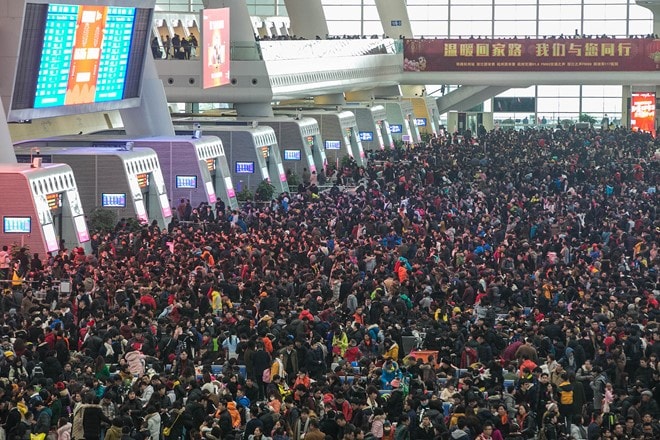 |
| Crowded scenes are a common sight at Chinese airports and train stations during the Lunar New Year. Photo: Getty. |
“The Lunar New Year is a peak period for Chinese airlines,” Steve Saxon, a partner at the consulting firm McKinsey in Shanghai, told Bloomberg. “For many people, the Lunar New Year is a rare opportunity during the year to take an extended vacation.”
The Civil Aviation Administration of China estimates that approximately 58.3 million people will travel by air, a 10% increase compared to the previous year. Mr. Saxon said that Chinese airlines earn about 20% of their annual revenue during this period.
China Southern Airlines, Asia's largest airline, added 3,600 flights during this Lunar New Year holiday, expanding its services to Australia and New Zealand. Xiamen Airlines, a subsidiary of China Southern Airlines, also added 100 flights to popular tourist destinations such as Bali and the Maldives.
Hu Nan, international business director of Xiamen Airlines, said: "Not only us, but all airlines in China are pouring all their resources into travel during the Lunar New Year."
Meanwhile, according to online travel site Ctrip.com, Chinese people will travel to 174 destinations outside mainland China over the nine-day Lunar New Year holiday. "Every airline will rake in the money during this holiday," said Will Horton, an analyst at CAPA Aviation Centre in Hong Kong.
Going to Japan to buy toothpaste
According to the World Tourism Organization, China is currently the country with the most citizens traveling abroad, with 128 million people spending a total of $292 billion in 2015.
The demand for travel during the Lunar New Year holiday is so high that cheap tickets are sold out 50 days before departure. These expensive tickets help airlines compensate for off-peak periods.
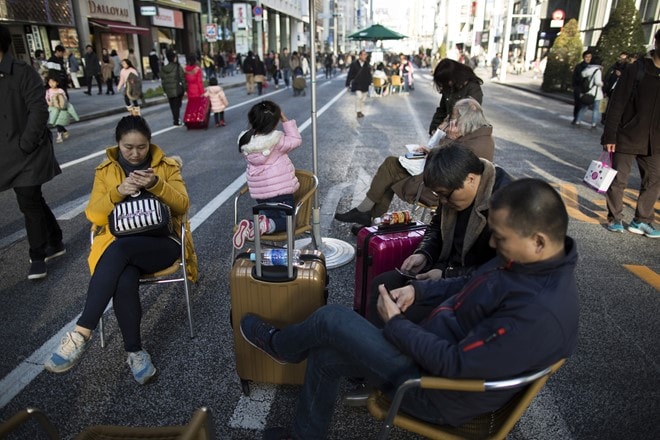 |
| Chinese tourists in the Ginza shopping district in Tokyo, Japan. Photo: Bloomberg. |
Conversely, destinations like Japan, Australia, and even Israel are implementing relaxed visa policies with long-term validity to attract tourists from China. The United Arab Emirates (UAE) even grants visas on arrival to visitors from China.
According to the Japan National Tourism Organization, in 2016, the number of Chinese visitors to Japan increased by 28%, reaching 6.4 million, making them the largest group of foreign tourists visiting the Land of the Rising Sun.
According to another statistic, Chinese tourists spent a total of $12.8 billion on shopping while traveling in Japan. Chinese people particularly favor Japanese technology, luxury goods, and consumer products such as cosmetics and toothpaste, believing these items are of better quality than those in their home country.
According to Zing


