
Children eking out a living at the cattle market.
(Baonghean) - "Whoever goes to Dai Son market/ Buys a magnificent buffalo to establish a large farm." It's unknown when exactly, but this folk song about the largest buffalo market in Nghe An province has become ingrained in people's hearts, a source of pride for Dai Son, Do Luong district. However, this market is no longer just for wholesale traders; it also features the presence of young children...
(Baonghean) - "Whoever goes to Dai Son market/ Buys a magnificent buffalo to establish a large farm." It's unknown when exactly, but this folk song about the largest buffalo market in Nghe An province has become ingrained in people's hearts, a source of pride for Dai Son, Do Luong district. However, this market is no longer just for wholesale traders; it also features the presence of young children...
I prefer going to the market to going to school.
No one knows exactly when the market originated, but on the 1st, 6th, 11th, 16th, 21st, and 26th of each lunar month, people flock to it. Ú Market is considered one of the largest cattle markets in Vietnam. Each market day sees thousands of cattle. From early morning, groups of people lead their cattle towards the market, chattering incessantly. The cattle hurry along, urged on by their owners, and the calves run around, creating a scene reminiscent of a cattle festival. Traders from other provinces like Thanh Hoa, Ha Tinh, and Quang Binh often arrive the day before. They load their cattle onto ox carts and trucks and transport them there. Along both sides of the road leading to the market, trucks carrying cattle are parked bumper-to-bumper.
We were at the Ú market on a Friday and witnessed a large crowd of children, around 14 to 16 years old. Some were with their parents, others were groups of three or four friends... The smell of buffalo and cattle mingled with the pungent, unpleasant odor of mud from the previous afternoon's heavy rain. Barefoot, bareheaded children chased each other, shouting and teasing each other. Some groups sat drinking sugarcane juice, watching to see who had just bought a buffalo or cow, then running up to ask if they needed help taking it home. A few others sat on carts guarding the buffalo and cattle, occasionally taking out their phones to text or play video games... We pretended to be teachers strolling through the market looking to buy buffalo and cattle for a wedding (the Ú market is right next to Đại Sơn Primary and Secondary School) to strike up conversations.
Navigating through the cattle waiting to be sold, I struck up a conversation with two young boys named Quang and Thanh, who were sitting on a cart tending the buffaloes. Both were from Hamlet 9, Tru Son Commune, and worked as hired buffalo herders for their cousin, a long-time trader at the market. Quang had dropped out of school, while Thanh was in 8th grade. Early in the morning, the two brothers herded the buffaloes from Tru Son to the market, and by noon, if they hadn't sold them all, they herded them back home. Each session earned them 70,000 dong. Upon meeting us, Quang jokingly said, "Whether you want to buy buffaloes or cows, we have them all. I'll sell them cheaply, just don't make me go to class all the time."
Unlike Quang and Thanh's rather crude way of speaking, Nguyen Thi Ly, sitting on the cart tending the buffalo with her mother, appeared shy. Ly is a 7th-grade student at Tru Son Secondary School. Her parents are long-time traders. This market day, Ly's mother had seven buffaloes to sell. Since her mother couldn't manage them alone, Ly had to skip school to go with her. We asked, "Why aren't you going to school? Aren't you afraid the teacher will give you a bad grade for skipping school like this?" Ly's mother quickly replied, "There's no test today. My daughter is very studious, but she occasionally has to skip school to take the buffaloes to the market with me. There's no one else at home; her older siblings have all gone away to work."
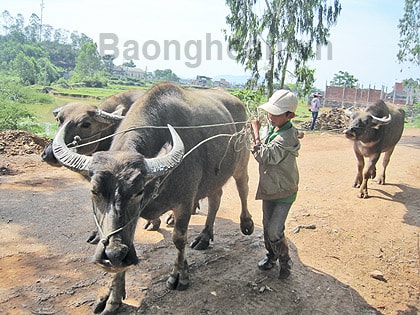
A child might "demand" three or four buffaloes at the same time.
The market was still bustling with people coming and going, looking at buffaloes and haggling. Following the directions of the market-goers, the buffaloes with numbered tags on their ears were those from other provinces. The numbers painted on the buffaloes' bodies were the phone numbers of their owners. Customers could freely look around; if they liked something, they could call the number, and the owner would come and negotiate the price. The cows bought from Laos looked bewildered. Meanwhile, some large, fat male buffaloes with dark skin and sharp horns appeared fierce. While trying to find a way out of the market, we encountered a small, frail boy struggling to lead three buffaloes from the market back to the neighboring village. The calf sometimes ran ahead, leaving the boy unable to keep up, and other times it would turn its head back to look at its companions, refusing to go. After walking a considerable distance, the boy hesitantly told us his story. His name was Nguyen Van Hung, from Hamlet 15, Nghi Van Commune, Nghi Loc District. Hung comes from a family of nine siblings, and he is the fifth child. Due to difficult family circumstances, he had to drop out of school to herd cattle to earn money to help his parents. Herding these three buffaloes is exhausting, and he only earns 20,000 dong. At just 14 years old, having worked as a cattle herder for traders for over a year, Hung is very familiar with the prices and routes of the surrounding villages. Hung said: “Once, I and four friends herded 21 buffaloes to Nghi Kieu for 300,000 dong. Midway through the field, some of the buffaloes jumped into the rice paddies, and we were fined 300,000 dong by the local police. Luckily, the owner was with us that day, otherwise, even if we pooled our money, we wouldn't have had enough to pay. That's not to mention encountering buffaloes that would block people; sometimes we had to run for our lives, which was exhausting. At the market, there are many people who herd cattle for hire. Those who live nearby often form groups, because working alone often leads to bullying and competition for customers.”
Although his family circumstances weren't so dire that he had to drop out of school, Dang Quang Dung, a 7th-grade student in Tru Son commune, preferred going to the market to attending classes. We met Dung as the market was starting to thin out. He was happily eating an ice cream cone, seemingly rewarding himself after a hard day at the market. Dung boasted, "This morning, I earned 80,000 dong." When asked about his studies, Dung innocently replied, "I'm terrible at school and don't like going to school at all, but my parents force me to. Every time it's market day, I skip school and come down here to herd the buffaloes and cows. Just leading them from inside the market to the cart earns me 5,000 dong. The market is lively and I earn money, so I can buy whatever I want."
According to local traders, in recent years, with more transportation options available, they often hire trucks to transport their cattle quickly. Only small traders or those living near the market, who find it inconvenient to hire trucks, rely on young children to herd their cattle for a fee of only 30,000 to 40,000 dong, depending on the distance. Therefore, the children usually return home the same day. Previously, it was common for people to have cattle transported all the way to Thanh Chuong or Yen Thanh, sometimes taking 3 or 4 days, with fees reaching 400,000 to 500,000 dong. Because of the relatively high earnings, many students have dropped out of school to herd cattle for traders.
Adult responsibilities
The job of herding cattle for hire is somewhat arduous and dangerous, but the high pay makes it quite attractive to many. Most of the children come from Tru Son and Dai Son communes (Do Luong district) and Nghi Van and Nghi Kieu communes (Nghi Loc district). Most of these children come from difficult family circumstances, with many siblings, so their parents have little time to care for them. A few others are lazy students who skip school to earn money for entertainment at the market. After each market day, they gather in billiard halls and internet cafes to play games. At their teenage age, their clothes may be dirty, but many have dyed their hair blue or red and carry expensive phones, trying to appear like young people. Because of their early exposure to the market environment, many of them speak in a somewhat rough manner. However, beneath their rough exterior and seemingly "sophisticated" demeanor, they appear innocent and childlike, and need more care and attention. To help them understand that the money they earn now might buy them a can of Coca-Cola, an ice cream, a game of billiards, or even a phone without having to ask their parents, but it's not worth it to sacrifice their future.
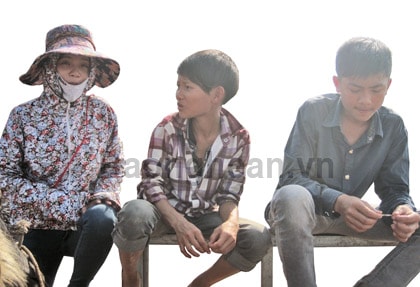
Children demand buffaloes at Ú market, Đại Sơn commune.
Many teachers in schools near the Ú market lament the high rate of student absenteeism. Every market day, students write letters requesting leave of absence, citing illness as the reason for going to the market. The high number of absent students means that even with their best efforts, the class's academic performance doesn't improve. Speaking with us, Ms. Tô Thùy Linh, Principal of Đại Sơn Secondary School, said: “The reality of students dropping out of school to work as buffalo herders is real. Many students still prefer going to the market to school because they earn money there. On the school's part, we have tried our best, using every possible means, coordinating with agencies, organizations, the Đại Sơn Commune People's Committee, and with the attention of the district and the Đô Lương District Department of Education and Training to address this situation. To date, the number of students dropping out has decreased significantly, but it hasn't been completely eradicated.”
Ms. Linh also shared that Dai Son is far from the center, and the lives of the people are still very difficult. The awareness of some families about investing in their children's education is limited. They believe that going to school costs money, and after school they can go back to trading or herding cattle, which provides them with money and experience, preventing them from making mistakes when they grow up. Previously, the dropout rate was very high, with about 40 to 45 students dropping out each year. Many others would skip school for a few days during market days to herd cattle to surrounding districts, affecting the quality of education. Whenever there was a market day, teachers had to go to the market to bring students back to class. At the beginning of the 2009-2010 school year, a conference on combating school dropout was held with the participation of various departments, Dai Son Secondary School, the People's Committee of Dai Son commune, and village Party branches, with the participation of district leaders and the head of the District Education and Training Department of Do Luong district. The conference agreed to establish an inspection team to immediately report any instances of frequent absenteeism to the families. The inspection team would then visit the families to persuade and encourage parents and students to return to school...
Thanks to the attention and cooperation between the school and local authorities, and the decisive direction of the Do Luong district leadership and the Department of Education and Training, the rate of school dropouts and absenteeism has significantly decreased. However, ending student absenteeism cannot be achieved overnight, but rather a long-term process. The temptation of money from the cattle markets is immense, and ensuring students attend school is not solely the responsibility of teachers and social organizations, but also largely depends on the awareness of parents and students. Many parents are unaware of the consequences of their children's lack of education; some even encourage their children to go to the market early in the morning!
Text and photos: Nguyen Le - Ho Lai


