
Implementing Decree 67: Positive signs
(Baonghean) - Government Decree 67/2014/ND-CP on some policies for fisheries development (Decree 67) has been in effect since August 25, 2014. To date, the implementation of Decree 67 in practice has shown positive signs; procedures for reviewing applications to help fishermen borrow capital for shipbuilding are being carried out urgently; and shipbuilding facilities are also ready.
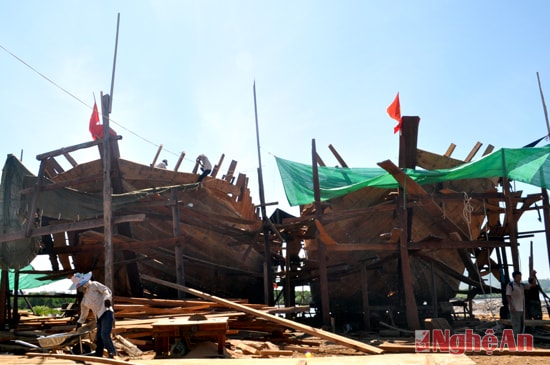 |
| Building large-capacity fishing vessels in An Hoa commune (Quynh Luu district). |
Checking records"movement"
Nghe An is one of the localities that organized early and proactively, from the provincial level to the grassroots, the implementation of Decree 67. The Department of Agriculture organized workshops, together with shipbuilding units, to introduce ship models and guide fishermen on registration… before Decree 67 was issued. The number of vessels in localities needing to register for loans was 874 (including 844 fishing vessels and 28 logistics service vessels). After the decree came into effect, the Ministry of Agriculture and Rural Development, based on considering the situation of the localities, allocated 100 vessels to Nghe An (including 95 fishing vessels and 5 service vessels). Based on the needs of the localities, the Department of Agriculture allocated the quotas as follows: Hoang Mai Town: 20 vessels, Quynh Luu: 30 vessels, Dien Chau: 5 vessels, Nghi Loc: 10 vessels, and Cua Lo Town: 5 vessels. Thus, the total number of vessels allocated in the first phase is 70, and the remaining quota will be distributed to localities that effectively utilize the vessels allocated in the first phase. According to Mr. Tran Huu Tien, Deputy Director of the Department of Agriculture and Rural Development, during the allocation process, in addition to prioritizing localities with a tradition of offshore fishing, consideration was also given to forming cooperative groups at sea to both exploit resources and protect maritime sovereignty. With 20-30 vessels, 2-3 new cooperative groups will be formed at sea to help each other stay at sea for extended periods.
The number of registered vessels, exceeding 800 compared to the allocated quota of 100, was far too low, leading to difficulties in selecting eligible borrowers. To address this issue, the Department of Agriculture issued a set of nine criteria. This served as the basic basis for localities to select eligible borrowers. Consequently, upon the issuance of these criteria, many fishermen who felt they did not meet the criteria withdrew their names from the list. Mr. Ho Hong Nghiep, Chairman of the Son Hai Commune People's Committee (Quynh Luu District), stated: “When registering, people often followed the herd mentality, not fully understanding all the responsibilities, obligations, and conditions for obtaining a loan, resulting in many registrations. In reality, only a few percent met the bank's loan requirements. Since 107 households in the commune registered, to facilitate the selection process, the commune instructed the Party branches and hamlets to encourage households that did not meet the criteria to withdraw their applications.” To ensure accurate and targeted selection, the Department of Agriculture also canceled the results of Quynh Phuong ward, Hoang Mai town (which was allocated 5 vehicles) due to incorrect organizational procedures. Currently, localities allocated quotas are carrying out the selection process to identify eligible households for loans and submit them to the competent authorities for approval. Quynh Luu district has the highest number of registrations in the province with 357 vehicles. The District People's Committee has issued a directive to the communes to review and publicly post the registration lists; the final list was submitted to the Department of Agriculture for appraisal on October 20, 2014; then it was submitted to the district's steering committee for review and compilation before being sent to the province. Based on the lists submitted by the districts, the province formed a team to appraise them, and then submitted them to the Provincial People's Committee for a decision.
In addition, in localities such as Cua Lo town, Nghi Loc, and Dien Chau, households registering for the program are hesitant about the matching funds, wondering if they will be able to get loans from banks (30% matching funds for wooden-hulled vessels, 10% for steel-hulled vessels). For example, to build a wooden-hulled vessel worth 4 billion VND, fishermen must contribute 1.2 billion VND in matching funds, which is a considerable amount. Regarding this issue, Mr. Ho Cong Dam, Director of the Agricultural Bank branch in Quynh Luu district, stated: In 2014, the branch provided loans to fishermen in Quynh Luu to build 98 new vessels with engine power of 400 horsepower or more. Loans have been disbursed for 93 vessels, and procedures are underway to disburse funds for 5 more vessels, totaling over 273 billion VND. The branch is ready to invest the necessary matching funds for fishermen, provided that borrowers meet the requirements such as collateral and commit to fulfilling all obligations to the bank. To demonstrate how effective investment can help fishermen get rich, Mr. Dam cited the case of boat owner Nguyen Quoc Tien from Phong Thang hamlet, Tien Thuy commune. Three years ago, he and his fellow fishermen borrowed 3.6 billion VND to build a new fishing boat with a 480 HP engine, and repaid the debt in two years. Now, he has borrowed another 5.7 billion VND to build a boat with a 750 HP engine, with the bank ready to invest. On his first trip to sea, he earned over 200 million VND.
Regarding lending under Decree 67, Mr. Dam expressed his concerns, which we believe require a policy from the State Bank of Vietnam for commercial banks to implement. According to Mr. Dam, the eligible borrowers under Decree 67 are organizations and individuals (referred to as ship owners), but the concept of "ship owner" needs clarification. In reality, in Quynh Luu district, no ship owner has invested in building a ship, despite having sufficient financial capacity. Shipbuilding capital is usually formed by shareholders to avoid risk and to hold each member responsible for the ship during its use. When borrowing from a bank, the members on board are independent customers, even though the ship is a shared asset. Each individual must sign a separate loan agreement and fulfill their own obligations. According to banking principles, to avoid risk, the assets must be divided among individuals to ensure accountability. Similarly, for loans under Decree 67, identifying the "ship owner" is merely an administrative procedure. When borrowing from a bank, all members on board are equal; each member is a contract holder, bearing equal responsibility. Only when this condition is met will the bank grant the loan. This is a condition that needs clarification regarding the concept of "ship owner" in the banking system's lending guidelines. Specific regulations are needed to define the role of the ship owner.
Thus, it can be seen that the implementation of Decree 67 in our province is being carried out in a systematic manner. This approach will help to filter out loan applications that are submitted based on trends, ensuring that the allocated quotas are given to the correct beneficiaries.
Shipyardready
Nghe An province has approximately over 60 fishing vessel construction and repair facilities, of which 20 facilities meet the requirements for building, upgrading, and modifying fishing vessels as stipulated in Circular No. 26/2014/TT-BNNPTNT of the Ministry of Agriculture and Rural Development "Regulations on workshop and equipment requirements for fishing vessel construction, upgrading, and modification facilities". Of these 20 facilities, 8 have the capacity to build fishing vessels with a total main engine power of over 400 horsepower (CV), and 12 facilities build fishing vessels with a total main engine power from 90 CV to under 400 CV. Thus, the capacity of shipbuilding facilities in the province to build large-capacity fishing vessels fully meets the demand for offshore fishing vessels under Decree 67. In reality, many facilities in the province have previously built fishing vessels with 700-1000 horsepower; however, many do not meet the requirements regarding land area and workshops as stipulated in Circular 26/2014/TT-BNNPTNT, and therefore are not recognized as qualified to build vessels under Decree 67. The Nghe An Department of Agriculture and Rural Development has developed seven models of wooden-hulled fishing vessels for various fishing methods: trawling, squid fishing, gillnet fishing, purse seine fishing, and offshore fishing logistics service vessels for fishermen to choose from. Mr. Tran Xuan Nhue, Head of the Fisheries Vessel Management and Logistics Department of the Nghe An Fisheries Exploitation and Protection Sub-Department, stated: The shipbuilding capacity of all facilities in the province is sufficient to meet the demand for new fishing vessels not only for local fishermen but also for those in other provinces. Among the eight facilities eligible for shipbuilding under Decree 67, the Trung Kien Shipbuilding Cooperative stands out with dozens of member facilities possessing professional expertise and years of experience in shipbuilding. This time, Nghe An has been approved for a loan to support the construction of 100 new fishing vessels, expected to be completed within one year.
Although the process of reviewing eligibility for loans under Decree 67 is still underway, shipbuilding facilities are already making preparations to get started. At Hai Chau Shipbuilding Company, many customers have already placed orders for shipbuilding. Mr. Tran Thanh Hai, the company's director, said: To increase the workforce for shipbuilding to meet the needs of fishermen, the company has recruited 80 additional workers, bringing the total workforce to approximately 200. Each year, the company builds about 30 fishing vessels for customers in provinces from Thai Binh and Nam Dinh to Kien Giang. Currently, the technical workforce and raw timber materials have been prepared, and once fishermen receive the loan support, the construction of ships according to each customer's needs will be quickly implemented.
The Ho Van Ngo shipbuilding facility in Quynh Nghia commune (Quynh Luu district) is one of eight units qualified to build, upgrade, and modify fishing vessels with a capacity of over 400 horsepower. Currently, Mr. Ngo's facility has over 30 skilled shipbuilders, including one hull engineer. Mr. Ho Van Ngo said: From the beginning of 2014 until now, the facility has built and launched 12 vessels, including 6 with a capacity of 380-400 horsepower and 6 with 750-800 horsepower. Currently, the facility is building 3 vessels, and has 3 more ordered. The facility is completely self-sufficient in terms of materials, labor, technology, and equipment to meet the needs of building large, modern, and high-quality vessels. Before launching, we carefully inspect every part and small detail on the vessel. It is essential to fill the ship with water to check for watertightness, durability, and hull rigidity, as well as to ensure that all onboard machinery is functioning properly. Afterward, the ship undergoes sea trials, including short and long voyages, to ensure safety before being handed over to the customer.
Thus, the selection and loan application process for fishing vessel construction under Decree 67 is being implemented very urgently, and shipbuilding facilities in the province are ready. However, localities need to coordinate with the Department of Agriculture to organize training for crew members, captains, and chief engineers to ensure sufficient labor for the fishing industry and meet the requirements for operating large, modern vessels at sea. In addition, relevant agencies need to quickly identify any issues arising in the practical implementation of Decree 67 to find timely solutions.
| According to Decree 67, newly built vessels must have a total main engine power of 400 horsepower or more; upgrading vessels with a total main engine power of less than 400 horsepower to vessels with a total main engine power of 400 horsepower or more, and upgrading the engine power of vessels with a total main engine power of 400 horsepower or more are permitted for offshore fishing and providing logistics services for offshore fishing. Loan limits vary depending on the type of vessel, ranging from 70% to 95% of the total investment value, with an interest rate of 7% per year; fishermen only have to pay interest of 1-3% per year, with the remaining amount subsidized by the state budget. The loan term is 11 years, with the first year being interest-free and principal repayment not required. The state budget subsidizes the interest waived for the first year for commercial banks. Vessel owners can mortgage the value of assets formed from the loan capital as collateral for the loan. |
Anh Tuan - Quynh Lan


