
North Korea fired missiles as a show of force against both South Korea and China.
(Baonghean)On June 29, South Korean and Japanese media reported that North Korea had launched two more short-range ballistic missiles into the sea east of Japan. The launch occurred just days after North Korea announced the successful test launch of a high-precision guided missile. As usual, North Korea's successive displays of military strength are alerting the public that the country is expressing anger toward a particular target. This time, it is considered particularly significant as the missile launches targeted both South Korea and China. So what is the reason?
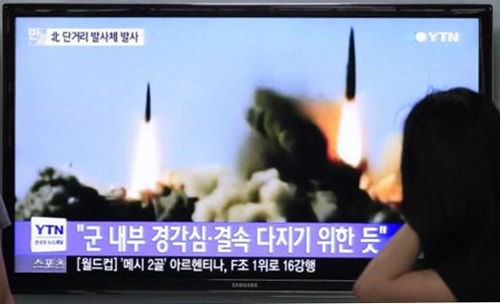 |
| The North Korean missile launch was reported on South Korean television. |
According to observers, it seems to have become a pattern that whenever North Korea wants to express its anger over what it considers provocation, it often conducts test launches of short-range missiles. The main targets are South Korea and joint military exercises with its ally, the United States, which North Korea considers preparations for invasion. For example, in March of this year, immediately after North Korean media strongly protested the US-South Korean military exercises, North Korea conducted a series of short- and medium-range ballistic missile test launches. Tensions further escalated when North Korea threatened to conduct a new type of nuclear test, also at the end of March.
In recent launches, including one coinciding with the 64th anniversary of the outbreak of the Korean War (June 25, 1950 - June 25, 2014), the target is still believed to be in retaliation for South Korea's recent artillery test launch into the disputed waters of the Yellow Sea. These North Korean missile tests occurred shortly after the two Koreas resumed talks on the management of the Kaesong joint industrial complex, which had been interrupted for six months due to tensions between the two sides. It is certain that the interruption will continue after these recent missile launches. This reflects the reality of the situation on the Korean Peninsula for decades: tension followed by relaxation, and then tension again. Fundamentally, mistrust and mistrust have yet to be reconciled to reach a unified solution for both sides.
While targeting South Korea in missile tests is undeniable, this time, North Korea's actions are also seen as a gesture toward China. Chinese President Xi Jinping's upcoming visit to South Korea on July 3rd and 4th, preceding his visit to North Korea, seems to have displeased Pyongyang. For the past two decades, no Chinese president has arranged their foreign travel itinerary to include South Korea before their ally North Korea. Looking back, President Xi Jinping's predecessor, Hu Jintao, visited North Korea in 2005 and only visited South Korea a year later. Former President Jiang Zemin also visited North Korea in 1990 and South Korea in 1995. Meanwhile, North Korean leader Kim Jong-un has not made a single visit to China since coming to power in 2011.
From China's perspective, it can be argued that Beijing wants to take a tough stance, putting pressure on North Korea regarding its nuclear weapons program. The visit to South Korea also reflects the strained and increasingly strained relationship between China and North Korea, which has worsened since North Korea's nuclear test last February. However, US Assistant Secretary of State for East Asian and Pacific Affairs Daniel Russel assessed the Chinese President's visit to South Korea as a "turning point" that could help promote cooperation on the North Korean issue. The US has repeatedly urged China to take a tougher stance on North Korea's nuclear weapons program. Meanwhile, South Korea hopes that the visit will break the current deadlock in negotiations with North Korea. Specifically, the South Korean presidential office announced on June 27 that the leaders of the two countries would "exchange views on ways to cooperate in addressing the situation on the Korean Peninsula, including North Korea's nuclear issue."
From North Korea's perspective, it's clear that China – a close ally – prioritizing Sino-Korean relations over Sino-North Korean relations has made Pyongyang uneasy. It's possible that North Korea will conduct further missile tests in the near future. And then, there will likely be retaliation and sanctions from the major powers. This vicious cycle will not benefit any country.
Phuong Hoa


