
Returning from Russia
(Baonghean)- In mid-June, good news arrived from Moscow about student Nguyen Thi Phuong Trang, class 11C6, winning a silver medal in the Russian Language Olympiad at Phan Boi Chau Specialized High School. This happiness is one thing for Trang and her family, but it is also the result of a long journey for Phan Boi Chau Specialized High School in its efforts to revive the Russian language and culture…
The atmosphere at the welcoming ceremony for student Nguyen Thi Phuong Trang's return from the International Physics Olympiad was not as boisterous as the celebration for the two physics students who won prizes at the Asian Physics Olympiad a month earlier. However, this did not diminish the solemnity, especially since once again, Ms. Dinh Thi Le Thanh – Member of the Provincial Party Standing Committee and Vice Chairman of the Provincial People's Committee – personally came to congratulate and present flowers to Trang and her teacher, Ms. Tran Minh Nguyet – the two who had just brought glory back from the homeland of the famous poet Pushkin.
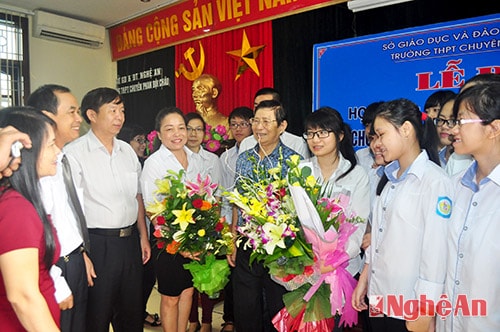 |
| The joy of the teachers and students of Phan Boi Chau Specialized High School. |
Joy was evident in every glance. The Vice Chairman of the province, in particular, embraced Ms. Minh Nguyet, his former colleague from his time working at the school. That embrace spoke volumes, conveying countless unspoken feelings, because more than anyone else, ten years ago, Ms. Dinh Thi Le Thanh understood just how difficult it was to bring Russian back to the specialized program at Phan Boi Chau High School for the Gifted.
Nguyen Thi Phuong Trang only returned to studying Russian two years ago, when she passed the entrance exam to the 10th grade specialized Russian class at her school, even though she had lived with her family in Russia for nearly ten years before that. But living in Russia is one thing, and learning Russian is another, and to learn it, Trang had to start from scratch like a beginner. And things were not simple at all, because although it was called a specialized class, it didn't even have a single textbook. Related materials for the subject were also scarce. This situation lasted until the end of 10th grade. Fortunately, last year, during a visit by leaders from the Ministry of Education and Training, teacher Tran Minh Nguyet raised this issue. After that, the policy of reprinting Russian textbooks was restarted. From then on, the teacher and students of the specialized Russian class finally stopped learning Russian using photocopied books.
Ms. Minh Nguyet, the homeroom teacher, was the one who rekindled Phuong Trang's passion for the Russian language. In reality, there were times when Trang and many other students in the class considered Russian merely a stepping stone to getting into university, while their ultimate goal remained English, a popular foreign language offering more choices when applying to universities. However, with the experience of someone who had spent many years studying at a Russian university, experiencing Russian culture and people, Ms. Nguyet gradually instilled that passion in her student. Naturally, the more Trang learned, the more she understood Ms. Nguyet's teachings, and the more she studied, the more memories of her time with her parents in the suburbs of Saria came flooding back. Trang also remembered the day she and her family left Russia; although she knew it meant the end of her parents' hard work abroad, her mother still felt a deep sense of unease. She still dreams that one day, Trang will return to Russia, to study there, a country with many great universities and many outstanding teachers. These are things that her generation, those who went abroad for work, never dared to dream of.
Unexpectedly, even before entering university, at the age of 17, Trang was chosen to represent Vietnam at the Russian Language Olympiad alongside more than 200 other students from around the world. However, upon arriving in Moscow, before even having a chance to fully experience the homeland of Lenin, Pushkin, and its ancient bridges, Trang and her teammates were already feeling anxious. Simply put, although it was called a Russian language competition, when encountering contestants from other countries, the Vietnamese team couldn't distinguish between Russians and foreigners. This anxiety was entirely justified, as it was later discovered that most of these contestants came from or had Soviet origins. Trang's mother, Nguyen Thi Ha, recounted: "Upon arriving in Russia, I saw my daughter on Facebook for about five minutes, and before I could even ask anything, she typed: 'I already know I'll lose before the competition even starts.'" At the time, I didn't understand why either, I just felt sorry for my child and hoped she would have the strength to overcome this first psychological obstacle.
But that wasn't the first difficulty. Earlier, on May 12th, Trang and her teacher, Nguyet, received news that they had been selected for the Vietnamese team to compete in the Russian Language Olympiad. That same day, the Ministry of Education and Training requested that they both travel to Hanoi for intensive exam preparation on May 13th. With only one day to prepare, they barely had time to pack their bags, get their passports, and complete other procedures when they received urgent notice to prepare a presentation titled: "I want to tell you," about the relationship between Vietnam and Russia. So, to submit their presentation to Hanoi by May 15th, the two had to race against time, and in fact, Trang's preparation was much more rushed than that of the other team members.
Not to mention, even teacher Tran Minh Nguyet herself was at a loss as to how to handle this exam because no student from Phan School had ever participated in the International Russian Language Olympiad before. Later, she still regretted and felt guilty because that was the reason Trang's presentation score was much lower than other contestants. However, in the reading comprehension and country studies sections of the exam held in Russia, despite facing very difficult questions and having to face five foreign judges alone, Trang confidently performed excellently. Trang's high scores in these sections were not unexpected, because even during the exam preparation days, despite being younger than her peers and lacking much support, Trang was considered by the teachers at the Pushkin Institute in Hanoi to be "the student with the fastest progress."
The silver medal won in the first competition by students from Phan School, while not the highest achievement of the Vietnamese team in this competition, is still a very proud result. For Trang, the achievement is only part of the story; what she gained more after the competition was the affection and friendship of students from other countries. One story that Trang, her teacher Nguyet, and the other members of the delegation will never forget is their encounter with the contestants from China. During the opening ceremony, even though Vietnamese and Chinese students were seated near each other, the Vietnamese contestants were puzzled and asked their teachers: "Why are the Chinese students so serious and unwilling to talk to the Vietnamese delegation?" When asked about this, a student from the Chinese delegation surprised everyone with the answer: The Chinese students felt shy and embarrassed in front of the Vietnamese students. Because of that sincere answer, the Vietnamese and Chinese student delegations later became particularly close, often chatting with each other. Not only that, the two countries were even assigned adjacent rooms at the hotel, receiving awards first the Chinese delegation followed by the Vietnamese delegation, and sharing the same bus at the airport. Moved by the genuine affection between the students of both countries, in her account upon returning to Phan Boi Chau School, teacher Minh Nguyet said: "Young people from all countries want peace and friendship, and that is a message that all levels of government need to consider."
Teacher Tran Minh Nguyet's return to Russia after nearly 30 years of absence also included an unforgettable memory: she reunited with her former homeroom teacher, Rana, from her time studying Literature and Linguistics in Russia. When they met, one as a judge and the other as a teacher accompanying students to an international competition, both were deeply moved, especially when she learned that her former homeroom class now had only one Vietnamese student still pursuing Russian. Receiving this appreciation, Teacher Minh Nguyet became even more convinced that the path she had chosen was the right one, and she had no regrets, even though returning to teaching Russian meant a 10-year break from her English teaching career and periods where she had to relearn the language from scratch, following a "teacher learns first, student learns later" approach. At the same time, she silently thanked her former principal, Ms. Dinh Thi Le Thanh, for her perseverance in persuading her to return to Phan School, succeeding the previous generation of teachers who had reached retirement age, in rebuilding the Russian language specialization class at the school. She also silently thanked her students, who overcame many difficulties and doubts to join her and the school in dedicating themselves to the Russian language, making the Russian language specialization class one of the highest-achieving specialization classes at the school.
This victory will hopefully usher in a new era of Russian language learning for students in Nghe An. And certainly, this will be the shortest and most effective way to connect Vietnam with Russia and with other countries around the world, fostering better understanding and peaceful coexistence on this planet.
My Ha


