
Growing long beans TV 06407
Using imported seed sources from the Asian Vegetable Research & Development Center (AVRDC), the Plant Resources Center (PRC) - Vietnam Academy of Agricultural Sciences has successfully researched and developed the TV 06407 long bean variety.
Long bean variety TV 06407 is an indeterminate growth type, with green stems, dark green oval leaves, and purple flowers. The time from sowing to first harvest is 48-50 days, and the harvesting period is extended. Commercial pods are dark green, with thick flesh, no visible seeds, and a sweet taste. The pods are 52-57 cm long and 6.9 mm wide, containing 16-19 septa that hold brown, kidney-shaped seeds with a white hilum.
The weight of 100 seeds is 14 grams. Each plant typically produces 24-33 fruits, with 2 fruits per stem, weighing 12.8-15.5 grams. Each square meter yields 2.2-2.95 kg of fruit, with a total yield of 22.8-25.69 tons/ha. The variety is resistant to fruit borers, Fusarium wilt, and has fairly good resistance to rust.
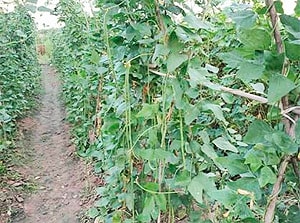
Experimental planting model of long bean variety TV 06407
This variety has high yield potential, good quality, suits the tastes of domestic consumers, and meets the demand for raw materials for export processing.
To successfully grow the TV 06407 long bean variety, farmers need to pay attention to the following points:
- Growing season: It is possible to grow three crops per year, with the most suitable being the spring crop (sowing seeds from February 20th to March 20th) and the summer crop (sowing seeds from July 5th to August 5th).
- Soil selection and preparation: Choose light loam soil with a pH of 6-7, loose, and well-drained. Intercropping with other plants, especially rice, is recommended to limit disease sources. Prepare the soil by breaking up weeds, creating raised beds 25 cm high and 100 cm wide.
- Fertilization: Apply 15 tons/ha of well-rotted manure and 400 kg/ha of phosphorus fertilizer as base fertilizer by spreading it evenly in the furrows and covering the fertilizer before sowing the seeds.
- Care: Before sowing, if the soil is dry, lightly water it to ensure sufficient moisture for germination. Sow two rows horizontally in each furrow, spaced 60-65 cm apart, with plants spaced 25-30 cm apart.
Sow 3 seeds in each hole. When the seedlings have 1-2 true leaves, thin out 1 seedling, leaving 2 healthy seedlings, resulting in a density of 100,000 plants/hectare. After sowing, cover with a thin layer of fine soil.
Loosen the soil surface, remove weeds, and thin out weak plants when they have 1-2 true leaves. Use only nitrogen and potassium fertilizers for topdressing, with a rate of 200 kg nitrogen + 200 kg potassium per hectare. This entire amount of fertilizer should be divided equally into 3 topdressing applications: the first when the plants have 2-3 true leaves, the second when the plants have 5-6 true leaves (before staking), and the third after the second harvest, when the plants are in full bloom.
Regularly water the plants with clean water to maintain sufficient moisture (75-80%) for optimal growth, development, abundant flowering, and fruit setting, resulting in high yields and good quality. Install trellises when the plants begin to grow tall (6-7 true leaves), placing one 1.8-2 meter long stake in each hole in an A-shape or X-shape with horizontal supports (approximately 1,500-1,600 stakes are needed per 1000 square meters).
- Harvesting: After harvesting the second crop of fruit (approximately 60-65 days after planting), apply the third and final fertilization by digging holes 5-7 cm from the base of the tree, adding nitrogen and potassium fertilizer, covering with soil, and watering adequately.
Depending on the fruit yield after each harvest, additional well-rotted manure can be applied to promote larger fruits, more flowering, and a higher fruit set for the next crop. Absolutely do not use fresh manure, fresh human waste, urine, or fresh liquid fertilizer for irrigation.
- Disease prevention: Pay attention to pest and disease control for beans according to the instructions of plant protection officers, ensuring the prescribed quarantine period.
According to nongnghiepvn – LY


