
Growing shallots yields 11 times more income than growing rice.
(Baonghean.vn) - Shallots in Nghi Lam (Nghi Loc) have become famous because this crop yields an income of over 300 million VND per hectare. Currently, farmers are harvesting 55 hectares of shallots in the spring crop, with an estimated revenue of over 20 billion VND.
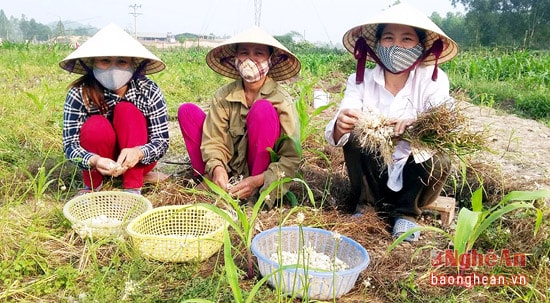 |
| Farmers in Nghi Lam harvest shallots in the spring. |
These days, Ms. Tran Thi Linh's family in Hamlet 4, Nghi Lam Commune, is focusing all their manpower on harvesting shallots in the fields. She said: "This area used to be frequently dry, making rice cultivation inefficient, so this year my family switched to growing shallots. After several days of harvesting, we estimate that one sao (approximately 1000 square meters) of shallots yields 8 quintals."
Currently, 1 kg of shallots costs between 27,000 and 33,000 VND. After deducting expenses, one sao (approximately 1000 square meters) of shallots yields nearly 26 million VND for the family. Compared to growing rice previously, one sao of shallots is 11 times more economically valuable.
Ms. Linh happily shared: “We are very pleased that the local authorities have encouraged farmers to switch to a more rational crop structure, resulting in increased income. My family plans to convert all 3 acres of our upland land to growing shallots and other high-value crops next year.”
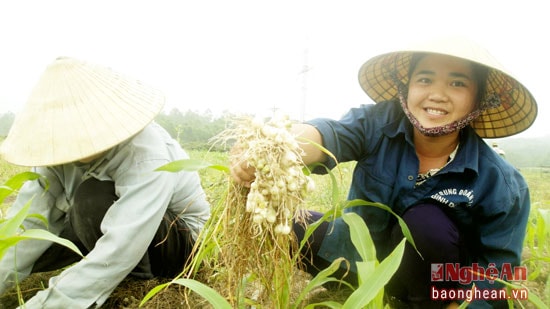 |
| Each plot of shallots is expected to yield 8 quintals of bulbs, at a selling price.From 27,000 to 33,000 dong. |
Shallots are easy to grow, resistant to pests and diseases, and drought-tolerant, making them particularly well-suited to the upland soil conditions of this region. The growing season begins in August each year, with farmers starting to sow and harvest in March of the following year.
Growing shallots involves several steps such as plowing the land, clearing weeds, and creating raised beds. After sowing the seeds, a layer of straw or dry pine needles is applied to retain moisture for plant growth and to create loose soil for larger, brighter bulbs. Ms. Nguyen Thi Lieu, an agricultural extension worker in Hamlet 5, Nghi Lam Commune, said: “Although the weather was unfavorable this year, the people in our hamlet still managed to grow 8 hectares of shallots. The farmers have mastered the techniques and regularly inspect the fields, so the yield is higher than last year.”
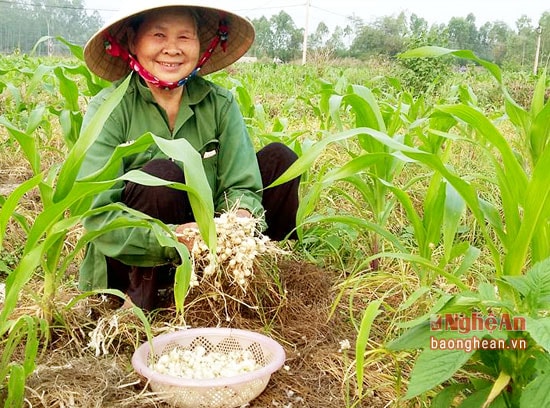 |
| Shallots can be intercropped or grown in succession with other crops. |
Previously, shallots were only grown by a few households living on the hillside for family consumption. But in recent years, shallots have become a valuable cash crop with a stable market, so the people of Nghi Lam have expanded the cultivation area to 55 hectares.
At this time of year, after harvesting, one hectare of shallots yields an income of over 300 million VND. Thus, after deducting production costs, the 55 hectares of shallots grown during the winter-spring season in Nghi Lam still generate a profit of nearly 17 billion VND.
What's very encouraging is that during the shallot harvest season, traders come directly to the fields to buy the produce, making it easier for the farmers to sell their goods.
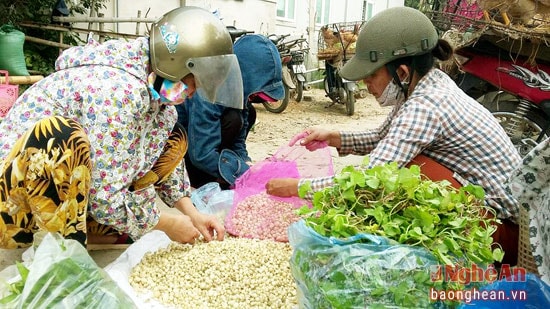 |
| Shallots are a familiar product in all markets in Nghe An and other provinces in North Central Vietnam. |
Mr. Tran Van Binh, Vice Chairman of the Nghi Lam Commune People's Committee, added: "This year, we are very pleased to see people expanding the cultivation of shallots, resulting in both a good harvest and good prices. This is a positive sign for our commune in increasing people's income. We will also research and coordinate with businesses to create a sustainable brand for the product."
Thu Hien
Nghi Loc Radio Station


