
China - Go, listen, and see.
(Baonghean) - Although we only spent a week in China and visited a few places, the trip left many impressions on us. These included the ancient and magnificent historical and cultural relics, preserved in their original state despite the passage of time and the ups and downs of history; the spacious, clean streets filled with flowers and greenery; and the modern and civilized cities.
Preserving the old traditionsamidst the urban whirlwind
Beijing welcomed us on a truly ideal afternoon; it was late spring, yet cherry blossoms were still in full bloom along the road from the airport to the city center. The six-lane highway, interspersed with stretches of planted birch, willow, pine, and cherry blossom forests, created a truly peaceful atmosphere. In the eyes of tourists, Beijing always retains its majestic and ancient beauty, and that is why crowds of people from all over the world continue to flock here every day.
Although we had already admired the beauty of these historical sites through famous Chinese films such as "Dream of the Red Chamber," "Romance of the Three Kingdoms," "The Sunset Behind the Forbidden City," and "The Battle of the Forbidden City," seeing the magnificent Forbidden City, the splendid Summer Palace, the ancient Lion Grove Garden, and the majestic Hanshan Temple with our own eyes still left us in awe.
Located in the heart of bustling Beijing, the Forbidden City (also known as the Imperial Palace) stands as an enduring wonder, preserving the glorious memories of a golden age when more than 24 emperors of the Ming and Qing dynasties reigned. In 1987, UNESCO recognized the Forbidden City as one of the World Cultural Heritage sites.
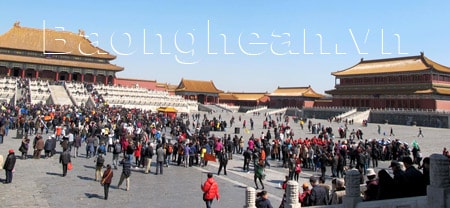
Numerous tourists visit the Forbidden City.
With a total area of over 250,000 square meters, the Forbidden City is a palace complex comprising 9,999 rooms, surrounded by an 11-meter-high, 3,400-meter-long wall with a deep moat and four watchtowers at the four corners, and four main gates leading into the city. All the architecture is concentrated in three main halls: Taihe, Zhonghe, and Baohe, and is divided into two areas: the outer court and the inner court. Every structure, from the domes, columns, and foundations to the decorative patterns on the walls and doorways, is meticulously crafted down to the smallest detail. During the reign of Empress Dowager Cixi, six Western-style buildings were added to the east to symmetrically complement the six Chinese-style buildings to the west. Within the Forbidden City grounds, there are a total of 308 large cauldrons, which are filled with water year-round for fire prevention. In winter, fires are lit underneath to prevent the water from freezing.
The Forbidden City is the largest and most well-preserved ancient palace complex in the world today. Majestic, mysterious, and possessing a harmonious and balanced beauty, the Forbidden City is like a painting depicting a glorious past, grand and magnificent in its opulent form. The Forbidden City truly deserves its reputation as a golden goose for China's tourism industry. On average, it attracts about 10 million visitors annually. Despite the large number of tourists and vast area, surprisingly, there is no street vending or chaotic souvenir stalls. Tour guide Zhang Yongtam said: "Previously, the Forbidden City also faced the whirlwind of commercialization. Some areas within the site were occupied by businesses and traders who considered historical sites as opportunities to get rich. Afterward, the Chinese government implemented a plan to restore and protect the heritage, resolutely preventing profit-seeking activities at any cost from continuing..."
Leaving Beijing, we arrived in Suzhou, a famous tourist city in Jiangsu Province, China. With its white city walls, ancient houses with black tiled roofs, streets lined with elegant antique lanterns, and magnificent palaces, Suzhou has attracted many tourists from around the world.
The Lion Grove Garden, a prime example of Yuan Dynasty architecture, was built in 1342 and is named "Lion Grove" because of its many mountains and rocks resembling lions. The garden features a long corridor connecting various architectural complexes, lined with ancient trees over 100 years old. In 2000, the Lion Grove Garden was recognized as a World Heritage Site by UNESCO. Located north of Suzhou, it was built at the end of the Yuan Dynasty by the monk Tianru to commemorate his teacher, Zhongfeng. Despite its construction during the Yuan Dynasty, the Lion Grove Garden has remained relatively well-preserved. Some of the existing structures were renovated and expanded during the Ming and Qing Dynasties. Maintenance and tourism development are the main focus. New trees are planted, but their species are consistent with the original historical elements, and exploitation is limited to avoid impacting the overall landscape. Besides its architectural heritage value, Lion Forest Pagoda also preserves almost all historical artifacts in its halls, including furniture, paintings, statues, calligraphy, and more, all of which are extremely valuable.
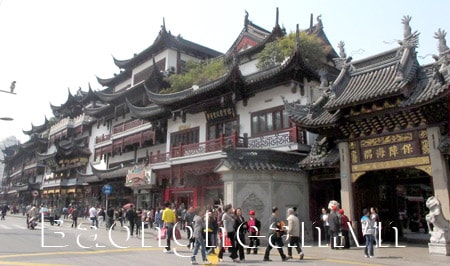
A corner of Nanjing Old Town
Although linking heritage sites with tourism, the Chinese government pays close attention to the regular maintenance of these sites, checking environmental hygiene requirements, preventing insect infestations, repairing damage and scratches, and preserving artifacts. At the same time, they limit the daily density of tourists.
Amidst the splendor of Beijing, the bustling Shanghai, and the vibrant Suzhou, heritage sites remain intact, untouched by commercial influences and unspoiled by the whirlwind of urbanization and modernization. While viewing heritage as fertile ground for tourism development, the Chinese consistently uphold the principle of "exploitation alongside preservation," and preservation always prioritizes the original form.
The Art of Tourism Business
Before traveling to China, despite having heard many experiences from previous travelers, despite telling ourselves, "It's expensive here, I don't know about the quality of Chinese goods, it's best to just look and not buy," and despite trying to restrain ourselves by minimizing the amount of yuan we brought, all 19 people in the group still spent their last penny on shopping at tourist spots.
On average, the group had about three or four different activities each day, and one activity always took up the most time: shopping. At each tourist destination, the Chinese have built shopping areas specifically for visitors. On the first day, we were taken to the Chinese Academy of Traditional Medicine in Beijing.
After resting, being served drinks, having fans to keep cool, and listening to an introduction about traditional Chinese medicine, one of the unique achievements of Chinese culture, and receiving a free medical examination, everyone was then introduced to various medicines for treating common and incurable diseases via a screen in Vietnamese, presented by a Vietnamese-Chinese professor. The presentation concluded with the emphatic statement: "These are rare and precious medicines, refined according to formulas passed down through generations, and cannot be purchased anywhere else except at the Beijing Institute of Traditional Medicine..." With the mindset of "when you're sick, you'll try anything," "health is everything," and "the opportunity to return to Beijing a second time to buy medicine is rare," many in the group readily spent money to buy medicine for stroke prevention, burn treatment, diabetes prevention, gout treatment, etc.
Before arriving in Suzhou, we were taken to a tea plantation that was advertised as very famous in China. The tea was grown on rolling hills, lush and green. Amidst these hills stood a rather imposing building. We were invited into a room where we drank tea while someone introduced us to the history of tea and the tea-drinking culture of the Chinese people; they spoke about the history of the tea plantation and the important uses of tea that many people are unaware of. They further explained: "Not all teas have such miraculous effects. Only the tea from the place you are visiting has such effects. The reason is the local soil and water quality. Therefore, you cannot use tea from anywhere else as a substitute. If you don't buy tea here, you will miss a golden opportunity to prevent cancer and many other serious diseases!" Convinced by the sweet talk and persuasive arguments of the tea shop staff, many people signed up to buy at a price that was "not cheap at all," with some even buying in large quantities to stock up.
In Hangzhou, we were taken to a rather large silk factory. After listening to the factory staff introduce the history of Hangzhou silk and touring the process of making silk products "entirely by hand and with natural materials," it was said that if you came to Hangzhou and didn't buy a silk scarf, pillow, or shirt as a souvenir, it was considered "not really Hangzhou." Then, tourists were taken to a shop selling silk products. Everyone rushed to choose items. Some bought silk comforter fillings because they "absorb sweat and prevent rheumatism"; others bought pillows containing silkworm droppings for a deep sleep; and the best-selling item was silk scarves as gifts.
After each destination, tourists, to varying degrees, bring back "spoils" purchased at tourist spots. By the last day, before leaving Shanghai, many even had to exchange Vietnamese currency for Chinese yuan with their tour guide to buy more household items. Our group of six, each carrying at least 1,500 yuan, had not a single penny left after five days in China. The tour guide jokingly said, "If you haven't spent your last yuan, you haven't left Shanghai yet. Thank you for contributing to the promotion of our country's trade!"
No pressure, no haggling, no pleading; it's entirely up to the tourists to decide what to buy. Yet, no tourist leaves empty-handed at any tourist destination in China! That's the art of tourism business. Thanks to this salesmanship, many Chinese travel companies are able to offer tours to foreign visitors at affordable prices. And "they finance it with one hand and get it back with the other, by selling goods to tourists," a friend knowledgeable in the "art" of Chinese tourism business shared.
A week-long experience in China, visiting various landscapes, and witnessing many new and interesting things that cannot all be covered in this article. Besides heritage preservation and the art of tourism business, the most impressive aspects were urban transportation planning, landscape construction, and environmental protection in public spaces, which we will discuss in subsequent articles...
Thanh Phuc


