
China stands alone in the Philippines' lawsuit regarding the South China Sea.
The Philippines' lawsuit against China at the PCA has forced countries to question China's "peaceful rise."
The case brought by the Philippines against China before the Permanent Court of Arbitration (PCA) in The Hague (Netherlands) regarding sovereignty issues in the South China Sea has begun with hearings from July 7-13.
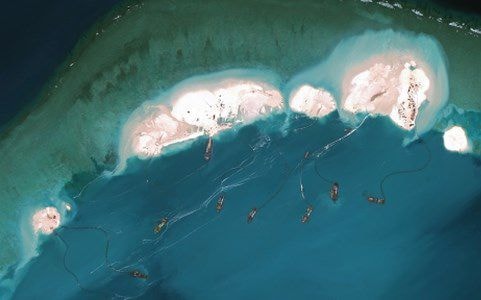 |
| China's illegal island reclamation activities in the South China Sea are causing great concern among other countries (AP photo). |
During this period, the Philippines prepared to answer questions from the Court, and the PCA received counterarguments from China, even though China was not participating in the proceedings. The main point raised by the Philippines during this hearing was China's violation of maritime rights within the 200-nautical-mile "exclusive economic zone" of the Philippines as stipulated by the 1982 United Nations Convention on the Law of the Sea (UNCLOS). Following the hearing, the PCA adjourned until the end of July.
International public opinion supports the Philippines' actions.
U.S. Senators John McCain, Jack Reed, Bob Corker, and Ben Cardin issued a statement regarding the Philippines' lawsuit, emphasizing: "While the United States does not take sides in any of the disputed claims, we commend Philippine President Benigno Aquino and his government for their commitment to pursuing this legal action."
"While China is building and militarizing new landmasses in the South China Sea, and tends to increase coercion to achieve its goals, we appreciate Manila's continued efforts to resolve these disputes peacefully, in accordance with international law and through international arbitration."
The New York Times, on July 17, assessed: “The Hague tribunal has become a new and important battleground in the multinational struggle over the South China Sea. Unsurprisingly, the Philippines is seeking various ways to protect its interests. Pursuing its claims through the tribunal is far wiser than confronting China at sea and deserves the support of the U.S. and other countries in the region.”
Richard Javad Heydarian, a geopolitical expert at De La Salle University, argues that the Aquino administration made a bold decision by directly challenging China, not with force, but with the language of law. The Philippines has been praised by many countries around the world for being the first to sue China in court.
According to The Diplomat reporter Prashanth Parameswaran, this lawsuit is significant because it represents a strong effort to resolve the South China Sea dispute through legal means, rather than the "might makes right" approach that China has employed in recent years.
Philippine Foreign Minister Albert del Rosario said the lawsuit is important not only for the Philippines but also for the principle of "rule of law in international relations" in general, especially the enforcement of UNCLOS.
According to Professor Carl Thayer of the Australian Defence College, whether China participates or not, a ruling in favor of the Philippines would impact the legal basis of China's so-called "undisputed sovereignty" over almost the entire South China Sea.
This will carry significant regulatory and moral weight within the international community, providing a legal basis for any legal action the Philippines may later take to protect its sovereignty.
Professor Renato Cruz de Castro of De La Salle University argues that the Philippines' lawsuit has put China in a difficult position. This lawsuit has also led countries to question China's "peaceful rise."
According to VOV.VN
| RELATED NEWS |
|---|


