
China's ambition for maritime hegemony.
Two weeks after the Pentagon submitted its annual report on China's security and military to the U.S. Congress, Beijing released its first ever military strategy white paper on May 26, revealing its ambitions for maritime hegemony.
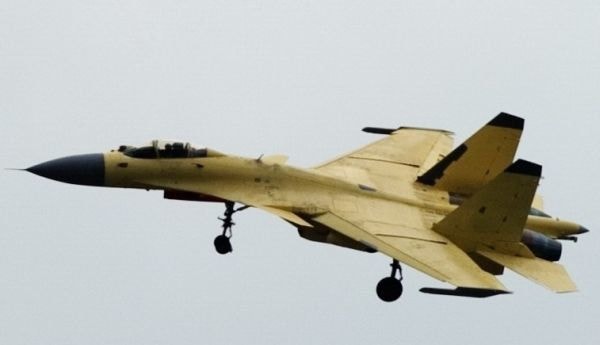 |
| A model of the Chinese J-15 fighter jet. Photo: asianarmsrace |
International experts were quite surprised by Beijing's public declaration of ambitious maritime policies and its brazen interpretations. However, they were not overly surprised by China's intentions, as they had been demonstrated through calculated moves over the past few years.
In fact, since 2014, the leadership in Beijing has clearly shown its willingness to accept heightened tensions in the region in the process of seeking advantages that serve China's interests.
Specifically, Beijing has increased its territorial claims in both the South China Sea and the East China Sea. For example, in the disputed Senkaku/Diaoyu Islands area with Japan, Chinese ships have entered and exited the area 16 times since the beginning of the year.
Expansion of ambitions for maritime dominance.
But most clearly, China is increasing its military strength to project power. The Pentagon report also indicated that China is developing a range of weapons that fall under its anti-access/area denial (A2/AD) strategy.
This includes intercontinental ballistic missiles, short- and medium-range ballistic missiles, anti-ship ballistic missiles (ASBMs), destroyer fleets equipped with cruise missiles, anti-ship cruise missiles (ASCMs), and nuclear-armed submarines.
The National Interest magazine quoted Professor Lyle J. Goldstein (U.S. Naval War College) as saying that among those weapons, the trump cards that China wants to use to threaten the U.S. are the ASCM and ASBM DF-21D missiles, capable of endangering aircraft carriers operating at distances of up to 900 nautical miles (approximately 1,667 km) from the Chinese coast.
"Beijing has upgraded a range of weapons to carry out regional attacks on maritime targets through coordinated operations between its newly upgraded fighter jets and two types of modern cruise missiles," Professor Goldstein emphasized.
Experts warn that the international community needs to take note of the fact that if ASCMs and ASBMs are developed to the appropriate level, they will allow China to build up its offensive capabilities at sea in the region.
From there, Beijing could pursue its ambition of dominating the entire sea region surrounding it. However, Professor Goldstein emphasized that these types of missiles still have many drawbacks and cannot counter the US submarine fleet.
Beijing has also spent heavily on Russian weapons such as Su-35 fighter jets and S-400 surface-to-air missile systems, weapons that Chinese military experts believe "could erode Taiwan's defenses."
With the S-400 missile system in its possession, Beijing will for the first time have the capability to control airspace covering the entire island of Taiwan and other areas. China's military strategy white paper also emphasizes its nuclear and strategic missile capabilities.
China will focus on independent weapons development, enhancing the effectiveness of its missile systems, and improving the capabilities of both nuclear and conventional weapons.
In addition, Beijing has also developed the JL-2 submarine-launched missile, the DF-31 (Dongfeng-31), DF-31A, and DF-41 strategic ballistic missiles capable of independently separating warheads and maneuvering on launch platforms, as well as medium-range ballistic missiles and hundreds of tactical ballistic missiles capable of carrying conventional or nuclear warheads.
Beijing is upgrading the range of these missiles to serve its plan to "penetrate" the sovereignty of countries bordering the South China Sea and East China Sea, including its sovereignty dispute with Japan over the Senkaku/Diaoyu Islands.
Recent evidence suggests that Beijing may be “believing” that new weapons purchased from Russia or manufactured domestically will allow it to take increasingly “provocative” stances in maritime territorial disputes with neighboring countries.
Satellite imagery from recent years shows that Beijing has militarized an island located approximately 299km northwest of the Senkaku/Diaoyu Islands. On this island, China has designed 10 helicopter landing pads, theoretically in preparation for an attack on the Senkaku/Diaoyu Islands.
Will the balance of power in Asia change?
IHS Jane's argues that China's military advances are altering the balance of power in Asia between Beijing and Washington. The report cites Washington's increased military and diplomatic presence in Asia as part of its "Asia pivot" strategy.
Meanwhile, China is expanding its territorial ambitions to the furthest reaches of the South China Sea. This is a move that experts believe Beijing is trying to "create conflict" with US allies in the region, such as Japan and other Asian countries.
China is making moves to strengthen its military with plans to develop the fifth-generation Chengdu J-20 and Shenyang J-31 fighter jets, ballistic missile systems, a series of advanced naval fleets, and the construction of another aircraft carrier after the Liaoning. The goal is to close the gap in the arms race with the United States in East Asia.
Chinese military expert Song Xinzhi said that Beijing is accelerating the completion of test versions of J-20 prototypes and other fighter jets. However, the Chinese military has not yet been able to deploy these aircraft due to numerous design flaws.
The Global Times once acknowledged that the J-20's stealth capabilities were still lacking because the aircraft's belly was designed to be quite large to carry various weapons, while the wing area was designed to be too small.
Furthermore, the J-20's two engines being so close together could be dangerous when the aircraft is flying at high speeds. Business Insider also suggests that the J-20 has components similar to those of the American F-35 and F-22 fighter jets.
These details may be contained within the vast amount of defense engineering data that Chinese hackers have painstakingly stolen over the years from U.S. military contractors.
(According to TTO)
| RELATED NEWS |
|---|


