
'Challenging' the Director of the Ministry of Health about procedures.
This was the topic of discussion at a working session this morning between the Prime Minister's Task Force and 11 ministries and agencies responsible for inspecting government and Prime Minister-assigned tasks related to specialized inspections of imported and exported goods.
Starting with the opinion of VCCI Chairman Vu Tien Loc, he expressed concern that the Food Safety and Hygiene Law's veterinary quarantine regulations only apply to fresh food, and that applying them to pre-packaged food is inappropriate. Therefore, he proposed abolishing this regulation.
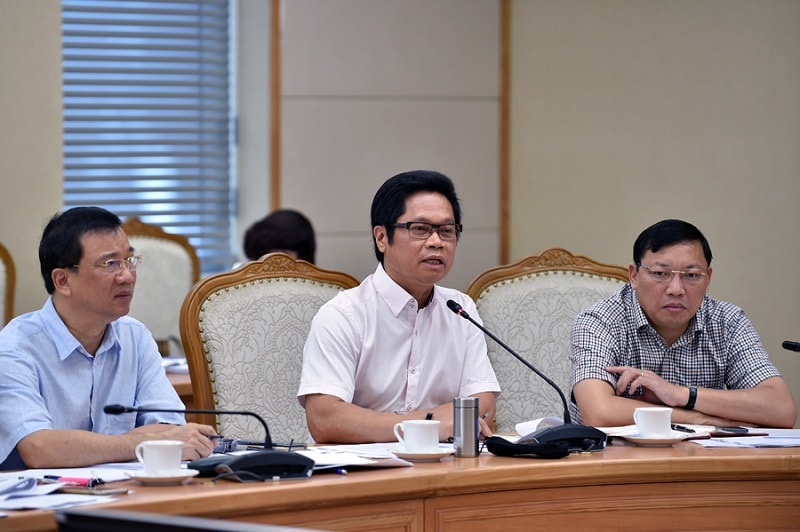 |
| Chairman of VCCI Vu Tien Loc. |
According to Nguyen Thanh Phong, Director of the Food Safety Department, the process of revising specialized inspection procedures has resulted in overlapping inspections across health, agriculture, and industry and trade sectors.
"The Food Safety Law does not stipulate quarantine, but the Veterinary Law does. The Ministry of Health cannot force the Ministry of Agriculture not to implement it, because it is constrained by the Veterinary Law and therefore dares not abandon it," Mr. Phong emphasized.
He suggested that the National Assembly should abolish this regulation, or that in areas experiencing an outbreak, both food safety inspections and quarantine measures should be implemented...
Minister Mai Tien Dung added: "The Director shouldn't over-explain that. We have to look at the reality of our industry. Those above may say one thing, but things are different below. If everything were that good, businesses wouldn't be complaining."
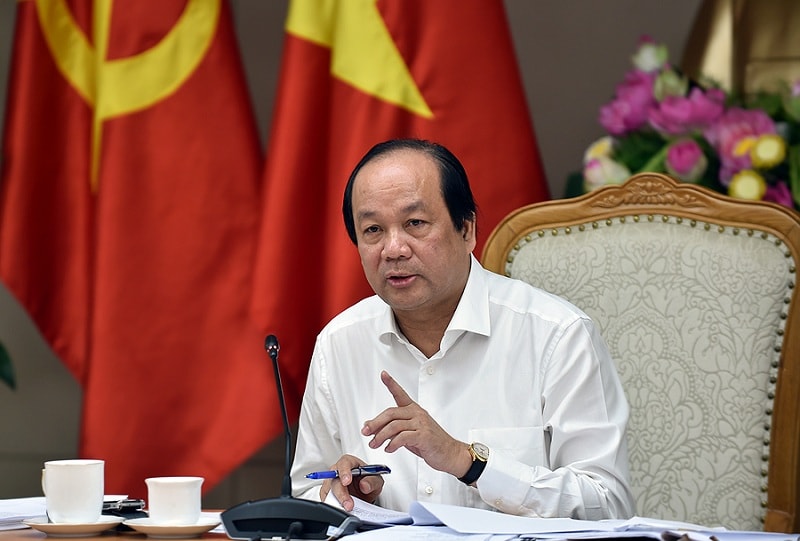 |
| Minister and Head of the Government Office Mai Tien Dung |
Minister Dũng suggested: "You say you've done a lot of work, but how many of those have you actually discovered? Do you know? Please publish that information for the press."
The Head of the Government Office noted that this story reveals institutional problems that require proposed amendments.
However, the Director of Food Safety affirmed: "The Ministry of Health is not making any excuses whatsoever."
He stated that his interactions were based on the principles of straightforwardness, decisiveness, and addressing issues correctly. "Even if a text message comes in while I'm riding my motorbike, I'll stop to reply. The Department can only do so much; the requests from large businesses are sometimes for amendments, and sometimes for things we can't fulfill," the Director said.
Businesses respond to the 5 "no's".
According to Dr. Nguyen Dinh Cung, Director of CIEM, the risk of food safety violations lies in other product groups, not in packaged food imported from abroad.
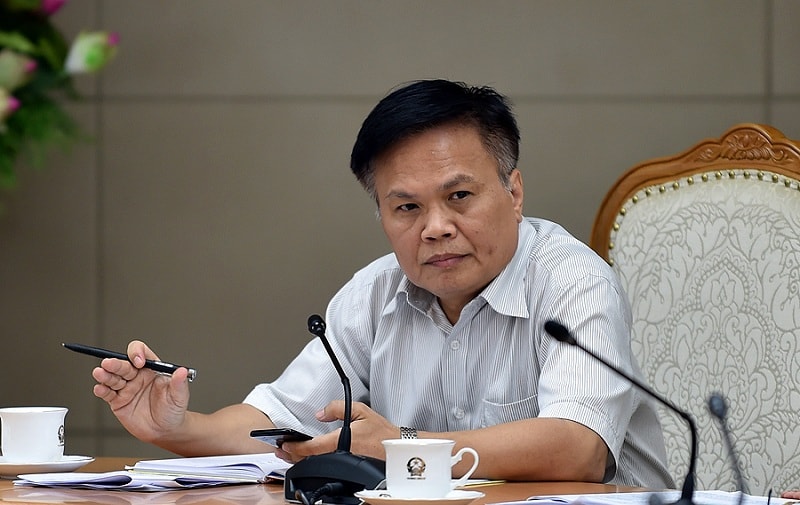 |
| Dr. Nguyen Dinh Cung, Director of the Central Institute for Economic Management Research |
According to Mr. Cung, imported packaged food is produced by manufacturers outside the country who have already published safety criteria and standards; it's not a case of injecting impurities into it.
"As for using vegetables from two or three different plots, or injecting impurities into shrimp as justification for the necessity of this procedure, in my opinion, the scientific and practical basis for defending this is not aligned," Dr. Nguyen Dinh Cung countered.
The Director of the CIEM Institute stated that businesses have been complaining about this procedure for five years. "I believe their complaints are valid and completely accurate," Mr. Cung affirmed.
He argued that businesses' reactions to specialized inspection procedures revolve around five "no's": not legal or reasonable, not transparent, not predictable, not effective, and not in line with international practices.
Dr. Cung explained that the lack of transparency is evident in the fact that while the procedures stipulate a certain number of documents, when submitted, the processing staff requests many other documents beyond what is required. For example, they request contracts with Vietnamese labels, requirements that have nothing to do with food safety and hygiene.
We suggest replacing the certificate with a notification to the Ministry of Health.
The Director of the Food Safety Department continued the debate: "Mr. Cung said it's not in line with international practice, and I've already reported that only Japan and some developed European countries, and Singapore in ASEAN, do not have pre-inspection but instead rely on post-inspection."
All other products, from China to Thailand and the Philippines, have a production license number on the product code. Therefore, it cannot be said that they do not comply with international practices.
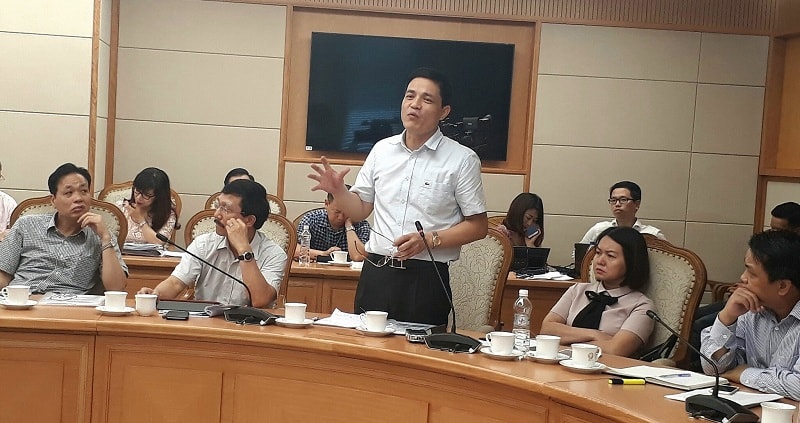 |
| Director of the Food Safety Department, Ministry of Health, Nguyen Thanh Phong |
Mr. Phong expressed that what was raised was for "the comrades to share, as state management agencies are under extreme pressure," and requested that members of the task force propose more appropriate methods for change.
VCCI Chairman Vu Tien Loc immediately offered a suggestion: "We only propose replacing that confirmation document with a notification sent by businesses to the Ministry of Health."
However, the Director of the Food Safety Department still compared the situation with other countries and reaffirmed: "I'm not making excuses," but Vietnam has not yet achieved that.
Minister Mai Tien Dung cited examples such as chocolate requiring 13 permits, yogurt undergoing quarantine by the Ministry of Industry and Trade and food safety inspection by the Ministry of Health, and silkworm cocoons requiring both animal quarantine and plant inspection. Regarding the information that Chocolate has 13 licenses, the Director of the Food Safety Department appeared bewildered: "I don't understand where this information came from. As for the ingredients, the company declares them itself." |
According to Vietnamnet.vn
| RELATED NEWS |
|---|


