
Legends of Ho Dynasty Citadel
(Baonghean.vn) – On the occasion of last night, June 16, 2012, Thanh Hoa province solemnly held a ceremony to receive the Certificate of Recognition as a World Cultural Heritage site...
(Baonghean.vn) –On the occasion of the eventLast night, June 16, 2012, Thanh Hoa province solemnly held a ceremony to receive the World Cultural Heritage Certificate at the Ho Dynasty Citadel (Vinh Loc district, Thanh Hoa). Here are some fascinating legends surrounding this historical site.
Feng Shui and the fulfillment of prophecies
The Ma and Buoi rivers flow to this area (Vinh Loc district), forming a relatively flat area of 10,000 hectares. Ho Quy Ly chose this land to build his citadel because, according to him, it had good feng shui: To the southeast was Don Mountain acting as a front barrier; to the northwest were Song Tuong Mountains, side by side, facing an area called Mam Xoi Mountain or Canh Phuong Mountain. One elephant facing north, another facing south, guarding Mam Xoi Mountain. To the southwest were five limestone mountains, the An Ton cave area – three mountains called Kim Ngo (golden horse); two mountains called Kim Nguu (golden buffalo). This citadel was also called An Ton because it was built on the land of the ancient An Ton village from the Tran dynasty. Regarding the Dragon Vein, Ho Quy Ly believed thatLand shaped like a dragon and a snake can be used to establish a long-lasting empire, at least 60 years.However, Ho Han Thuong (the second son), who was very knowledgeable in feng shui, reported to Ho Quy Ly that:"Father, I have carefully examined this land. It is indeed a land where dragons and snakes gather, but it is still immature, so it is only suitable for 'dragons and snakes drinking water, residing for six years,' meaning it can only be lived there for about six years."
Indeed, in the year Canh Thin (1400), Ho Quy Ly ascended the throne as emperor, and after only 3 months, he abdicated in favor of his son, Ho Han Thuong. In 1406, exactly 6 years later, Ho Han Thuong was invaded by the Great Ming army, and his city fell. In 1407, Ho Quy Ly and his son could not resist and fled to Ha Tinh province, where they were captured by the Ming invaders and taken to China. The people mourned and lamented the short reign, and consoled themselves: it was predestined.
He banged his head against the ground, pleading for his husband's innocence, until he sank into the rocks!
The section of the wall that has subsided contains an ancient temple called the Temple of Lady Binh Khuong. Inside the temple is a large, flat stone slab (2 m long, 0.4 m wide) with a small indentation the size of a human head, and two handprints deeply etched into the stone.
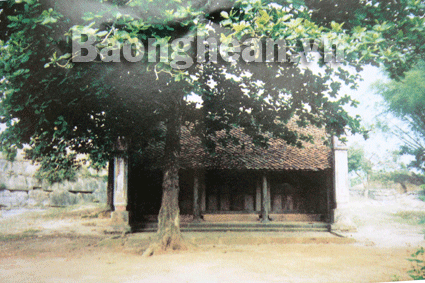
Ba Binh Khuong Temple
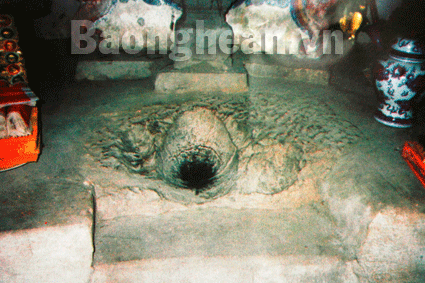
The stone slab has a hollow spot the size of a human head and the imprint of two hands.
Binh Khuong bangs on the rocks, crying out for justice.
The imprint of the head and hands leaves behind countless remnants of the past…
Today, on that collapsed section of the wall stands a tombstone inscribed with her husband's name. The tombstone bears the ancient inscription "Tran Cong Sinh's tombstone," and next to it is the temple dedicated to Mrs. Binh Khuong.
The Tran Khat Chan Temple and the "dead" lychee tree are bearing fruit again!
The Tran Khat Chan Temple and the Tam Tong Temple both worship the talented 29-year-old general Tran Khat Chan of the Tran Dynasty. Both temples are located next to Hoa Nhai (Hoe Nhai) Avenue, the road from the Ho Dynasty citadel gate to Don Mountain. Tran Khat Chan is revered for his role in killing Che Bong Nga, ending the great calamity of the Champa king's invasion of Dai Viet. Furthermore, he died unjustly at the Don Son Oath Ceremony. On that day, former officials of the Tran Dynasty, seeing Ho Quy Ly usurp the throne, conspired to assassinate him. Just before they were about to act, Tran Khat Chan signaled them to stop, preventing their attempt. Enraged, Ho Quy Ly ordered the execution of 370 people, including Tran Khat Chan. They were all buried together in a single pit, which the locals called the "Banh Day Tomb." Tran Thu Huong, Tran Khat Chan's daughter, was the only one to escape, but upon hearing of her father's death, she hanged herself from a tree branch to show her filial piety.
At the Tran Khat Chan Temple, there are many ancient trees, including a lychee tree with a broken top. The tree has two branches pointing straight up to the sky like two arms. In the 1990s, the tree shed its leaves, and the two bare branches pointing towards the blue sky were still visible from afar. Everyone thought the lychee tree was dead. Suddenly, in 1995 and 1999, when the two temples dedicated to Tran Khat Chan were classified as National Historical Monuments by the Ministry of Culture and Information, the lychee tree sprouted green leaves, bloomed, and bore fruit. People from the surrounding area flocked to see it. The temple caretaker reported it to local officials who came to witness, photograph, and record the event. Collector Pham Van Chay also recorded this event in his book "Ho Dynasty Citadel and the stories of its construction and fortifications(Thanh Hoa Publishing House).
The Ho Dynasty Citadel, a World Cultural Heritage site, is therefore even more attractive and fascinating to visitors from all over the world.
Hoang Chinh


