
Looking back at the role of trade unions from the perspective of strikes.
(Baonghean)The recent strike by workers at Prex Vinh Co., Ltd. in Lac Son Industrial Park (Do Luong district), a subsidiary of the South Korean KIDO Group, and workers at Hanosimex Company located in Nam Giang commune (Nam Dan district) has attracted significant public attention.
Clearly, strikes negatively impact employers, employees, and the business operations of enterprises. Furthermore, strikes have a detrimental effect on public opinion, affecting economic development and the investment environment in the localities where they occur, and in Vietnam as a whole. In recent years, strikes have occurred in increasing numbers, on larger scales, and with increasingly complex characteristics, particularly in enterprises operating under the Enterprise Law and those with foreign investment, attracting significant public attention.
The causes of these strikes all stem from very familiar reasons: disagreements over labor contracts, allowances and benefits, treatment by employers, working hours, rest periods, sick leave and maternity benefits, insurance, and the right to participate in and receive benefits from trade unions…
The aforementioned rights are entirely legitimate, and the workers have been demanding them for a long time, even enduring hardship to continue working, but the employer has not agreed or complied. Furthermore, both strikes by workers at Prex Vinh Garment Company did not follow the procedures stipulated by law. So, what is the role of the trade union in the process of workers demanding their rights and organizing strikes?
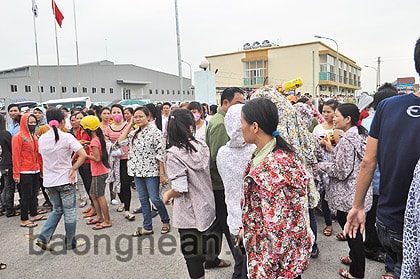
Strike at Prex Vinh Garment Company in Lac Son commune, Do Luong district.
A strike is considered legal when it follows the correct procedure: submitting a petition to the employer; reporting to labor arbitration if an agreement cannot be reached; and after labor arbitration fails to mediate, then obtaining the collective opinion of the workers to organize the strike… All these steps are carried out by the trade union within the enterprise. However, in the recent strike in Nghe An in particular, and more than 1,000 strikes that have taken place nationwide over the past 10 years (2003-2013), especially the recent spontaneous strikes, this procedure was not followed correctly, and most did not involve the participation of trade unions.
This not only shows that some points in our Law are not aligned with reality, but also reflects another reality: the role of trade unions in enterprises, especially those with foreign investment, is becoming increasingly blurred. During recent strikes, grassroots trade union officials did not fully understand the concerns and aspirations of the workers, and therefore failed to react promptly when grievances reached a peak. When workers' grievances are legitimate, they should immediately negotiate with the employer to resolve the issue. If the employer fails to resolve the issue satisfactorily, they should promptly report it to the higher-level trade union.
The reality is that once a trade union publicly demands workers' rights, the employer will immediately make things difficult for the union leaders. Therefore, almost 100% of recent strikes by workers have been spontaneous, initiated by the workers themselves, without the leadership or organization of the trade union. Furthermore, in some businesses, the trade union exists only in name. The grassroots trade union lacks the capacity to act as the sole representative of workers' interests in the enterprise, to discuss and negotiate with the employer regarding workers' demands.
Through these strikes, we have observed that some provisions of the current Trade Union Law reveal many limitations and are not suitable for practical situations, especially the specific operations of businesses. To contribute to protecting workers' rights and reducing strikes, from a legal perspective, the following regulations should be considered for amendment:
- In reality, when trade unions openly defend workers' rights, they often face obstruction from employers, because the unions also directly benefit from the employers' interests. Therefore, the law must strengthen trade unions within enterprises so that they have the necessary conditions to protect workers.
- Strengthening the role of trade unions in "leading strikes" means that trade unions play a mediating, guiding, and directing role in ensuring strikes are conducted legally, protecting the rights of workers while preventing conflict between trade unions and employers.
- Build strong relationships between grassroots trade unions and higher-level trade unions. This includes establishing a coordination mechanism for signing joint plans, regularly exchanging information, and supporting each other in completing tasks, especially in matters of protecting workers' rights and maintaining security and order.
- Strengthen the role of trade unions in protecting the rights of workers, especially basic rights such as wages, social insurance, allowances, working hours, rest periods, and maternity rights for female workers; promptly provide opinions and negotiate with employers to resolve legitimate demands of workers in a timely manner.
Article 10 of the Trade Union Law specifically stipulates the rights and responsibilities of the Trade Union: To guide and advise workers on their rights and obligations when concluding and implementing labor contracts and employment contracts with employers; To represent the collective of workers in negotiating, signing, and supervising the implementation of collective labor agreements; To participate with employers in developing and supervising the implementation of wage scales, labor norms, wage payment regulations, bonus regulations, and labor regulations; To engage in dialogue with employers to resolve issues related to the rights and obligations of workers; To organize legal counseling activities for workers; To participate with competent agencies, organizations, and individuals in resolving labor disputes; To make recommendations to competent state organizations and agencies to consider and resolve cases where the legitimate rights and interests of the collective of workers or individual workers are violated. Representing the collective of workers in lawsuits when their legitimate rights and interests are violated; Representing individual workers in lawsuits when their legitimate rights and interests are violated and authorized by the workers; Representing the collective of workers in labor, administrative, and bankruptcy proceedings to protect the legitimate rights and interests of the collective of workers and individual workers; Organizing and leading strikes in accordance with the law.
Nguyen Trong Hai (Trong Hai & Associates Law Office)


