
From the "Tuc Vinh" incident to "Diary in Prison"
(Baonghean.vn) The "Tuc Vinh" event, which took place on the afternoon of August 27, 1942, in Tuc Vinh market town, Guangxi province, China, is now exactly 70 years old (2012). This is a significant event and also the origin of the famous poetry collection "Diary in Prison" on Ho Chi Minh's revolutionary journey.
Early in the morning of August 13, 1942, from the revolutionary base in Cao Bang, Ho Chi Minh, accompanied by Le Quang Ba, crossed the Vietnam-China border to Chongqing with the aim of assessing the situation during World War II, securing international assistance, and propagating the anti-fascist movement in Vietnam. The route from Cao Bang to Chongqing (China) via Jingxi was the shortest.
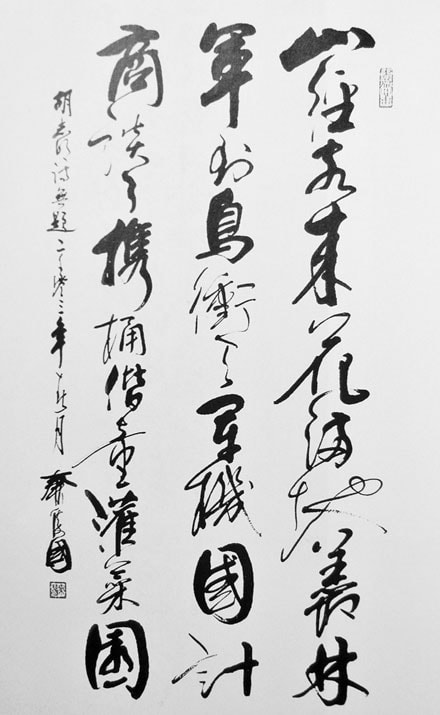
A calligraphy piece by Qin Shengguo (China) of the poem "Untitled" from the collection "Prison Diary". Photo courtesy of Kim Hung.
When Ho Chi Minh and Le Quang Ba arrived at the home of Tu Vi Tam, a sworn brother of Ho Chi Minh, in Pa Mong, it was almost the Mid-Autumn Festival (the 15th day of the 7th lunar month). Tu Vi Tam earnestly invited Ho Chi Minh and Le Quang Ba to stay and celebrate the festival. According to the customs of this region, the Mid-Autumn Festival is celebrated on the evening of the 14th day of the 7th lunar month. That evening, Tu Vi Tam invited several acquaintances from the area to celebrate the festival, including Duong Dao, who was only 19 years old at the time. Seeing that Le Quang Ba's leg was still swollen, Duong Dao proactively said:
- Tomorrow morning, I'd like to go with Uncle Ho (Ho Chi Minh) to Binh Ma. I know the way to Binh Ma.
Everyone agreed that Duong Dao should replace Le Quang Ba to accompany Uncle Ho to Binh Ma.
On the morning of August 27, 1942, the two men left Tu Wei Tam's house and set off towards Duc Bao. Upon reaching Duc Bao, they were apprehended by Kuomintang police. Mr. Ton Phuc Vinh, a witness to the incident, later recounted: "The afternoon market was closing, and we were playing badminton at the market entrance when we saw the old man and his son approaching. Suddenly, from nowhere, policeman Ma Hieu Vinh rushed out and stopped them, demanding to see their identification. We stopped playing badminton and ran to where the old man was rummaging through his pockets to get his papers to show the police. Afterwards, many people gathered to watch. The old man was very calm and composed. Duong Dao, however, was very annoyed and irritated..."
As darkness fell, the policeman still refused to let Ho Chi Minh and Duong Dao leave. A short while later, another policeman arrived, snarling and rushing towards them. They took Ho Chi Minh and Duong Dao to the village headquarters. From the headquarters, they took them to Hoang Chi Quang's house, then to Luc Van Phoi's house, about 500 meters from Tuc Vinh market town. The next morning, around 9 a.m., two policemen from the district came down to Tuc Vinh and escorted Ho Chi Minh and Duong Dao back to the district.
When Ho Chi Minh was apprehended by the Nationalist police in Tuc Vinh, he was carrying the following identification documents:
- Business card bearing the name Ho Chi Minh - "Vietnam Branch of the International Anti-Aggression Association".
- Business card bearing the name Ho Chi Minh - Correspondent of the International News Agency.
- "Special Pass" used in the Chinese Nationalist Army of the Fourth Theater Command, signed by the Commander of the Fourth Theater Command, General Zhang Fakui (this pass has expired).
September 1st, 1942, was the day of the Tinh Tay market fair, and also the day Ho Chi Minh and Duong Dao were escorted back to Tinh Tay by the authorities of Duc Bao district, acting on orders from the Fourth Military Zone Command.
While on her way to the market, Tu Vi Tam's older sister suddenly saw Ho Chi Minh and Duong Dao handcuffed and escorted by two policemen towards the district office. She immediately abandoned her shopping trip and rushed home to inform her younger brother, Tu Vi Tam, and Le Quang Ba. The next day, Vuong Tich Co (a sworn brother of Ho Chi Minh) and Le Quang Ba, through an acquaintance working at the Tinh Tay district office, secretly entered the prison to meet Ho Chi Minh. The following day, despite his leg pain, Le Quang Ba hurried back to Pac Bo, Cao Bang, to inform his comrades at home of the bad news and convey Ho Chi Minh's instructions.
Subsequently, numerous petitions from overseas Vietnamese in Kunming and Longzhou flooded into Chongqing, demanding that the Kuomintang Central Government release Ho Chi Minh. Our overseas compatriots didn't need to know if Ho Chi Minh was actually Nguyen Ai Quoc; they only knew him as a patriot in the "Vietnamese Branch of the International Anti-Aggression Association." Telegrams from the "Vietnamese Branch of the International Anti-Aggression Association" also flew from the Sino-Vietnamese border to Chongqing, requesting that President Chiang Kai-shek release Ho Chi Minh. Notably, two important generals in Chiang Kai-shek's headquarters, Li Zongren and Feng Yuxiang, met directly with Chiang Kai-shek to demand Ho Chi Minh's release.
There was one Vietnamese person who knew Ho Chi Minh as Nguyen Ai Quoc well: Ho Hoc Lam, from Quynh Doi commune, Quynh Luu district, Nghe An province. Ho Hoc Lam followed Phan Boi Chau's call to arms. Under Phan Boi Chau's guidance, Ho Hoc Lam enthusiastically joined Sun Yat-sen's army. During a battle in the Northern Expedition, he commanded a regiment to rescue Chiang Kai-shek's regiment from annihilation. When Chiang Kai-shek succeeded Sun Yat-sen as President of the Republic of China, he still remembered Ho Hoc Lam as a life-saving benefactor.
In January 1936, Ho Hoc Lam founded the Vietnam Independence Movement Alliance to legitimize the activities of Vietnamese communists living in China.
In late 1939, on his way to Chongqing, Major Ho Quang (Nguyen Ai Quoc) secretly visited Ho Hoc Lam, who was recuperating in Guiyang, the capital of Guizhou province. Knowing this, Ho Hoc Lam told his wife (Ngo Khon Duy) and daughter (Ho Diec Lan): "Nguyen Ai Quoc's return to the homeland is a great blessing for Vietnam."
In early September 1942, while recuperating in Guilin, Ho Hoc Lam received a telegram from Lam Ba Kiet (Pham Van Dong) sent from the Sino-Vietnamese border: "Comrade Ho Chi Minh has gone missing at the border; please find a way to rescue him." Upon receiving the telegram, Ho Hoc Lam angrily told his wife and daughter: "They have arrested Nguyen Ai Quoc!" He instructed his wife to write a letter, which he signed and sent to Chiang Kai-shek, demanding Ho Chi Minh's release.
Mrs. Ngo Khon Duy also instructed her daughter, Ho Diec Lan, to publicly report on this matter in the "Guangxi Women's Newspaper," where she worked, to expose it to progressive public opinion and prevent Chiang Kai-shek's authorities from plotting to assassinate Ho Chi Minh. At the same time, she advised Ho Diec Lan to use her status as a reporter to infiltrate prisons in Guangxi to find out where Nguyen Ai Quoc was being held and to find a way to rescue him. Mrs. Ngo Khon Duy instructed her daughter: "Anyone with a high forehead, a straight nose, bright, piercing eyes, tall stature, and an ethereal demeanor—that is Ho Chi Minh."
Faced with the powerful struggle of revolutionary organizations within the country, the Chinese Communist Party, many progressive figures within the Kuomintang ranks, and progressive public opinion worldwide, President Chiang Kai-shek was forced to release Ho Chi Minh.
On September 10, 1943, General Hou Zhiming, Secretary and Director of the Political Department of the Fourth War Zone, went to Ho Chi Minh's solitary confinement cell in Liuzhou to personally inform him of President Chiang Kai-shek's order to release him.
Although Chiang Kai-shek was forced to release Ho Chi Minh, he did not allow him to return to Vietnam freely, because, in his opinion, doing so would be "giving wings to an eagle." Chiang Kai-shek instructed General Zhang Fakui to "cleverly keep" Ho Chi Minh in Liuzhou to maintain relations with "Viet Cach" and "Viet Quoc," sowing seeds of doubt and suspicion within the Indochinese Communist Party.
In that context, Ho Chi Minh realized that insisting on returning to Vietnam would be unsafe on the more than 600-kilometer journey from Liuzhou to the Sino-Vietnamese border.
In late October 1943, at the request of General Truong Phat Khue, Ho Chi Minh participated in some activities of the Vietnam Revolutionary Alliance - an organization of Vietnamese people in China, comprising many factions, supported by the Fourth War Zone and directly led by General Truong Phat Khue.
Ho Chi Minh skillfully applied the principle of "adapting to changing circumstances while remaining unchanged," happily accepting the invitation. By cleverly securing the agreement of General Truong Phat Khue, Ho Chi Minh left Liuzhou on August 9, 1944, and arrived safely in Cao Bang at the end of September 1944.
When the "Tuc Vinh" incident occurred on August 27, 1942, Ho Chi Minh was 52 years old, approaching 53, the age of "understanding the Mandate of Heaven." He was considered a "saboteur" of their political system by the Kuomintang; his life and death were entirely in their hands, and he was deprived of his human rights. Despite this desperate situation, Ho Chi Minh continued to write poetry. During the long period of 379 days (September 27, 1942 - September 10, 1943), Ho Chi Minh wrote 134 poems, known as his "Prison Diary."
In his collection "Diary in Prison," Ho Chi Minh, as a prisoner, wrote only about his own imprisonment and that of his fellow prisoners. Introversion is a fundamental characteristic throughout the collection, evident even in the poem about his arrest in Tuc Vinh:
"Tuc Vinh has brought shame upon me."
Deliberately slowing yourself down;
They fabricated accusations that I was a spy.
Honor shouldn't be sacrificed for no reason.
The "Tuc Vinh" incident marked the beginning of imprisonment and exile across 18 prisons and 13 districts in Guangxi province. Ho Chi Minh remained calm in the face of the tactics that would unfold, and he firmly determined that:
"The body is in prison,
Spirit outside of prison;
To achieve great success,
The morale must be even higher."
Ho Chi Minh also depicted two clenched, sinewy hands, wrists shackled, raised high in a resolute and determined manner, expressing an unwavering will to never retreat in the face of a brutal enemy.
Facing the enemy directly, yet always filled with revolutionary optimism and unwavering faith in the inevitable victory and bright future of the Vietnamese nation, Ho Chi Minh overcame all difficulties, returned safely to his homeland, and continued to lead the country to complete and glorious victory.
The great Chinese poet Yuan Ying believed that the poetry collection "Prison Diary" was written by a man of "great character, great wisdom, and great courage."
The Cuban poet Felix Pita Rodríguez wrote in the preface to his Spanish translation of "Prison Diary": "Those beautiful words (from the poem) seem to have been conceived and written specifically for 'Prison Diary'. Yes, a human being, but this is a human being who has undergone the most refined and purest refinement, elevated to a great stature, so that everyone seems to perceive something truly lofty, outstanding, and possessing an extraordinary persuasive power..."
The "Tuc Vinh" event and the famous poem "Diary in Prison" are now 70 years old. This historical event and this unique poem have made a significant contribution to the greatness of Ho Chi Minh, which is admired by all of humanity!
Tran Minh Sieu


