
General Cương: 'There are 'undercurrents' beneath the South China Sea'
(Baonghean.vn) - After one year whenThe Permanent Court of Arbitration of the United Nations ruledDespite losing to the Philippines in the South China Sea dispute, China continues to quietly pursue its ambition of dominating the South China Sea.
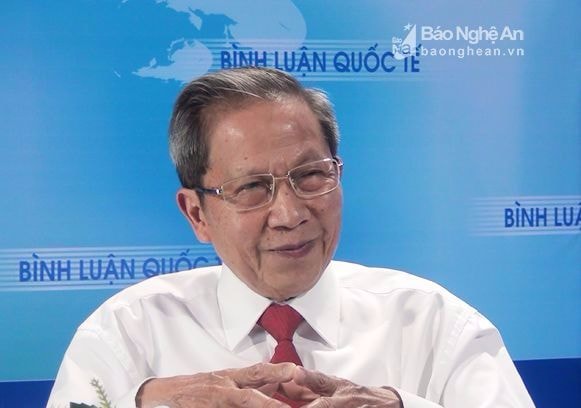 |
| Associate Professor, Doctor of Science, Major General Le Van Cuong. |
The situation in the South China Sea during the first six months of 2017
Regarding the South China Sea issue, Associate Professor, Major General Le Van Cuong, former Director of the Institute of Strategic Science, Ministry of Public Security, assessed that the situation in the South China Sea during the first six months of 2017 was relatively calm, without any tense clashes. The Major General explained that this calm was due to Beijing having almost completed the construction of infrastructure and militarization of the disputed area in the South China Sea and preparing for further military plans. Specifically, since the end of 2016, China has deployed MiG-27 and MiG-29 fighter jets and two HQ-9 anti-aircraft missile batteries to Phu Lam Island, part of Vietnam's Hoang Sa (Paracel) Islands; and has completed the construction of three large military airfields with runways up to 3,400 meters long, a military port on Gac Ma Island, and installed four high-frequency radar systems on Chau Vien Island, part of Vietnam's Truong Sa (Spratly) Islands.
Secondly, following the ruling of the Permanent Court of Arbitration (PCA) under the 1992 United Nations Convention on the Law of the Sea, which rejected China's unreasonable claims of sovereignty over the nine-dash line, China chose to remain silent and refrain from further aggression in the face of strong international reactions, aiming to somewhat appease the situation and avoid global boycotts.
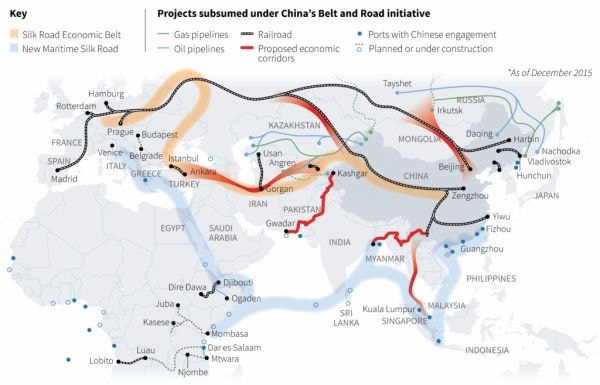 |
| China's ambition to revive the Silk Road through its 21st-century Belt and Road Initiative. Graphic: Reuters |
Third, China is focusing on promoting the "Belt and Road" initiative, as it is its ambitious mega-strategy.The entire "Belt and Road" initiative connects East Asia, Central Asia, the Middle East, North Africa, and Europe. China aims to become the "dominant force" in this Eurasian continent, with the ambition that 60 countries along this vital route will become economically dependent on China, and consequently, politically and diplomatically.The modern "Silk Road" project focuses on building road, rail, sea, and air infrastructure, oil pipelines, power lines, and telecommunications systems to enhance inter-regional connectivity. Therefore, China is not engaging in any aggression in the South China Sea.
Ultimately, China is exploring the new administration of Donald Trump, trying to gauge how far he will go on the South China Sea issue, whether he can maintain the strong commitment he made under Obama, and to what extent—no one knows for sure.
However, this is only a temporary lull, as this is China's new tactic. The country is deliberately avoiding causing any commotion or controversy that could draw criticism on the ground, in order to focus on other issues.
"Waves from the Underwater"
Although the situation in the South China Sea appears to be calming down on the "surface," Associate Professor, Major General Le Van Cuong believes that "in reality, there are fierce undercurrents beneath the surface." Accordingly, China is quietly and aggressively working to realize its dominance over the South China Sea.
The Major General stated that, despite Vietnam's protests against China's unreasonable encroachment on Vietnam's sovereign waters, China has organized a series of activities and events such as: commemorating the 5th anniversary of the founding of Sansha City; promoting tourism in Vietnam's Hoang Sa (Paracel) Islands; exploiting methane hydrate in the South China Sea; and conducting large-scale scientific surveys with 400 scientists from 13 countries in the Truong Sa (Spratly) and Hoang Sa (Paracel) Islands. In particular, China brazenly amended its Law on Maritime Traffic Safety, requiring all vessels transiting the South China Sea to obtain permission from China. This is a serious violation of the International Convention on the Law of the Sea.
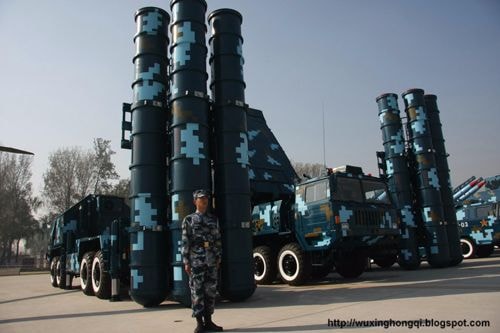 |
| A Chinese HQ-9 air defense missile system. |
"Even more dangerously, China has deployed 40 military fishing vessels, coast guard ships, and military aircraft to pressure Vietnam to withdraw the oil rig from Vietnam's exclusive economic zone," Major General Le Van Cuong added.
In the media field, during the first six months of 2017, China spent over $1.5 billion on propaganda regarding the South China Sea, including publishing books in Japanese that distorted the history of the South China Sea; and launching the China-ASEAN Young Scholars Fund to provide full scholarships for all ASEAN youth wishing to study the South China Sea...
Stay alert and avoid being manipulated.
General Le Van Cuong stated that the second half of 2017 will be a period of global upheaval and unpredictability. For example, while China is only concerned about and observing the US's behavior in the South China Sea, the Donald Trump administration is still "stuck" with a series of unstable issues within the US and the world. Other major powers like Russia and Japan have repeatedly voiced their opposition to China's actions in the South China Sea, but have yet to take concrete action. Furthermore, ASEAN countries remain divided on the South China Sea issue. "Thus, these circumstances will create favorable conditions for China to act more freely in the South China Sea, realizing its ambition of dominance," the General affirmed.
Predicting the situation in the last six months of 2017, Associate Professor, Major General Le Van Cuong stated that China's behavior in the South China Sea will be divided into two phases: before and after the 19th National Congress of the Communist Party of China. The Major General analyzed that before each Congress, two possibilities could occur: either China will maintain "calm waters," or it will "stir up trouble." Observations show that before major political events, Beijing often takes actions that provoke disputes in the South China Sea, aiming to demonstrate the strength of its current leaders in protecting national sovereignty. "Therefore, we cannot rule out the possibility that China will create new unrest, as 'a gift offered to the Congress'."
The Major General further analyzed that China would prevent the Trump administration's interference in the South China Sea by facilitating North Korea's continued development of nuclear weapons and ballistic missiles. "Clearly, in the North Korean issue, China plays an active role, and the US must rely on China to resolve it. Therefore, North Korea is the 'bargaining chip' that China will use to reduce US interference in the South China Sea."
General Cương further stated that, given the geographical location and importance of Southeast Asia, China will focus on strengthening friendly relations with ASEAN, especially with countries that have interests in the South China Sea. Through economic cooperation and creating a friendly atmosphere with developed countries in ASEAN, China aims to exert increasingly stronger pressure on Vietnam in the future.
Against this backdrop, Associate Professor Dr. Le Van Cuong believes that Vietnam needs to be vigilant, encourage, and demand that China fulfill its agreed commitments. In particular, he emphasizes the six principles and four joint declarations between the two countries' high-level officials regarding the resolution of disputes in the South China Sea based on international law and respect for the independence and sovereignty of all parties.
The Major General affirmed: "Vietnam is not alone. We have all the necessary conditions to protect our rights and interests in the East Sea, and this is fully supported by the international community. The core issue is that Vietnam needs to create a new position and strength to combine national strength and the strength of the times, leveraging the consensus of the international community to express Vietnam's viewpoint on peaceful development and the protection of legitimate rights and interests in the East Sea."
US Russia


