
Tuong Duong: Efforts to collect taxes
(Baonghean) - Tuong Duong district has a total area of over 281,129 hectares, accounting for 17% of Nghe An province's area, with 18 communes and towns. However, only a few communes and towns such as Hoa Binh, Tam Quang, Tam Thai, and Yen Na still have tax-generating activities. Overcoming many difficulties and challenges, the district collected 16.1 billion VND in the first nine months of 2014, reaching 135% of the annual plan.
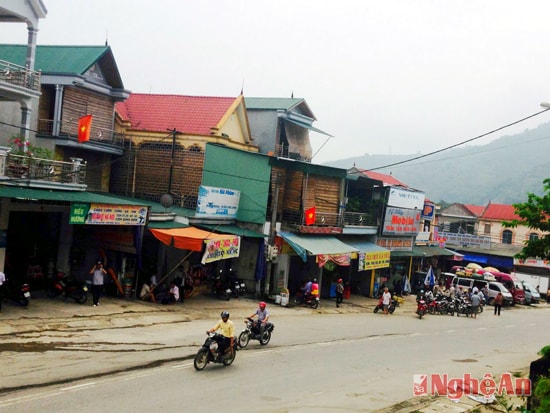 |
| Hoa Binh town - the trading center of Tuong Duong district. |
Hoa Binh town – the district capital of Tuong Duong – is quite bustling with trade and commerce. However, after traveling through the town and along National Highway 7 or the paved roads leading to Yen Na, Yen Hoa, Xieng My… for tens of kilometers, you won't find any shops or restaurants. Nguyen Minh Tuan, the team leader of the Tax Declaration Team at the Tax Department, shared: "Despite the difficult economic and social conditions, we still have to stay in the area and work closely with the community. Many of us live far away, sometimes not returning home for a whole month, but we are determined to overcome difficulties and strive to complete our tasks."
Given the terrain and economic conditions, it's difficult to imagine where the 16.1 billion VND in tax revenue collected by the Tuong Duong Tax Department in the first nine months of 2014 came from. Further investigation reveals that the Tuong Duong Tax Department has only 17 staff members. Tax collection in Tuong Duong relies primarily on revenue from production and business activities, household businesses paying taxes under the lump-sum method, revenue from some enterprises under the Department's management, and another important source: 2% deducted from the revenue of construction projects undertaken by contractors from outside the province. This limited and unstable revenue stream makes it difficult to analyze, forecast, and develop long-term, stable budgets to support local socio-economic development.
Mr. Vi Dinh Cat, Head of the Tax Department of Tuong Duong District, stated: In Tuong Duong district, only 34 businesses declare VAT deductions, primarily construction companies with little to no revenue. Many businesses declare zero VAT on a monthly or quarterly basis. Regarding corporate income tax, some are currently enjoying preferential treatment (tax exemption) as stipulated by the Corporate Income Tax Law. Revenue from these businesses in the first nine months of 2014 was approximately over 2 billion VND, accounting for over 11% of the total revenue in the district. Some businesses from other provinces contributed approximately 2.3 billion VND, accounting for 13% of the total revenue in the district, which was retained by the local government. Fees, charges, registration fees, and land use fees accounted for 40% of the total state budget revenue in 2014.
While in many other tax offices, business license tax is not a significant revenue item, in Tuong Duong it is a crucial part of the budget, with strict collection measures implemented from the beginning of the year to increase local revenue. The tax office currently manages business license tax for over 890 households, of which 486 pay monthly under a lump-sum method. However, some of these households do not pay VAT. In Tuong Duong, on average, one tax officer manages around 200 households. Furthermore, the majority of individual businesses are small-scale, primarily run by one person selling groceries, consumer goods, clothing, etc., resulting in low sales. Business owners belong to various ethnic groups, sometimes making tax collection difficult due to low awareness and compliance with tax laws. Very few households pay taxes directly through banks, and authorized collection is very difficult. The average monthly tax per household is only 270,000 VND.
Therefore, the District Tax Office always prioritizes the strict, transparent, and careful management of tax collection from individual business households. Information on businesses paying taxes under the lump-sum method and those exempt from VAT due to revenue below the threshold is publicly displayed at market management boards or commune/town People's Committee offices and posted on the Tax Department's website to ensure social fairness. Simultaneously, they encourage tax declarations and payments, regularly monitor the business situation of households subject to lump-sum tax collection, and promptly adjust revenue figures to reflect actual figures. This contributes to consistently higher revenue collection in this area each year, helping to balance the budgets of communes and towns.
2014 was a year of significant changes in tax policy, greatly impacting households and individual businesses, such as: the introduction of revenue thresholds for VAT exemptions, the application of VAT calculation methods based on a direct percentage of revenue, and an increase in personal allowances for personal income tax calculations. For businesses with a fixed tax payment, publicly available information includes: tax identification number, business name, business address, main business activity, total annual revenue, and tax payable for the year (total tax payable and details for each type of fixed tax incurred). The public disclosure of information for businesses with fixed tax payments is stable, and tax payments are made before January 30th of each year. We found a fairly large store in the district and inquired about their tax payable. Mr. Tran Gia Ngu, the owner of a grocery store in Lung village, Tam Thai commune, said: "My store gets its goods from Vinh, but they are expensive, and people don't have enough money, so sales are slow. The business license tax is 750,000 VND per year. As for VAT, my store pays 300,000 VND per month. Therefore, to achieve the best tax collection results, since the beginning of 2014, the Tax Department, based on the amended and supplemented VAT policy regulations, has coordinated with the tax advisory councils of communes and towns to publicly post and compile the 2014 business license tax records. Every month, they compile a list of households paying VAT using the fixed-rate method and households not subject to VAT, using the prescribed form, for public posting."
In the final months of 2014, despite the predicted continued economic difficulties, the Tax Department was determined to strive to complete its revenue targets through various measures, such as: proactively advising the District People's Committee and coordinating with departments, agencies, and the People's Committees of communes and towns in urging collection, recovery, and combating revenue loss; exploiting revenue from land use rights; reviewing and promptly collecting revenue from basic construction units outside the province, resource taxes, and environmental protection fees from units and individuals exploiting natural resources and minerals; conducting inspections to ensure that 100% of households engaged in actual business activities are under tax management; and coordinating with the Department of Natural Resources and Environment and the Department of Finance and Planning to promptly collect land use fees and registration fees from households allocated land. Strengthen inspection and supervision of the People's Committees of communes and towns to ensure timely collection and remittance to the State budget of fixed revenues, public property revenues, and fees at the commune level. Conduct on-site inspections of taxpayers, increase surprise inspections as required by management, and collect and penalize cases of false declarations and tax evasion to combat budget revenue losses. Focus on analyzing and classifying tax debts by group of taxpayers, and then implement flexible measures to collect tax debts, resolutely handling and organizing coercive measures to collect tax debts from businesses and households that deliberately delay or evade payment.
Implement diverse and comprehensive forms of educational and persuasive propaganda to raise awareness and encourage voluntary compliance with tax obligations among organizations, businesses, and economic sectors. Provide effective support to taxpayers through various means, promptly and correctly addressing the concerns of the public and taxpayers. Apply information technology in tax management, utilizing software programs from the General Department and the Tax Department. Implement tax management according to ISO 9001:2008 standards; organize and operate an efficient "One-Stop" service center to receive documents and address difficulties and obstacles faced by taxpayers when carrying out tax administrative procedures; publicly display tax administrative procedures at the "One-Stop" service center, at the headquarters of commune and town People's Committees, market management boards, etc.
Mr. Lo Thanh Hai, Vice Chairman of the People's Committee of Tuong Duong District, shared: The district and the Tax Department pay close attention to tax collection in the area. The district has developed a plan to exploit revenue sources, established teams to collect outstanding tax debts, and combated tax evasion in transportation and basic construction businesses. The district People's Committee directed the allocation of revenue targets to communes and towns at the beginning of the year. From there, the local Party committees and authorities of the communes and towns submitted their revenue targets to the People's Councils at the commune level for allocation to the relevant departments, agencies, and organizations at the commune level for implementation. Thanks to decisive leadership, tax collection in the first nine months of the year exceeded the provincial target by 35%.
Chau Lan


