
2016 Admissions: Many major changes expected.
On October 28th, the Association of Vietnamese Universities and Colleges held a workshop on high school graduation exams and university/college entrance exams. Many issues were discussed, such as whether to continue with the national exam or to separate the high school graduation exam and the university/college entrance exam.
If you don't meet the minimum score... then study abroad.
Speaking about this year's national exam, Professor Tran Phuong - Rector of Hanoi University of Business and Technology - expressed that the Ministry of Education and Training's decision to organize a single exam is reasonable, cost-effective, and achieves two goals: graduation and university/college admission.
Besides agreeing that a single exam should continue, Professor Phuong suggested that instead of 100 exam centers, the Provincial Departments of Education and Training should organize the exam, with the Ministry only responsible for designing the exam questions. Professor Phuong's second suggestion was that the Ministry allow universities to conduct two admission rounds per year. Currently, the admission process is lengthy and wasteful for society.
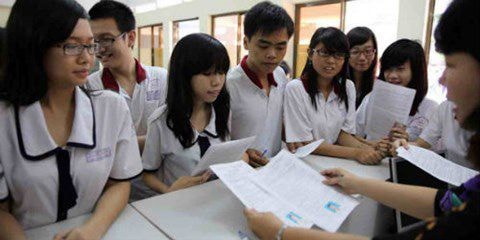 |
| Illustrative image. |
Professor Phuong questioned how the Ministry's experts calculated that this year there would be 530,000 candidates above the minimum score, yet universities are still short of students even though recruitment is almost at the end of October. Hanoi University of Business and Technology has only recruited 2,600 out of 4,500 students so far.
According to Professor Phuong, it's time to reconsider the minimum admission score. Is it really true that having a minimum score guarantees good academic performance? Every year, thousands of Vietnamese students go abroad to study because they don't meet the minimum score, while domestic universities lack applicants.
“For a long time, the Ministry has only focused on the input while neglecting the output. But I believe that the most important aspect of university education is the output. University graduates must pass at least 60 exams to graduate. I think the Ministry needs to address this issue. The university program is 130 credits – similar to the US – but Vietnamese people don't become professionals with that many credits. Americans don't need to learn English. So, where would they find the time to teach English, information technology, general subjects, not to mention physical education and national defense? Therefore, I think 130 credits is not enough.”
Regarding passing grades for subjects, a score of 6 or higher is required. The current regulations of the Ministry are unacceptable,” Professor Phuong raised a series of issues.
Should they be separated?
From another perspective, Associate Professor Van Nhu Cuong assessed that the recent exam had three shortcomings: it failed to reduce stress, did not reduce financial costs, and did not accurately select candidates based on their abilities. "I believe we failed because the Ministry controlled every aspect from A to Z. While in preschool and high school, the Ministry controls Z, in university, the Ministry controls A," Professor Cuong said, using an analogy.
According to Associate Professor Van Nhu Cuong, the university entrance exam should be administered autonomously by the universities, allowing them to choose a suitable model. He suggests separating the two exams: the high school graduation exam, which is very concise and can be considered a second-semester exam, and the university entrance exam, which should be left to the universities' autonomy.
Sharing the same view, Professor Lam Quang Thiep argued that the high school graduation exam should be handled by the Department of Education and Training because "even if the Ministry takes over, it cannot standardize the entire country." As for university admissions, he suggested that universities should have autonomy, without a minimum score requirement, and that the exam scores should be determined by the universities themselves.
 |
| The Ministry of Education and Training hopes to overcome the shortcomings of the 2015 entrance exam. (Photo: Pham Mai/Vietnam+) |
Professor Vo The Phuong, Rector of Dong Do University, believes that organizing a 2-in-1 exam like the one recently held is a misguided idea because the purposes of the two exams are different. One is to record graduation results, and the other is for university entrance examinations. Therefore, combining the two exams is like forcing them into a marriage.
Furthermore, the exam format is unreasonable, as universities are responsible for handling graduations for the provincial education departments. In addition, extending the exam to just one week is impractical, impacting the daily lives of families and society as a whole.
"Furthermore, the unreasonable exam structure leads to inaccurate student assessment, resulting in a 40% decrease in the quality of university entrance exams this year. In addition, the inclusion of elective subjects in the high school graduation exam, compared to the current 13 compulsory subjects taught in high school, leads to students choosing their exam subjects in advance, resulting in unbalanced learning."
Therefore, if we continue with the 2-in-1 exam, we must address the shortcomings of the previous exam. Alternatively, if we separate graduation and university entrance exams into two independent processes, the graduation component should be entrusted to the local authorities,” Professor Vo The Phuong suggested.
Is calling it a 2-in-1 exam inaccurate?
Representing the Ministry of Education and Training, Mr. Mai Van Trinh, Director of the Department of Examination and Quality Assurance, stated: “The teachers' claim that the exam is a ‘2-in-1’ exam does not accurately reflect the nature of the national exam. The essence is that after 12 years of schooling, students need a scale to see where they stand. This scale serves two purposes: graduation and university admission. Therefore, it is neither a graduation exam nor a university entrance exam, so it is not a ‘2-in-1’ exam. The Ministry has given universities autonomy in their own entrance exams. The Ministry does not force universities to use the Ministry’s overall results.”
According to Online Law


