
USD exchange rate today, December 26, 2024: Maintaining its upward trend.
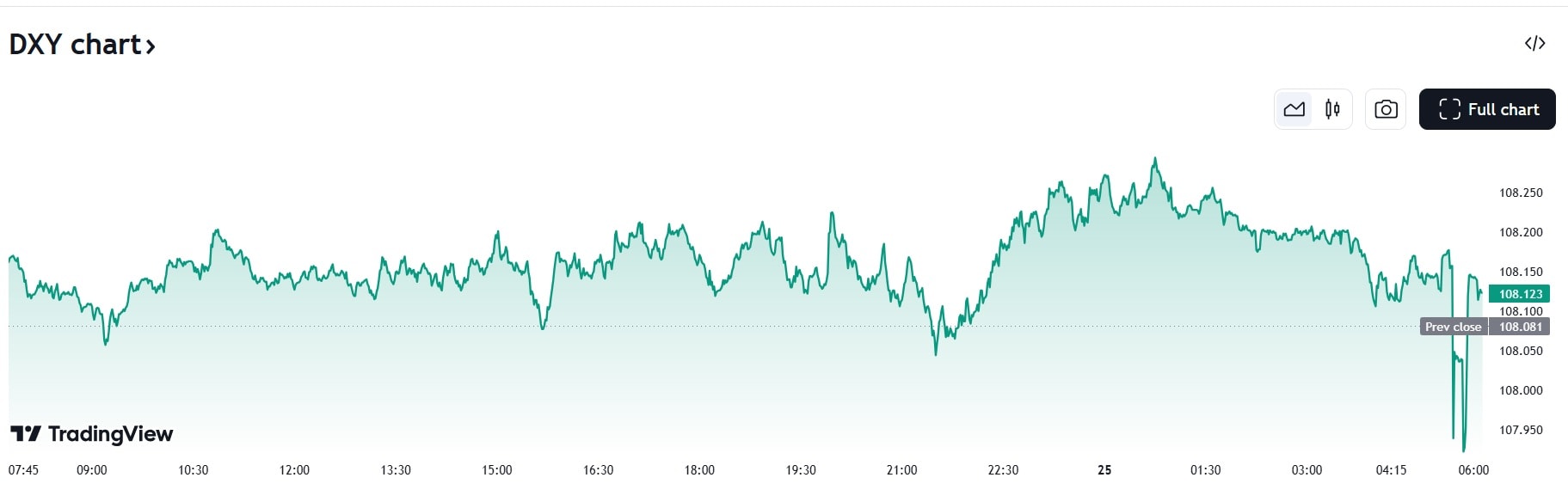
Today's USD exchange rate (December 26, 2024): Maintaining its upward trend ahead of the new year, the US Dollar Index (DXY) rose 0.09%, currently at 108.12.
Today's USD exchange rate worldwide
Meanwhile, in the US market, the US Dollar Index (DXY), which measures the fluctuations of the US dollar against six major currencies (EUR, JPY, GBP, CAD, SEK, CHF), rose 0.09%, currently standing at 108.12.
The US dollar continued its strong upward trend, supported by expectations that the Federal Reserve would delay interest rate cuts. Market expectations of US economic growth also contributed to the dollar's more than 7% gain since September. Inflation and the Fed's forecast of slowing the pace of interest rate easing next year further strengthened the greenback's position.
The yield on 10-year US Treasury bonds reached a seven-month high of 4.629%, reflecting the contrast between the Fed's dovish stance and global growth forecasts. The widening interest rate differential between the US and other economies has fueled a stronger dollar.
With the market focused on interest rates, trading volume is expected to remain low ahead of the new year 2024. The DXY index is holding at $108.12, up slightly by 0.09%. Maintaining above the $107.9 mark indicates a short-term uptrend. If it breaks through the resistance level of $108.54, the DXY index could advance to the next resistance level at $108.9.
Conversely, the main support level for the DXY index is at 107.60, with the next support level around 107.18. To maintain the uptrend, the index needs to stay above these levels.
The yield on 10-year US Treasury bonds recently surged to 4.62%, breaking through resistance levels, reflecting investor confidence in the strength of the US economy and expectations that the Fed will cut interest rates more slowly. This increase in yield reflects heightened demand for higher returns amid global economic uncertainty.
High 10-year yields typically support a stronger USD, as higher yields attract foreign investment. When yields surpass 4.58%, this could further boost the USD and put pressure on commodities and assets priced in USD, including gold and silver.
In other developments, the EUR/USD exchange rate is currently trading at $1.03912. The EUR has fallen slightly by 0.13% against the USD. The main support level is $1.04465, which will determine the EUR's next move. If this level is breached, the EUR/USD pair could target resistance at $1.05324, followed by $1.06288.
Conversely, the support level for the EUR is $1.03426. If it falls below this level, the price could move towards the next support level at $1.02760.
Today's domestic USD exchange rate
The central exchange rate for the VND/USD currency pair, announced by the State Bank of Vietnam and applicable on December 26th, increased to 24,320 VND, a rise of 12 VND compared to the previous rate.
The reference USD exchange rate at the State Bank of Vietnam's Exchange Department was listed at 23,400 – 25,450 VND/USD (buy – sell), unchanged from the previous session. Meanwhile, the free USD market in Hanoi this morning continued to record an increase compared to the previous session. By 6:39 AM, the USD exchange rate (buy - sell) was 25,699 – 25,799 VND/USD, a decrease of 37 VND/USD in both buying and selling rates compared to the previous session.
On December 26th, commercial banks increased their USD buying and selling rates compared to the previous session. At Vietcombank, the USD exchange rate was listed at 25,206 – 25,536 VND/USD, an increase of 13 VND/USD in both buying and selling rates. BIDV listed the USD buying and selling rates at 25,236 – 25,536 VND/USD, an increase of 8 VND/USD in the buying rate and 13 VND/USD in the selling rate compared to the previous session. At Vietinbank, the USD exchange rate was listed at 25,125 – 25,530 VND/USD, unchanged from the previous session. Eximbank listed the USD exchange rate at 25,200 – 25,536 VND/USD, a decrease of 20 VND in the buying rate and an increase of 13 VND in the selling rate compared to the previous session.


