
The percentage of Russians supporting Putin has risen to a record high.
A poll in March showed a record increase in support for Putin among Russians, despite domestic economic difficulties.
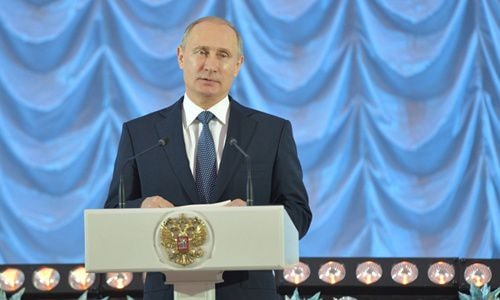 |
| Russian President Vladimir Putin. Photo: Itar Tass |
According to the results of a poll published on March 13 by the All-Russian Center for Public Opinion Research, 88% of respondents approved of President Vladimir Putin's actions and policies. This is considered a record high during Putin's presidency.
Furthermore, 65% of those surveyed also expressed confidence in the leader. One-sixth of them believed that the Kremlin leader's main achievement was stabilizing the country. Others praised his efforts in building and strengthening Russia's position on the international stage.
"No national leader has maintained an approval rating above 60% for more than 15 consecutive years like this. And these figures are absolutely not manipulated," commented Alexei Levinson, a researcher from the independent Levada polling center.
The question of why Putin's approval ratings are consistently high has always puzzled Western politicians and academics. On March 30, Russian experts attempted to explain the reasons behind the Russian people's admiration for the president at a seminar held in Moscow. They concluded that, despite recent instability, Russians support their leader because they feel Putin is capable and is striving to protect the population from both domestic and foreign threats, while simultaneously instilling a sense of national pride and self-respect, according to the Moscow Times.
Symbol of unity
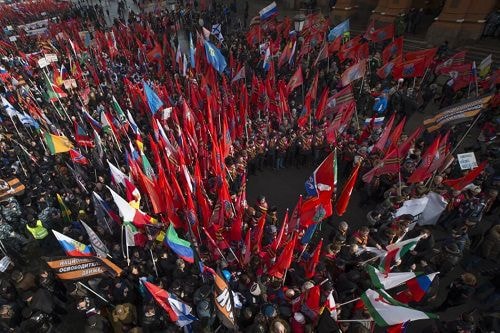 |
| People participate in a march in support of President Putin in Moscow in late February. Photo: China News |
Some analysts in the Levada consider Putin to be the "symbol of unity" for the Russian people. Their faith in him is not tied to the upheavals in life such as inflation rates, economic recession, or the continuous decline in the value of the ruble.
During his 15 years in political power in Russia, Putin has catered to a wide range of priorities for the majority of the population. In the 2000s, Russian society experienced a great leap forward in consumption. The improved living standards eased people's anxieties about the struggle to maintain daily life.
In 2011, Russians began to pay more attention to long-term development, desiring improved healthcare and education. However, these demands were not met, leading to some disappointment. By the end of 2013, many social indicators were deteriorating. People felt a loss of faith in the future and believed the country was entering a period of stagnation, according to a survey by the Levada Center.
This bleak outlook ended in early 2014. The Sochi Winter Olympics, held simultaneously with the annexation of Crimea by Russia, boosted national unity and strengthened support for the president.
According to Levinson, the Russian people see President Putin not only as a leader but also as someone responsible for the spiritual aspects of their lives. Putin is the embodiment of the state and national identity.
On the other hand, criticism from the Western press or sanctions imposed on Moscow ultimately only served to strengthen the bond between Russians and the president, Levinson emphasized. "Russian society is beginning to unite to confront the outside world. Feeling isolated by hostile forces only intensifies the Russian people's yearning for national unity," he observed.
Lev Gudkov, director of the Levada Center, also believes that the annexation of Crimea and the consequences of the crisis in eastern Ukraine have changed people's thinking and attitudes towards the government. During and after Crimea's return to Russia, "the president's behavior has always been in line with what the majority of the population expects," Gudkov commented.
Alexey Mukhin, director of the Russian Center for Political Information, also believes that Western sanctions and external pressure have led to increased public support for the president because people feel the need for their leader's protection.
Furthermore, over the past 15 years, Putin has repeatedly steered Russia out of crises. This fact has led Russians to believe that he can resolve all of the country's difficulties.
Putin "has experienced the Chechen war, overcome the economic crisis of 2008-2009, where everything seemed on the verge of collapse. This has led people to hope that 'perhaps the president holds some kind of secret solution'," said Alexei Makarkin, deputy director of the Center for Political Technology Research, based in Moscow.
However, according to Dmitriyev, a member of the Citizens' Initiatives Committee, President Putin's approval rating always reflects how the Russian people think about the economy. These two variables are currently not aligned. "If the Ukraine crisis is over or the conflicts freeze, it is very likely that the president's approval rating will drop sharply, bringing it back to accurately reflect the people's attitude towards the state of the economy," Dmitriyev said.
According to VnExpress.


