
Responding to the rice leaf roller infestation.
(Baonghean) - Currently, the province has planted nearly 57,000 hectares of summer-autumn rice and over 90,000 hectares of autumn rice. Early-planted summer-autumn rice is in the tillering stage, while autumn rice is in the vigorous branching stage. The biggest concern now is the small leaf-rolling caterpillar, which has been and is currently spreading rapidly across all rice crops, both summer-autumn and autumn, and has the potential to become a large-scale pest outbreak if not controlled promptly and effectively.
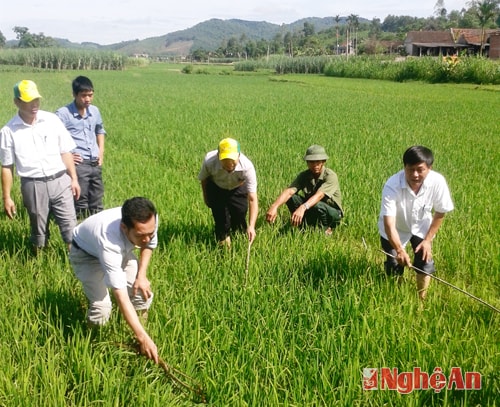 |
| Officials from the Plant Protection Station of Nghia Dan district inspect rice crops for pests. Photo: Nhu Trang |
Leaf roller infestationspreading on a large scale
Visiting Hung Dao commune, Hung Nguyen district, one can clearly see the extent of the damage caused by the rice leaf roller. In the rice fields of Hamlet 4, the green color of the rice has disappeared, replaced by a silvery white due to the devastating damage caused by the leaf roller. Meeting Ms. Nguyen Thi Hai standing in a heavily damaged rice field, she recounted: "This season, my family planted 12 acres of summer-autumn rice, and 7 acres have been severely damaged like this, while the remaining 5 acres are less affected. For the past few days, my whole family has been taking turns spraying pesticides to save the rice. I heard that the next generation of leaf rollers will be even more numerous, which would be very dangerous."
Mr. Le Viet Hung, Deputy Head of the Hung Nguyen Plant Protection Station, said: "The station accurately predicted the emergence of the third generation of rice leaf rollers and the fourth generation of larvae that will hatch between July 14th and 20th. The District People's Committee has also issued a document urging communes to implement measures to control rice leaf rollers throughout the district, but farmers in the communes still have the habit of only buying pesticides to spray when they see the rice leaf rollers in their nests, or even when the rice leaves have turned white and torn. This is the reason why people waste money on pesticides and effort spraying without killing the pests, resulting in crop failure. Because at the rice heading stage, if we do not proactively control rice leaf rollers in time, the rice yield will certainly decrease seriously, or even result in no harvest because the leaves (functional leaves) are destroyed by the pests."
In Nghia Loc commune, Nghia Dan district, over 4 sao (approximately 0.4 hectares) of rice fields belonging to Mr. Bui Trong Luu's family in Hai Loc hamlet, as well as the rice fields of many other farmers in the hamlet, have been infested with rice leaf rollers at a high density. If timely spraying with pesticides is not carried out, it will significantly affect yield. Mr. Luu said: "The summer-autumn crop season usually sees pest outbreaks, but this year, the density of rice leaf rollers is so high that we farmers are very worried. We are following the district's recommendations and proactively spraying pesticides to minimize damage caused by rice leaf rollers." Nghia Loc commune has 100 hectares of early-season rice, and currently, rice leaf rollers have appeared in the fields at densities ranging from 40-70 larvae/m2, with some areas reaching 100-150 larvae/m2, and localized areas reaching 150-200 larvae/m2. After receiving the district's directive on controlling rice leaf rollers, the commune's People's Committee quickly instructed farmers to spray pesticides.
According to the survey results of the Nghia Dan District Plant Protection Station, the early and main rice crops are currently in the rooting to tillering stage, and the third generation of rice leaf rollers is emerging and causing damage at high densities. The entire district has 700 hectares infested with pests, with a common density of 20-50 larvae/m2; in some areas, it reaches 100-150 larvae/m2; and exceptionally, 200-250 larvae/m2. The third generation of rice leaf rollers emerged in large numbers from July 8-12; the first and second instars of the fourth generation will emerge in large numbers from July 15-20. The fourth generation larvae have the potential to develop in high densities, over a wide area, and cause damage to rice crops during the tillering to late tillering stages, significantly affecting the growth and development of the rice plants. This is especially concerning because the fourth generation may overlap, thus prolonging the damage period. In response to this situation, the People's Committee of Nghia Dan district urgently directed relevant agencies and 25 communes and towns to promptly guide people in spraying pesticides for pest control.
Mr. Nguyen Viet Trung, Head of the Plant Protection Station in Nghia Dan District, advised: “Currently, we have proactively disseminated information and organized pest control measures when the density of leaf-rolling caterpillars is high; we have assigned agricultural and plant protection officers from the communes to cooperate with district plant protection officers to investigate the situation and disseminate control measures to farmers. The People's Committees of the communes have sent official letters to pesticide dealers in the area to ensure that dealers sell the correct pesticides according to the instructions for effective pest control. Note: If pesticide dealers in the area sell pesticides incorrectly, the Chairman of the People's Committee of the commune will handle the matter according to Decision No. 37/2013/QD-UBND dated July 17, 2013, of the People's Committee of Nghe An Province on the promulgation of regulations on the management of pesticides in Nghe An Province.”
To date, the province has planted nearly 57,000 hectares of summer-autumn rice and over 90,000 hectares of autumn rice. The majority of the summer-autumn rice crop is concentrated in the coastal plain districts, while the autumn rice crop is mainly planted in the highland districts. Currently, the early-planted summer-autumn rice crop is in the tillering and heading stage. Most of this area is concentrated in the districts of Dien Chau, Yen Thanh, Quynh Luu, Hung Nguyen, Nam Dan, Do Luong, Thanh Chuong, etc. The autumn rice crop is currently in the vigorous tillering stage.
Warning about rice leaf roller pests.
In the 2010 summer-autumn crop season, the entire province suffered crop failure due to rice leaf roller infestation, and the Provincial People's Committee spent 1.9 billion VND to purchase pesticides to help farmers control the pest. That season, the province planted 57,380 hectares of rice, and most of this area was continuously damaged by rice leaf rollers, with multiple generations overlapping throughout the season, causing the greatest losses in history since the introduction of the summer-autumn rice crop. The average yield for the 2010 summer-autumn crop was only 19.24 quintals/hectare, a decrease of 27.5 quintals/hectare compared to the 2009 summer-autumn crop and 25.8 quintals/hectare below the planned target. The total rice production for the 2010 summer-autumn crop decreased by 15,697 tons compared to the 2009 summer-autumn crop and by 13,565 tons below the planned target.
With the current high temperatures, rice leaf rollers are developing more rapidly and aggressively. Several districts have experienced significant damage to their summer-autumn rice crops, including: Quynh Luu (2,300/7,600 ha), Hung Nguyen (1,200 ha/5,300 ha), Dien Chau (1,300/9,000 ha), and Yen Thanh (2,200/12,700 ha). Quynh Van Agricultural Cooperative in Quynh Luu district is one of the cooperatives with a considerable area of rice damaged by rice leaf rollers. According to Mr. Ho Huu Giao, Chairman of Nam Son Agricultural Cooperative, the cooperative planted 260 hectares of rice this summer-autumn season. The third generation of rice leaf rollers has already damaged nearly 100 hectares. According to the district's Plant Protection Station's forecast and field inspections, the fourth generation of rice leaf roller larvae is about to hatch, and this generation could be considered a "pandemic" as many larvae are seen on rice leaves in every field. For the past few days, the Management Board of Nam Son Agricultural Cooperative has been assigning members to go to each hamlet to encourage farmers to prepare all necessary pesticides and sprayers, so that everyone can simultaneously go to the fields to spray insecticide on July 15th, 16th, and 17th.
According to forecasts from the Nghe An Plant Protection Sub-Department, the third generation of rice stem borer will emerge in large numbers between July 7th and 12th, followed by the emergence of first and second instar larvae of the fourth generation from July 14th to 20th. In particular, the fourth generation larvae are likely to develop and spread rapidly, posing a high risk of becoming an epidemic causing severe to very severe damage to summer-autumn rice crops during the tillering and heading stages, and to late-tillering rice crops.
Solutions for controlling leaf-rolling caterpillars.
To proactively detect and control the fourth generation of rice leaf roller effectively, we request that production facilities and farmers implement the following:
- Regularly inspect and monitor the fields to detect early and accurately the peak appearance time of the third generation of adult caterpillars and the first and second instars of the fourth generation of caterpillars, so that proactive control measures can be taken immediately.
- To effectively control this pest, we should only spray insecticide when the pest density reaches 70-100 insects/m2 or more for rice in the tillering stage (seasonal rice) and 30 insects/m2 or more for summer-autumn rice currently in the heading stage.
Only specific insecticides should be used for spraying, such as: Ammate 150SC, Clever 150SC, Obaone 95 WG, Voliam Targo 063SC, Virtako 40 WG… All spraying should be done according to the recommended dosage when the larvae are in their 1-3 instar stage, as indicated on the packaging and label.
- Absolutely do not buy pesticides from unlicensed, informal stalls in the market. It's very easy to buy counterfeit, substandard, or expired pesticides, resulting in wasted money without eliminating pests and causing environmental pollution. It's best to buy from registered pesticide and agricultural supply stores or directly from district plant protection stations for guidance on the most effective pesticide application methods. Controlling rice leaf roller pests in summer-autumn and main rice crops is extremely necessary and urgent at this time. However, our farmers lack experience in controlling this pest. Most production facilities and farmers only buy pesticides when they see the rice leaves rolled up, the green color disappearing, and the entire clump of leaves becoming withered and dry. By then, it's ineffective.
Spraying against the small leaf-rolling caterpillar is only effective when the caterpillars are in their first and second instars. Therefore, insecticide spraying must be carried out only when notified by the district's Plant Protection Stations, which then inform the people through the commune's public address system.
Doan Tri Tue - Nhu Trang


