
The dream of "getting ashore"
glorious times
 |
Along with Mr. Hoa, Mr. Tran Van Thu, who was in the same transport team, recalled with regret: "Back then, the American enemy dropped bombs terribly. The detachments had to grope their way through the night, and during the day they hid and camouflaged themselves along the riverbanks. Once, in an emergency, we had to transport food supplies to Huong Khe (Ha Tinh) to reinforce the front lines. As the convoy was nearing the assembly point, 7-8 jet fighters swooped down and dropped bombs. The entire stretch of river was torn apart and churned. The boat carrying rice belonging to Mr. Chu Van Nhung's family, with 11 people on board, and the boat belonging to Mr. Do Kim Phuong's family, with 8 people on board... were hit by bombs and exploded." Throughout the war against America, each of those glorious and proud voyages saw the heroic sacrifice of fishermen who completed their missions, such as martyrs Ngo Thi Loan and Ngo Van Hong... After the country was unified, some boats had to remain forever on the Lam River, while the remaining ones gathered together, anchored at the old docks, continued their fishing trade on the river, and created the bustling fishing village we see today.
The ups and downs of life
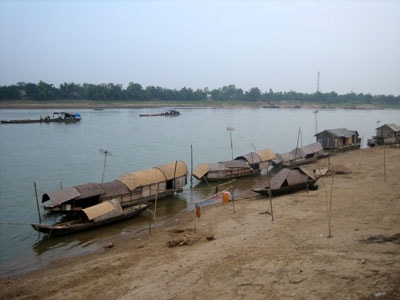
The winding road leading to Luong Giang fishing village meanders through endless mulberry fields. From afar, you can see mostly dilapidated boats bobbing and huddled together, forming a long, faded streak along the river. As evening falls, smoke from cooking fires fills the area. Boarding a boat, a man named Pham Van Loc, around 60 years old, poured a bowl of strong tea with his gnarled hand and recounted: "The children of this fishing village all have safe and sound lives on the boats, living the arduous fishing trade passed down from their ancestors. The Lam River is normally calm, but during the flood season, the water from the upstream rushes like a waterfall. The waves roar high, ready to engulf everything. Logs from smugglers break and crash into the small boats. In some flood seasons, many boats are swept away by their anchors; the most tragic was Minh Ha's boat, where he and his two sons were swept away by the flood before they could escape." But as the floodwaters rose, they anchored their boats, children and the elderly sought refuge in the village, while the husband and wife had to risk their lives to hold onto their boats. For fishermen, the boat is an indispensable means of earning a living; their livelihood, their entire existence, depends on it.
The lives of the fishermen in the village seem increasingly precarious. Without homes, possessions, or even a plot of land to call their own, they eke out a living year-round by fishing or carrying sand and gravel for hire. Mrs. Tho, struggling to speak in a broken voice, said, "Please tell the people of Luong Giang fishing village that we are suffering terribly living on the water. We desperately want to move ashore so that our children and grandchildren can receive an education. If things continue like this, all the fishermen will become illiterate."
Aspiration for a better life
The Luong Giang fishing village has nearly 78 households, but the family with the most assets has 5 million dong, while the least has 500,000 dong. The villagers struggle to make ends meet, let alone afford books, newspapers, or movies. High birth rates, poverty, and disease plague the lives of those in the fishing village, making them even poorer. Therefore, some have become involved in transporting illegal timber from the Vietnam-Laos border. The provincial mobile forest rangers stationed at Khe Choang (Con Cuong) have previously apprehended many individuals from the fishing village transporting smuggled timber.
From ordinary fishermen, they have "changed their ways," becoming tough and employing sophisticated thuggish tactics. Next, they support illegal sand miners who are rampant, digging, excavating, and sucking up sand along the Lam River, causing horrific landslides, altering the river's course, and encroaching dozens of meters of land onto the banks of Trang Son and Dang Son communes each year... Not to mention, day and night they set up makeshift dams at the Ba Ra Dam, a crucial irrigation system supplying water to four districts, use explosives to catch fish, or use electric shock devices to hunt for fish, destroying the environment, and even quarreling with officials protecting the Ba Ra Dam in Do Luong. For the sake of a living, they are capable of doing anything.
What does the future hold for the Luong Giang fishing village? No one dares to answer. The Dang Son commune government has done its best to find a solution, but it seems there are still many difficulties. Mr. Tran Duc Tra, the commune chairman, said: "We really want to relocate the fishermen to a certain area to stabilize their lives, but it's not possible yet. Dang Son is densely populated; consider that the entire commune only has a little over 100 hectares of agricultural land. On average, there's only 200 square meters of arable land per person of working age. Where would the Luong Giang fishing village fit into that?"
The fishermen have also requested that the commune authorities facilitate their construction of houses with concrete pillars on the alluvial plain outside the dike. However, according to the dike regulations, this is not permitted, and furthermore, it is very dangerous during the flood season, with the entire alluvial plain being submerged. Some villagers are being too demanding, so the commune intended to allocate land to them in the barren area near the cemetery, but this was not allowed. This area is infertile, far from residential areas, lacks clean water, and has no arable land, so how can the villagers make a living? We have submitted petitions and requests to the district and provincial authorities, but so far we have not received any response from the relevant agencies. The only way out to save the fishing village now is to move them ashore, provide them with houses and arable land for long-term economic development, but the commune's resources are limited and cannot handle this.
Mr. Nguyen Minh Hanh, Vice Chairman of Do Luong District, said: "Luong Giang fishing village has made great contributions to the revolution; these people deserve respect, and the State needs to create conditions for them to quickly move ashore." Mr. Truong Cong Phuc, Deputy Secretary of the District, also expressed his concerns: "Resettlement land for the fishing village residents is very difficult. Neighboring communes to Dang Son, including the town and Luu Son, have very limited land resources, making it difficult to integrate them. If we can relocate them to a new resettlement area, they will be forced to change professions, because for a long time they have only been accustomed to river life. A new profession without stable income will easily lead them back to river life. Currently, many families in the fishing village live on the Lam River, even living far away in Anh Son, Con Cuong, or downstream on the Cua Tien River..."
As darkness fell over the fishing village, I looked back at the dilapidated, rickety boats submerged in the murky rain and felt a pang of pain. I still saw the eyes yearning for hope of settling ashore in a warm family home filled with laughter. I silently wondered, should these people, who had experienced war and bloodshed, allow an entire generation of young people to remain uneducated, allowing the seeds of social ills to sprout? I urge the relevant authorities to pay attention to the legitimate aspirations and desires of the Luong Giang fishing community today: to live on land.
Report by: Van Truong


