
Drinking plant root tea doesn't necessarily guarantee health benefits.
Some people, due to treating ailments such as liver heat, allergies, etc., or self-detoxifying their liver from excessive alcohol consumption, drink water infused with the roots of this plant, sometimes even replacing their regular water intake.
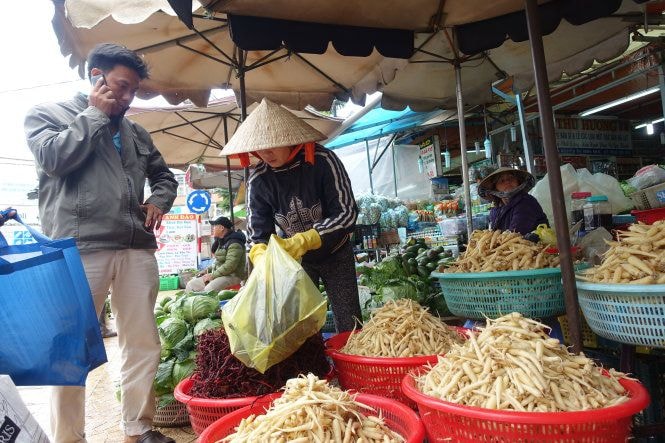 |
| The roots of the plant known as Lang Biang red ginseng are sold alongside other agricultural products from Da Lat - Photo: MAI VINH |
It is unclear whether the roots being consumed are real roots, and whether drinking large quantities has any beneficial or harmful effects.
Upon arriving at the entrances of many tourist attractions or visiting temporary stalls outside the markets in Da Lat, Lam Dong, tourists will encounter various types of forest roots being sold as vegetables and tubers.
Most common are the roots of plants known as Lang Biang red ginseng and Da Lat codonopsis (a perennial plant native to northeastern Asia and the Korean Peninsula, often found growing around streams or in sparse forests under the shade of large trees - according to Wikipedia).
The root products on display have labels clearly indicating the type of plant, but each stall has a different name, depending on the seller.
A group of tourists from Vinh Long stopped at a stall selling a type of dark red root with rhizomes about the size of a little finger. The vendor repeatedly introduced it as Lang Biang red ginseng, claiming it detoxifies the liver, enriches the blood, and is good for the elderly's health. He even insisted that the roots were dug up by ethnic minorities at the highest point of Lang Biang, making them just as beneficial as Korean ginseng.
When the tourists asked how to use it, the vendor gave a vague answer: "If you like, soak it in alcohol, or boil it in water. The more you boil, the better. Drink it instead of water every day."
Hearing advertisements praising the medicinal properties of the root known as "red ginseng" and its price of only 200,000 VND/kg, a tourist named Lam bought 4kg, and everyone in his group bought 1kg each. Lam said, "We're buying it to give to acquaintances; it'll be beneficial in one way or another."
Several other localities, such as Buon Ma Thuot City (Dak Lak) and Gia Nghia town (Dak Nong), also have many people looking to buy tree roots and medicinal plants.
In Buon Ma Thuot City, not only the honey locust tree, but also many other medicinal plants such as Polygonum multiflorum, plants that claim to cure all diseases, and various roots advertised as having effects similar to Ama Kong medicine... are widely and openly sold. No authorities have inspected or issued warnings regarding the safety of these plants and roots sold for medicinal purposes.
Regarding the uncontrolled sale of various types of roots falsely labeled as Lang Biang ginseng and Da Lat ginseng, Dr. Nguyen Van Trinh, deputy director of Pham Ngoc Thach Traditional Medicine Hospital (Lam Dong), stated that Lang Biang red ginseng is a name given by locals based on the color and shape of the roots.
This type of root has never been studied for its medicinal or tonic properties, nor has it been recognized as a medicine with remarkable effects such as cooling the liver or benefiting the kidneys... Regarding Da Lat ginseng, Dr. Trinh stated that there have also been no comprehensive studies evaluating its medicinal properties.
In Lam Dong province, over the past 10 years, two deaths have been recorded following the consumption of forest roots soaked in alcohol. Most of the roots found at the victims' homes were of unknown origin and were consumed along with some forest leaves.
"The use of forest roots requires caution. The opinion of a specialist in medicinal plants is necessary," said Dr. Trinh. He argued that there's no need to discuss plants that haven't been recognized as medicinal plants; even medicinal plants can be dangerous if harvested and used improperly.
Firstly, medicinal plants contain many different active compounds, some of which can cause side effects in people with unsuitable constitutions, leading to poisoning. Therefore, appropriate guidance is necessary, from how to consume them to the method of extracting the active compounds (boiling in water or soaking in alcohol).
Secondly, since the roots of medicinal plants are harvested by people without expertise, it is difficult to guarantee that they are not mixed with other types of roots, including poisonous and extremely poisonous ones.
With the same warning, traditional medicine practitioner Nguyen Van Tuy (Buon Ma Thuot City, Dak Lak) advised: "The medicines sold haphazardly on the market are truly harmful if you buy the wrong kind. When people are sick or in pain, they should go to medical facilities or pharmacies for examination and prescription of medicine."
According to Alobacsi.vn


