
The Quinvaxem vaccine will be temporarily suspended for 2 months.
The Quinvaxem "5-in-1" vaccine in the Expanded Immunization Program will be temporarily suspended for two months pending the results of testing from the World Health Organization.
According to Mr. Nguyen Tran Hien, Director of the National Institute of Hygiene and Epidemiology and Head of the National Expanded Immunization Program, the Ministry of Health will make a further decision regarding the use of this vaccine by the end of June, once the test results are available.
According to Professor Nguyen Tran Hien, the temporary suspension of use is not due to any "issues" with the quality of the Quinvaxem vaccine.
"After carefully considering reports of severe reactions occurring after vaccination with Quinvaxem in the past period, the Ministry of Health has decided to temporarily suspend the use of this vaccine in the Expanded Immunization Program for precautionary reasons to ensure the safety of children, while awaiting sufficient evidence on the vaccine's safety," Mr. Hien emphasized.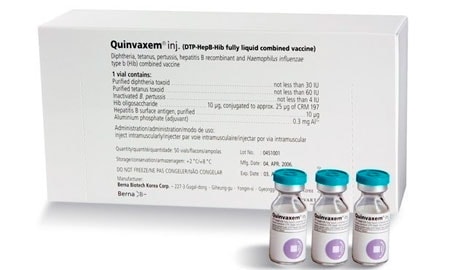
The Quinvaxem vaccine will be temporarily suspended for two months for quality re-evaluation.
The World Health Organization is expected to have a full conclusion on the safety of the Quinvaxem vaccine by the end of June. At that time, the Vietnamese Ministry of Health will decide whether to resume use of this vaccine or replace it with another one.
Options have also been put forward to ensure that vaccination does not become a reactive measure.
Therefore, if by the end of June, the test results show no evidence of a link between severe post-vaccination reactions and vaccine quality, then Quinvaxem vaccine should be used again.
If relevant, replace them with domestically produced vaccines as previously used, namely the 3-in-1 vaccine (Diphtheria-Pertussis-Tetanus) and the Hepatitis B vaccine, which does not contain the Hib component.
At the same time, in the long term, a plan with an appropriate roadmap needs to be developed and submitted to the Government to replace the old vaccines with other newer generation vaccines that have fewer local reactions.
However, Mr. Hien also emphasized: "No vaccine is 100% safe. After switching to another vaccine, there may still be reports of severe post-vaccination reactions due to the child's constitution and random coincidence."
According to Mr. Hien, the decision to stop vaccines must be based on scientific evidence and should not disrupt the expanded immunization program or affect the achievements of what is considered one of Vietnam's most effective health programs over the past 25 years.
Regarding the two-month interval, Mr. Hien stated that this does not affect the immune response of children when they receive subsequent vaccinations, especially for those who have already received one or two doses.
During the temporary suspension of the Quinvaxem vaccine, Mr. Hien advised mothers to continue having their children vaccinated with other vaccines under the Expanded Immunization Program, such as the Hepatitis B vaccine for newborns, Tuberculosis, Polio, Measles, and the fourth dose of DPT, and to monitor the Ministry of Health's subsequent decision regarding vaccine use.
According to Vietnamnet-MD


