The campaigning is done in an... "imposing" manner!
(Baonghean) - The policy of mobilizing social resources in the education sector is considered one of the important solutions to contribute alongside the budget for building and strengthening school facilities. However, during implementation, some schools have made mistakes in the process, causing this meaningful policy to be met with public backlash, with parents feeling "forced" rather than "voluntarily" encouraged.
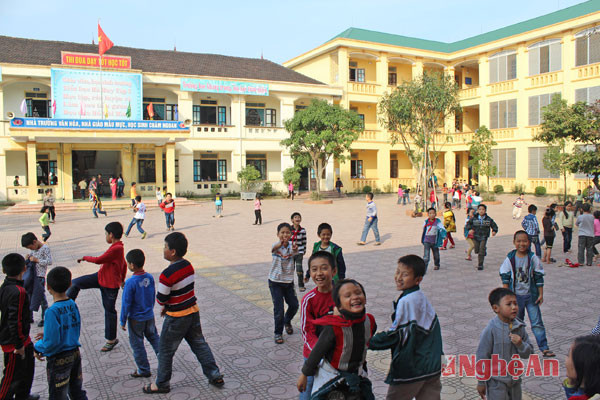 |
| Recess time at Ha Huy Tap 1 Primary School (Vinh City). |
| RELATED NEWS |
|---|
In the last five years, the term "socialization" has become familiar in the education sector, especially since the government implemented the policy of not collecting school construction fees from students. Therefore, schools wanting to build more classrooms, renovate buildings, replace desks and chairs, or purchase additional equipment rely heavily on social mobilization, with a large portion coming from parents' contributions.
From 2010 to 2013, along with funding for school infrastructure improvement, the Board of Directors of Nam Dan 1 High School appealed to businesses and parent associations for contributions to school construction. The total construction cost over the past three years exceeded 12 billion VND, of which approximately 2.5 billion VND was "matching funds" mobilized from parents. The school's management calculated that if each student contributed an average of 400,000 VND per year, it would take 3 to 4 years to collect the full amount; if they collected 300,000 VND per student, it would take 4 to 5 years for the school to pay off the construction debt. During the fundraising process, in the 2011-2012 school year, the school collected over 300 million VND. In the 2012-2013 school year, over 367 million VND was collected, and in the 2013-2014 school year, over 450 million VND was collected.
Therefore, to pay off the debt, within the next 2 to 3 years, Nam Dan 1 High School must continue to mobilize contributions from parents of students in the 15 western communes of the district. This is not including other unforeseen sources that must be raised through social mobilization. The school principal, Mr. Ho Viet Hung, said: “We know that people in rural areas still face many difficulties, but to match the investments from the budget and businesses, there is no other way than to mobilize contributions from parents. However, during this process, we do not collect contributions from poor families, and the amount collected depends on each parent's ability; we only set a necessary amount to balance the debt repayment…”
Through practical observation, most schools from preschool to high school in the province mobilize contributions from parents (except for some schools in remote, disadvantaged, and particularly difficult areas). The contribution levels are higher in the plains and urban areas than in the midland and mountainous regions. This is consistent with the living standards of people in different regions. However, many schools in Vinh City have requested excessively high contributions, which has drawn public disapproval.
Ms. Nguyen Ha Linh, residing in Quan Bau ward, enrolled her child in Ha Huy Tap 1 Primary School to be closer to her workplace, making drop-off and pick-up easier. Over the three years of schooling, Ms. Linh contributed nearly 2 million VND to the school and other fees. She stated: “For the past two years, the school has implemented a system of collecting higher social contributions from students outside the ward compared to those within the ward. Although the school didn't issue an official document, at the parent-teacher meeting at the beginning of the year, the homeroom teacher announced the school's policy and hoped for parental support. At the beginning of this school year, through a teacher, the school announced that students from outside the ward would be charged 850,000 VND per student. That's too high; I only contributed 750,000 VND. We understand the school's difficulties, as I am a teacher myself, but that contribution is high compared to the average income of civil servants and employees…”
Upon investigation, it was learned that for the 2013-2014 school year, Ha Huy Tap 1 Primary School had a policy of collecting social contributions from students within the ward, with a minimum contribution of 600,000 VND, and 850,000 VND for students outside the ward. Hearing this information from the teachers, most parents complained and discussed paying the same amount as last year, 530,000 VND per student, with students from outside the ward paying a higher amount. Besides mobilizing parental contributions for building classrooms and purchasing equipment, the school also changed student uniforms for the 2013-2014 school year. Many parents reacted negatively because this policy was not discussed with them, while the new uniforms purchased the previous year were still in good condition. Explaining the above information, Principal Nguyen Thi Xuan Hien said: "The school didn't impose anything; we only set a contribution level, depending on each parent's ability to contribute. As for changing the uniform, it's because last year's white pants were dirty, so they're being replaced with striped ones..."
The explanation given by the principal of Ha Huy Tap Primary School is also the "method" used by many schools in Vinh City and surrounding wards. Through homeroom teachers and parent-teacher associations, the school sends out a message requesting contributions from parents, according to their ability, but without forgetting to set a minimum amount. Immediately afterwards, the school distributes forms with the contribution amount left blank as "...". Because of their children, many parents reluctantly fill in the "..." with the amount initially requested.
This approach seems consistent with the principles of mobilizing contributions from parents issued by the Ministry of Education: voluntary, purposeful, not indiscriminate, democratic, open, and transparent. However, in reality, there have been instances of imposition based on the reluctance and "necessary favoritism" mentality of parents. In previous years, through inspections, the Department of Education and Training discovered many schools that had written minimum contribution amounts from parents and took action. Learning from this experience, this year schools have resorted to verbal announcements through homeroom teachers and parent associations. Therefore, Mr. Tran Huu Hy - Chief Inspector of the Department of Education and Training - admitted: "At the beginning of this school year, we also received feedback from parents about initial contributions, but after inspecting several schools, we did not find any procedural violations. In terms of documentation, the implementation method was in accordance with the regulations of the sector, and no school issued a document stipulating a minimum contribution amount..."
Voluntary, not indiscriminate, and transparent.
During the discussion, Mr. Le Van Ngo, Director of the Department of Education and Training, stated: “We highly appreciate and value the contributions of parents in building and strengthening the infrastructure of the school system. However, the process of social mobilization must ensure adherence to the principles: Voluntary participation, no indiscriminate contributions, and transparency. Every year, at the beginning of the new school year, the Department thoroughly disseminates and organizes training sessions for educational institutions on the correct implementation of the principles and regulations of social mobilization. At the beginning of the 2013-2014 school year, on August 7, 2013, the Department issued Official Letter 1421/SGD&ĐT-KHTC “On the implementation of revenue and expenditure for the 2013-2014 school year,” which clearly outlines the Government Decrees, the guiding Circulars of the Ministry of Finance, the Official Letters of the Ministry of Education and Training, the Department of Finance, and the announcements of the Provincial People's Committee on the implementation of educational socialization. During the implementation process, the Department increased We will strengthen inspection and supervision, and any facility found to be in violation will be strictly dealt with according to regulations… We also affirm that, despite the difficulties and shortages in the budget for the education sector, the contributions of businesses and parents are valuable resources for schools to improve their facilities and better serve the teaching and learning mission.”
Essentially, the socialization of education is considered a sound policy to mobilize the participation of businesses and parents in building modern schools, purchasing facilities, and improving teaching and learning conditions. This policy is consistent from the central to local levels and will continue for many years to come due to the shortage of funds for school construction and the purchase of teaching equipment in the education sector. The issue is that schools must hold thorough discussions with parents to reach a consensus on the projects and tasks requiring support before soliciting parental contributions. This contribution is the socialized funding as guided by the Department of Education and Training's document, and this source of funding depends on the voluntary contributions and economic conditions of parents; schools are not allowed to set a "minimum" amount for each parent. In addition, schools should also explore the possibility of soliciting parental contributions between semesters to avoid putting financial pressure on families at the beginning of the new school year.
In discussions about the socialization of education, we found that many parents agreed and shared their views, but there were also quite a few dissenting opinions. Among those opinions, we would like to quote one parent's sentiment as a concluding remark: “School principals must clearly define this as a fundraising effort, not a request or imposition. Avoid the situation where some schools assign quotas for socialized donations to homeroom teachers based on the number of students and set a minimum amount. This puts pressure on both teachers and causes discomfort for parents when contributing. This affects the image of teachers and creates negative effects on the ‘socialization’ policy of the education sector as well as other fields…”
Text and photos:Nguyen Nguyen