
The song of Dien Bien Phu will forever resound.
In the history of our nation's founding and defense, the historic victory of Dien Bien Phu is one of the most glorious peaks, adding another heroic and glorious chapter to our nation's history, like the victories of Bach Dang, Chi Lang, and Dong Da in the Ho Chi Minh era. Although 59 years have passed, the echoes of the Dien Bien Phu victory still inspire the entire Party and people to continue on a new path; the path of building a beautiful and prosperous country.
(Baonghean)In the history of our nation's founding and defense, the historic victory of Dien Bien Phu is one of the most glorious peaks, adding another heroic and glorious chapter to our nation's history, like the victories of Bach Dang, Chi Lang, and Dong Da in the Ho Chi Minh era. Although 59 years have passed, the echoes of the Dien Bien Phu victory still inspire the entire Party and people to continue on a new path; the path of building a beautiful and prosperous country.
After the August Revolution of 1945, the French colonialists, with the support of imperialist powers, returned to invade our country. Unwilling to surrender, the entire Party, people, and army united in resistance against the invasion with the spirit of "rather sacrifice everything than lose our country, rather die than be enslaved." By 1953, our people and army had gained control of the battlefield, creating a favorable balance of power for us.
To salvage the situation, the French colonialists and American interventionists launched the Nava Plan in a last-ditch effort to regain decisive military initiative on the battlefield. They deployed paratroopers to occupy Dien Bien Phu and built it into the strongest fortified complex in Indochina; considering it "an impregnable fortress," a place designed to draw in and destroy our main forces.
Faced with this situation, on December 6, 1953, the Politburo met to assess the situation and decided to launch the Dien Bien Phu Campaign. To implement this decision, the entire nation concentrated its strength on the Dien Bien Phu front with the slogan "All for the front line, all for victory." Main army units quickly assembled, working day and night clearing forests, cutting through mountains to build roads, hauling artillery, and constructing fortifications, ready to attack the enemy. 261,451 civilian laborers and volunteer youth, undeterred by bombs and bullets, headed to Dien Bien Phu to ensure logistical support for the campaign.
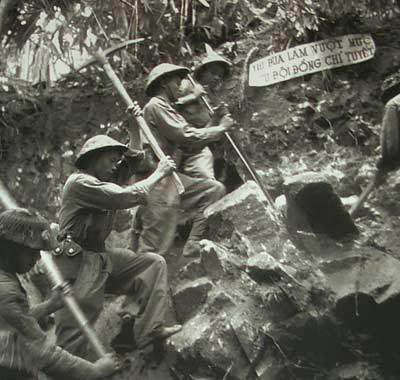
Opening the road to Dien Bien Phu. (Archival photo)
At 5 PM on March 13, 1954, our troops launched an attack on the Dien Bien Phu fortified complex. During the first offensive (March 13-17, 1954), our forces completely destroyed the Him Lam and Doc Lap strongholds, forced the surrender of the Ban Keo stronghold, and broke through the northern gateway of the Dien Bien Phu fortified complex. From March 30 to April 30, 1954, our troops launched the second offensive, simultaneously attacking the eastern strongholds of the central sector, tightening the encirclement, cutting off and continuously attacking, controlling the Muong Thanh airfield, and limiting enemy reinforcements to the fortified complex. This was the most protracted, intense, and difficult offensive, with both sides fighting for every inch of land and every section of trench. After the second offensive, the central area of Dien Bien Phu was within range of our weapons, and the enemy fell into a passive state, suffering a severe loss of morale.
From May 1st to May 7th, 1954, our army launched the third offensive, capturing the eastern strongholds and launching a general offensive to completely destroy the Dien Bien Phu fortified complex. At 5:30 PM on May 7th, 1954, the "Determined to Fight, Determined to Win" flag, bestowed upon our army by President Ho Chi Minh and the Party, flew high over Dien Bien Phu, where the strongest military complex in Indochina, and the center of the entire Nava plan, had been crushed. General De Castries was captured alive, forcing all the defeated French colonial soldiers at Dien Bien Phu to surrender en masse.
During the nine years of resistance against the French, Nghe An province had over 80,000 young people enlist in the army, and 10,630 joined the Youth Volunteer Force. The Cu Chinh Lan Youth Volunteer Force, with its five companies, served in various battlefields and campaigns. The province also mobilized 927,447 civilian laborers, contributing 21 million man-days of work. In 1954 alone, 155,974 civilian laborers served on the front lines, including 20,400 people and 1,486 bicycles serving in Laos, and 30,000 civilian laborers and 3,700 bicycles serving in the Dien Bien Phu campaign. During these years, Nghe An also received 2,045 civilians and 132 children from Thua Thien and Quang Tri provinces who were relocated to the North.
Throughout the nine years of resistance, Nghe An province was honored to have eight of its sons awarded the title of Hero of the People's Armed Forces. These were comrades: Cu Chinh Lan, Nguyen Quoc Tri, Phan Tu, Dang Quang Cam, Tran Can, Pham Minh Duc, Dang Dinh Ho, and Nguyen Thai Nhu. During the Dien Bien Phu Campaign alone, out of 16 national heroes honored, Nghe An had three: Martyrs Tran Can, Dang Dinh Ho, and Phan Tu. Among the 4,825 martyrs from across the country who sacrificed their lives in the Dien Bien Phu Campaign, 680 outstanding sons of Nghe An (the highest number nationwide) rest forever in the land of Northwest Vietnam.
Continuing the tradition of the past, the Dien Bien Phu veterans in Nghe An province still uphold the qualities of Uncle Ho's soldiers, just as General Vo Nguyen Giap, "the elder brother" of the Vietnam People's Army, wrote in a letter dated June 3, 2008, to the Dien Bien Phu veterans in Vinh City: "...I hope you will continue to uphold the qualities of 'Uncle Ho's soldiers,' always showing camaraderie, love, solidarity, and mutual support in life, and actively contributing to the cause of national renewal, construction, and defense...".
Fifty-nine years have passed, but the echoes of the Dien Bien Phu epic remain as valuable as ever. President Ho Chi Minh once wrote: "Dien Bien Phu is like a golden milestone in history..." Our nation is proud to have gone through the Dinh, Ly, Tran, and Le dynasties with countless glorious victories, and we are even more proud to have Dien Bien Phu, to the Great Victory of Spring 1975. From those golden milestones, "The Fatherland soars into the boundless spring."
Tran Hai


