
Gold continues to plummet, reaching 40.75 million VND per tael.
Domestic gold prices have fallen to their lowest level in the past month, while global gold prices have marked their longest losing streak since 2009.

Over the past week (May 13-18), domestic SJC gold prices continued to fluctuate downwards. From 41.40 million VND at the beginning of the week, the price of SJC gold as of this morning (May 18) is currently at 40.75 million VND/ounce, the lowest level in the past month (since April 16).
Thus, in just one week, the price of SJC gold in Vietnam decreased by 650,000 VND/ounce. The difference between domestic and international gold prices increased to its highest level this week, reaching 6.8 million VND/ounce.
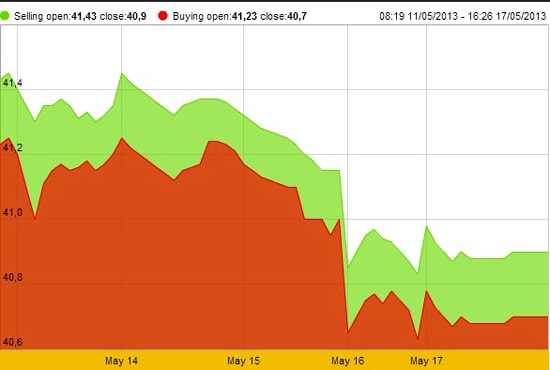
Domestic SJC gold prices fluctuated during the week of May 13-18. (Image: sjc.com.vn)
The State Bank of Vietnam (SBV) held three more gold bullion auctions last week. However, in all three auctions, the trading volume did not meet expectations. In the 17th auction (May 14th), the SBV only sold 14,500 taels of gold out of a total of 26,000 taels offered, with the highest purchase price being 41.32 million VND/tael.
In the 18th gold auction held on May 16th, the State Bank of Vietnam sold 18,500 out of 26,000 taels of gold offered, leaving a surplus of 7,500 taels. The lowest winning bid price was 40.8 million VND/tael, and the highest was 40.85 million VND/tael.
Continuing with the 19th auction (May 17th), the State Bank of Vietnam only managed to sell 8,000 out of 26,000 taels of gold offered. This was the auction with the largest surplus of gold after 19 sessions and also the fifth consecutive session in which the State Bank of Vietnam had a large surplus of gold offered for sale.
Thus, from March 18th to May 17th alone, the State Bank of Vietnam (SBV) held 19 gold bullion auctions, with a total winning bid volume of 477,000 taels out of a total offered volume of 562,000 taels. After 19 auctions, the SBV has supplied 490,200 taels of gold to the market, equivalent to approximately 18.8 tons of gold.
Notably, in the State Bank of Vietnam's initial gold auctions, there were always 22 participating businesses and credit institutions. However, in recent auctions, the number of participating businesses has decreased, especially banks, which have gradually disappeared. Meanwhile, banks were the main buyers in previous auctions, and with the June 30 deadline approaching, many credit institutions have completed their settlements.
As for retailers, they said they would still buy gold when needed. "Customers buying gold are still more numerous than selling, but overall consumption remains very slow compared to before," said a representative of a large business in Hanoi.
In addition, along with the general decline in global market demand, demand for gold jewelry and gold bars in Vietnam also decreased in the first quarter. According to the World Gold Council (WGC), global gold demand fell by 13% in the first quarter, the lowest level in the past nine years. In terms of value, global gold demand decreased by $50.5 billion, a 16% decrease compared to the same period in 2012.
The WCG report also indicated that in the first quarter, Vietnam's total investment in gold bars and coins was 14.2 tons, a decrease of 18% compared to the same period in 2012 (17.4 tons). Meanwhile, demand for gold jewelry was 4.4 tons, down 12% compared to the first quarter of 2012. Overall demand for gold bars and jewelry reached 18.6 tons, down 17% from 22.4 tons in the same period last year.
According to WCG, in terms of value, Vietnam's investment in gold bars and coins in the first quarter of 2013 reached US$745 million, down 21% compared to the same period in 2012. The value of gold jewelry purchases also decreased to US$229 million, down from US$269 million last year. Overall, the value of gold investment in Vietnam in the first quarter reached US$974 million, down 20% compared to last year.
In the 12 months ending at the end of Q1 2013, Vietnam's demand for gold jewelry was 10.8 tons, a decrease of 13% compared to the 12 months ending at the end of Q1 2012. Meanwhile, demand for gold bars and coins reached 62.2 tons, a decrease of 32%.
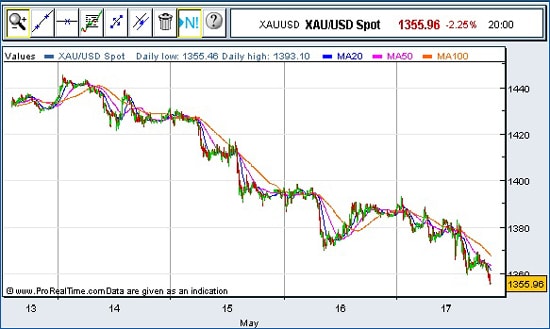
The price fluctuations of world gold during the week of May 13-18. (Image: kitco.com)
Compared to the region, while markets such as India, China, Hong Kong, and Taiwan saw increased demand for investment in gold jewelry, gold bars, and gold coins, demand in Vietnam decreased, reportedly due to lower disposable income and government control over the gold market.
As of 6:00 AM on May 18th (Vietnam time), the price of gold on Kitco stood at $1,360/oz, a decrease of $25 compared to the beginning of yesterday morning. Earlier, the price had even dropped to $1,359.5/oz. Compared to the beginning of the week, the world gold price has decreased by $860/oz, from $1,440/oz to $1,360/oz.
Thus, from the beginning of 2013 to May 16th, the price of gold fell by approximately 17% as investors gradually lost confidence in gold. Trust funds continued to sell off gold and pour money into stocks as stock markets repeatedly set records. This was the seventh consecutive day of decline for gold, marking the longest losing streak since March 2009, when positive US economic news led to a rise in the USD and speculation that the US would end stimulus measures.
Furthermore, the US economy is showing positive signs of recovery, prompting the Federal Reserve (FED) to signal a gradual reduction and possible cessation of its monetary easing program from the beginning of this summer. This move has caused the USD index to rise sharply, its strongest increase in the past three years.
“The gold market continues to face challenges as global equities continue to rally, causing investment flows away from gold, and the US central bank gradually withdraws stimulus. Gold will struggle in a strong USD environment,” said Steve Scacalossi of TD Securities.
According to data submitted to the U.S. Securities and Exchange Commission (SEC), in the first quarter, billionaire George Soros's investment fund reduced its holdings in the SPDR Gold Trust – the world's largest gold exchange-traded fund – to 530,900 shares, a 12% decrease compared to the fourth quarter of 2012. Prior to this, other major investment funds such as Northern Trust and Blackrock also reduced their SPDR holdings by more than half.
According to (vov.vn) - LT


