
Will "white gold" continue to flow?
The natural rubber industry has truly attracted investors in the last 5 years as rubber prices have been favorable. On the stock exchange, many companies outside the rubber industry have also entered this sector and own significant land holdings. While it hasn't reached the point where "everyone is planting rubber," it's clear that rubber planting projects will increase significantly. The question is whether, in 5-10 years, rubber trees can continue to yield "white gold" as they do now?
The natural rubber industry has truly attracted investors in the last 5 years as rubber prices have been favorable. On the stock exchange, many companies outside the rubber industry have also entered this sector and own significant land holdings. While it hasn't reached the point where "everyone is planting rubber," it's clear that rubber planting projects will increase significantly. The question is whether, in 5-10 years, rubber trees can continue to yield "white gold" as they do now?
Rubber trees have a relatively long growth and development cycle (7 years). Therefore, a prerequisite is that growers must know how to care for the trees so that they can produce latex and avoid diseases affecting the plantation.
Not for beginners.
Currently, with the application of new varieties, the risk of disease has decreased, but it requires growers to closely monitor their plantations. When rubber trees show unusual symptoms, timely measures must be taken.
Furthermore, the rubber tree planting phase requires significant capital investment. Currently, the investment per hectare of rubber is approximately 120-140 million VND; 50% of this amount must be spent in the first year. This investment does not include land lease/purchase costs. Therefore, businesses cannot expect to make a profit within the first 5 years. Rubber planting is not a short-term game for businesses with limited capital.
Carefully selecting the geographical location of the plantation also determines the latex yield when it begins to be harvested. A good location for rubber trees should also avoid being near the sea, as adverse weather conditions like storms can "wipe out" the plantation in just 3-5 minutes, as was the case with a listed company 6-7 years ago. Climate and soil factors also need to be considered.
Thus, it can be seen that planting rubber trees requires businesses to have experience in the industry, not just be amateurs. In addition, to increase the efficiency of the project, each rubber plantation should have an area of 3,000 - 5,000 hectares, economically sufficient to house a processing plant but not too large for easy management, avoiding the loss of rubber latex during harvesting.
The crucial issue for long-term rubber prices is whether supply and demand are balanced, given the trend of expanding planted areas in some countries. Currently, predictions about the industry's outlook after 5-7 years have been made, but not all of them are convincing.
Global demand for natural rubber depends on the demand from China, India, the EU, and North America. Therefore, it can be said that the global economic situation is the main factor affecting rubber prices. Regarding supply, weather conditions also influence global rubber production.
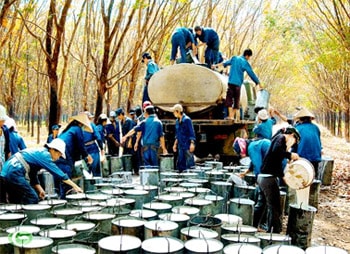
Therefore, succeeding in the rubber industry is not easy, from finding projects, planting, harvesting to selling. Vietnamese businesses have the advantage of cheap labor, so the break-even point for one ton of rubber is relatively low compared to other countries like Malaysia and Thailand. This allows domestic businesses to still generate profits when rubber prices are low (the estimated break-even point for listed companies is $1,200/ton).
However, for new projects, this figure will be higher due to higher land lease costs compared to existing orchards. To achieve sustainable development, Vietnamese businesses need to implement projects systematically right from the initial planning stage.
Furthermore, it is necessary to diversify the customer base and consumption markets, avoiding dependence on a few markets or a specific customer group. Finally, having a long-term vision and avoiding a short-sighted, trend-following mentality are also decisive factors in the success or failure of rubber projects.
Growth expectations?
Currently, the stock market has five listed natural rubber companies: DPR, HRC, PHR, TNC, and TRC. In the first quarter of 2013, due to a decrease in the average selling price of rubber by approximately 10 million VND/ton, all listed companies achieved lower profits compared to the same period in 2012.
It should be noted that rubber prices in the first quarter of 2013 were contrary to previous predictions. In addition, concerns about the bursting of the Chinese economic bubble and the unresolved European debt crisis also weakened demand for natural rubber.
Given the current factors, it is predicted that rubber prices will not break through in 2013, especially since the peak rubber harvesting season falls in the third and fourth quarters of each year (these two quarters account for 65-70% of the total annual production).
Therefore, rubber businesses will have to redouble their efforts if they want to achieve their 2013 business plan. Overall, the operations of natural rubber companies will remain stable, but the potential for long-term growth will depend on many factors.
Expectations for rubber companies remain high, but whether they will continue to rise is another matter that needs further consideration.
According to (Business Times) - PH


