
Regarding Mrs. Le Ngoc Han, the second wife of Emperor Quang Trung.
(Baonghean.vn) - For generations, the people of Thang Long (Hanoi) have, every spring, fondly remembered the peach blossoms of the Spring of the Year of the Rooster (1789). That spring, with his robe still smelling of gunpowder, Nguyen Hue hastily sent a messenger on horseback with a branch of Nhat Tan peach blossoms straight to Phu Xuan (Hue) to give to his beloved wife and announce the joyful news of his victory!
(Baonghean.vn) - For generations, the people of Thang Long (Hanoi) have, every spring, fondly remembered the peach blossoms of the Spring of the Year of the Rooster (1789). That spring, with his robe still smelling of gunpowder, Nguyen Hue hastily sent a messenger on horseback with a branch of Nhat Tan peach blossoms straight to Phu Xuan (Hue) to give to his beloved wife and announce the joyful news of his victory!
The beloved wife who had the honor of receiving a peach blossom branch from Thang Long that year was Princess Le Ngoc Han.
It is not entirely clear how many wives Emperor Quang Trung had. According to old records, only two are mentioned: the Empress Consort and the Northern Empress. The Empress Consort was from the Pham family, from Quy Nhon Prefecture. At the time of Quang Trung's coronation in the year of Ky Dau (1789), she was appointed Empress Consort and gave birth to three sons and two daughters. Nguyen Quang Toan was the eldest son – when his father died, Quang Toan ascended the throne at the young age of 10.
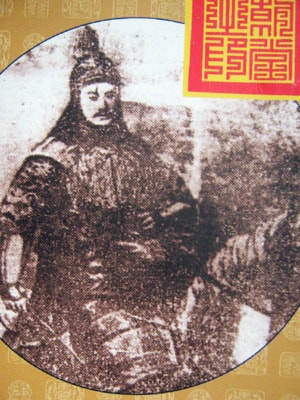
Quang Trung on horseback - Archival painting
The Northern Palace Empress was Ngoc Han. When Nguyen Hue ascended the throne, Princess Le Ngoc Han, then only 18 years old, was bestowed the title of Northern Palace Empress and was greatly cherished by the Emperor. As the daughter of Emperor Le Hien Tong, Princess Ngoc Han was initially shy and unfamiliar with the surroundings. During the ceremony at the ancestral temple, Nguyen Hue and Ngoc Han rode in palanquins together. After the ceremony, they rode back together. It is said that Nguyen Hue, proudly, asked the Princess: "How many of the Emperor's sons and daughters have been as glorious as you?" The Princess calmly replied: "The Emperor has little fortune; all his sons and daughters are simple and poor. Only I am fortunate, like a pearl-like raindrop falling from the sky into such a magnificent palace. That is my good fortune!" Hearing this, Nguyen Hue was very pleased and cherished Ngoc Han even more.
Empress Ngoc Han bore Emperor Quang Trung two children: a son, Nguyen Van Duc, and a daughter, Nguyen Thi Ngoc. Not only beautiful in appearance and character, Ngoc Han also possessed talent in literature, poetry, music, and painting, and had a wealth of insightful knowledge of national affairs. Their love grew stronger and more enduring. But alas, fate rarely favors them! Their happiness lasted only six years. On July 29th, 1792 (the year of the Rat), Emperor Quang Trung suddenly passed away after reigning for four years, at the age of 40. The admiration and heartbreaking grief that followed were expressed by Empress Ngoc Han in the three works that remain to this day: "Congratulatory Message to Quang Trung on the Occasion of His Fortieth Birthday," "Eulogy for Quang Trung," and especially "Lament of Sorrow," a 164-verse poem in the seven-syllable, six-line verse form.
How sad! Dew falls, wind blows through.
A desolate scene, the sound of falling dew drops.
Thinking of the heartfelt will
Tears cannot be uttered, awake but like in a trance.
Sadly, spring has arrived and the flowers are blooming.
Who can untangle this private sorrow?
Taking a gamble to keep one's promise is the best policy.
What fear is there in the schoolyard, what hesitation is there in the middle of the stream?
The little egg is pitiful because of a little bit.
The bond of kinship has not yet been broken.
So sometimes, you should hesitate.
The body may remain, but the spirit has gone...
Besides the poignant and heartbreaking sentiments, "Ai Tu Van" also portrays the image of a hero "in simple clothes and carrying a red banner" whose contributions have been and will forever be remembered by the country and its people, even though his life was short:
I heard there were kings like Tang and Wu before.
More industrial activity leads to a longer life expectancy.
But now, the cloth garment with the peach blossom flag...
Helping the people build the nation is a monumental undertaking.
I heard it clearly before Emperors Yao and Shun.
The greater the merit, the longer the reign.
And now, I am filled with such profound gratitude.
The rain falls, nourishing all nine continents.
That's the amount of work done, and that's the amount received.
Why is the lifespan of a palm tree so short, like the work of creation...?
Although her works are not numerous, with just "Ai Tu Van," the history of medieval Vietnamese literature has given Princess Ngoc Han a well-deserved and irreplaceable place!
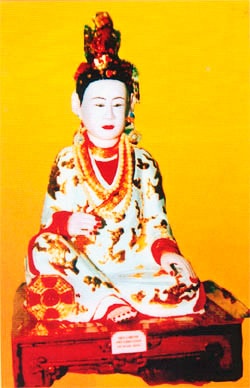
The statue of Queen Le Ngoc Han is enshrined in the Ghenh Temple - Archival photo.
After King Quang Trung's death, Crown Prince Nguyen Quang Toan ascended the throne. From then on, the maternal side wielded absolute power, leading to internal strife and purges within the Tay Son dynasty. The fate of Empress Ngoc Han and her two children was tragic and unfortunate: Ngoc Han and her two children had to change their names and live among the people in Quang Nam. Shortly after, she was discovered and captured, and committed suicide by poisoning herself at the young age of 29. Her two children with Emperor Quang Trung were also killed. This event occurred in the year Ky Mui (1799). Some documents even indicate that after her death, the Tay Son court posthumously bestowed upon her the temple title of Nhu Y Trang Than Trinh Nhat Vu Empress.
There is also an opinion that, after Quang Trung's death (1792), Nguyen Anh returned to occupy Phu Xuan, ascended the throne as emperor, and took the reign name Gia Long (1802). Ngoc Han then married Gia Long! According to some reputable historians, including Hue scholar Nguyen Dac Xuan – author of the book 700 Years of Thuan Hoa – Phu Xuan – Hue (2009), the truth is not like that. At the time Nguyen Anh returned to Phu Xuan in June 1801, Princess Ngoc Han had already died two years earlier. The woman who remarried Emperor Gia Long was Princess Ngoc Binh, born in 1785, the youngest daughter of Emperor Le Hien Tong, and a half-sister of Princess Ngoc Han.
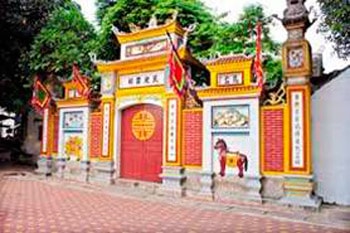
Ghenh Temple (located in Bo De ward, Long Bien district, Hanoi) - Archival photo
The 18th and first half of the 19th centuries were a period of profound crisis, a violent outburst of long-standing contradictions within Vietnamese feudal society. It was also a period of peasant uprisings with many tragic and heroic elements. The life of Le Ngoc Han was undoubtedly influenced by the course of the nation's history... Regarding this figure, some argue that Ngoc Han's marriage to Quang Trung was a political marriage, a desperate situation. Out of filial piety to her father, Ngoc Han was forced to accept the mandate!? In reality, this is probably not the case. Between the declining Le dynasty and the newly risen Tay Son dynasty, Ngoc Han sided firmly with the Tay Son because they included Nguyen Hue, who was both strong and compassionate. Only Nguyen Hue could avenge her humiliation and resolve the tangled emotions she felt at that time. In a congratulatory tribute to Empress Ngoc Han of the Northern Palace, praising her virtues in relation to Emperor Quang Trung in particular and the nation's destiny in general, a passage reads: “At midnight, she attentively helped the Emperor put on extra clothing to attend to matters of state. She laid the first foundation. On one occasion, she encouraged and reminded the soldiers to bring back victory when they went into battle wearing armor! In managing the household and governing the country, she participated in the Emperor's military campaigns. She was humble, gentle, and continued to uphold her pure and natural qualities...”
Indeed, it is not easy to receive such sincere, heartfelt, and lofty praise for a "woman" in our feudal era, even though her life was that of a princess, a wife of the king who was both talented and beautiful, yet also full of hardships and injustices!
Kim Hung


