
Regarding the poem "Spring Letter"...
An Australian veteran presented a notebook containing the poem "Spring Letter" to Lieutenant Colonel Nguyen Thi Tien.
(Baonghean.vn) - One early spring day, we visited the home of Lieutenant Colonel Nguyen Thi Tien - former Deputy Director of the Museum of Military Region 4 (in Block 7, Trung Do Ward, Vinh City) to learn about the diary containing the poem "Spring Letter," a poem that once shocked peace-loving people around the world when Australian veteran Laurens Wildeboer tried to return it to its owner after 40 years of keeping it.
It was an intact notebook, securely bound and covered in a deep red cover. On the cover, in the upper right corner, was an image of a sailboat gliding over waves, and the number 320 pages was written. The notebook was bound with checkered paper. Inside, there were also several pages of a small English-Vietnamese dictionary, a stack of parchment paper (the kind used for writing letters), and a draft poem tucked in between.
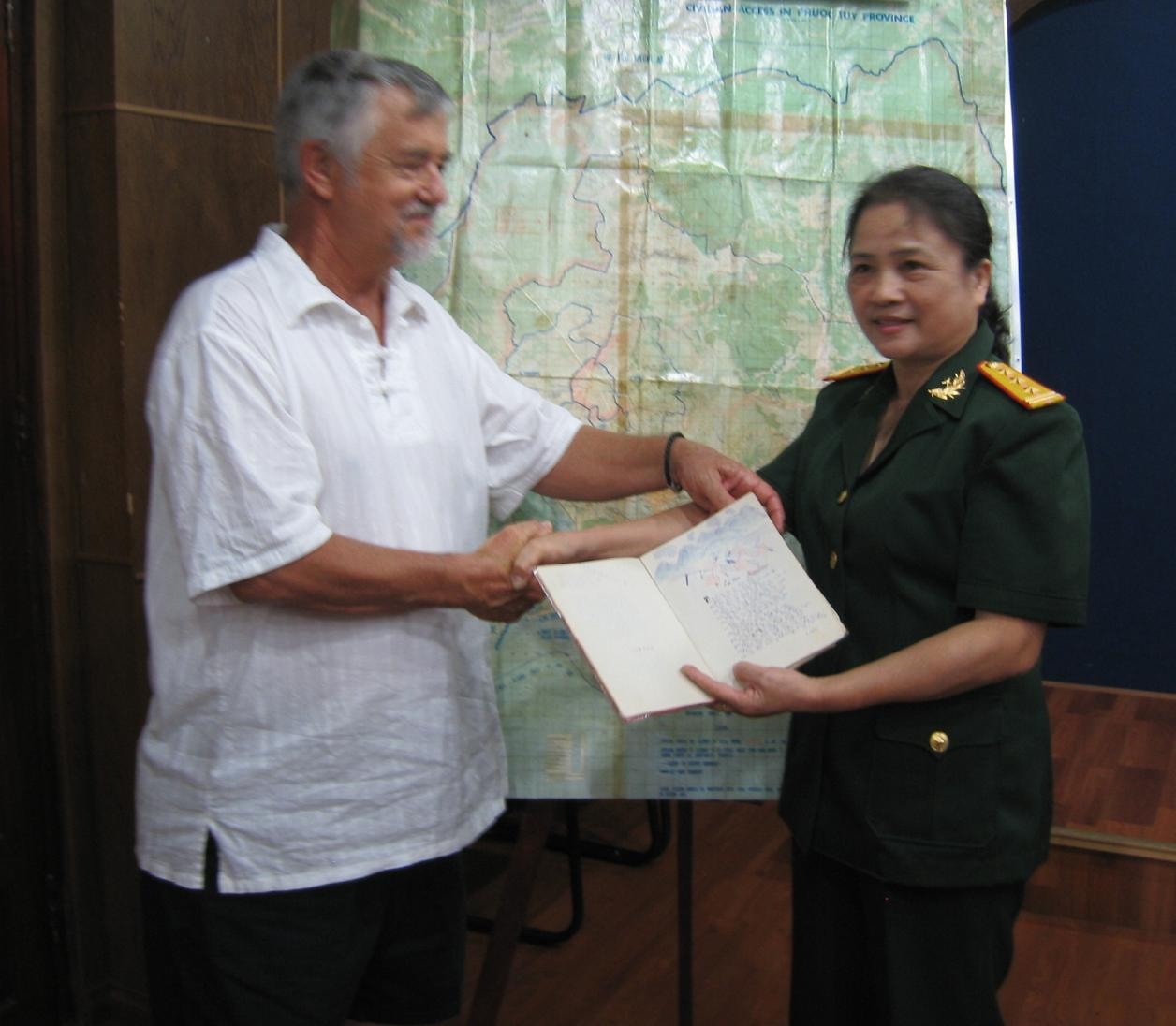
An Australian veteran presented a notebook containing the poem "Spring Letter" to Lieutenant Colonel Nguyen Thi Tien.
The diary begins with the line of poetry:We are not like a ship that waits for the wind to come before its sails are hoisted."The inscription "Thanh Phong" is engraved in square characters. This notebook contains several drawings of cherry blossoms, swallows, and mountains, drawn with Culo colored pencils (a type of pencil with one blue end and one red end). The 17 poems in this notebook are not written in chronological order, but rather were meticulously transcribed by the author as he composed them during his marches. Therefore, some poems listed at the end of the notebook are written before poems that were composed later.
The poem "Spring Letter" was composed in January 1968, while our troops were conducting the Tet Offensive. After a night of marching, at midnight on New Year's Eve, in his longing for home, his homeland, and his loved one, the soldier wrote "Spring Letter" and sent it to "my love back home." The first stanza of the poem expresses his longing for his lover:
"Since that day, I've been far away from you."
Time flies, and springs have come and gone so quickly.
My dear, still living in our hometown.
I bet swallows are soaring happily in the sky out there.
Writing a letter to you in early spring of 1968
Back home, I'm shivering from the cold.
It's very cold here in spring, my dear.
Don't cry anymore, I miss you so much.
I remember the moment we parted, looking at each other in silence.
Tears of sorrow for the farewell.
And how many springs have passed since then?
I miss you so much!
Beyond love, the soldier wrote about his sacred patriotic duty, about the battlefield, about the night before the war in which he hoped to defeat the foreign invaders, who would be "buried in the black mud":
"The longing for my homeland is rising up."
US warship takes hit and bursts into flames.
Even the invaders from heaven are buried in black mud.
And here, I stand between fate and destiny.
As New Year's Eve arrives, the joyful sound of trumpets signals the start of battle.
The night march to celebrate the Lunar New Year of 1968
The peach blossoms are absent, but the apricot blossoms are fragrant.
Camouflage branches and leaves rustled on his body.
Following the marching steps of the army, determined to win."
The poem, written in a free-flowing, slanted script, is adorned with a drawing of a small swallow perched on a branch full of blossoms. To date, the author of the poem remains unknown. According to initial analyses and assessments by Lieutenant Colonel Nguyen Thi Tien, this poem was written by a soldier from North Vietnam fighting in the southern battlefield.
Previously, the poem "Spring Letter" was attributed to martyr Phan Văn Bần, commonly known as Phan Thanh Hùng and alias Phan Thành Nhơn, from Long Thành, Biên Hòa, Đồng Nai. However, after comparing archived records and related details, the author of the poem is not martyr Phan Văn Bần.
The poem was written 45 years ago, during the Tet Offensive of 1968, when the US imperialists escalated their bombing campaign against North Vietnam. The soldier was fighting in the South. As Tet arrived and spring came, when families reunited, the longing for home, for his hometown, and for his loved one burned fiercely in the soldier's heart. This longing was conveyed through every line and every word. This longing further motivated him to defeat the enemy and return home."New Year's Eve arrives with the joyful sound of battle trumpets / A night march celebrating the spring of 1968 / The peach blossoms are absent, but the golden apricot blossoms are fragrant / Camouflage branches and leaves rustle on my body / Following the rhythm of the marching army, we march down the road to victory"...
Thanh Phuc


