
The beauty of Cua Rao
(Baonghean) - Cửa Rào is a term referring to the meeting point of three sacred rivers: Nậm Nơn, Nậm Mộ, and Lam River, located in Xá Lượng commune, Tương Dương district today. Hidden behind that tranquil surface are majestic and sacred relics, standing firm throughout history, such as Vạn Temple - Cửa Rào, the remains of the gate of the former Tương Dương district palace…
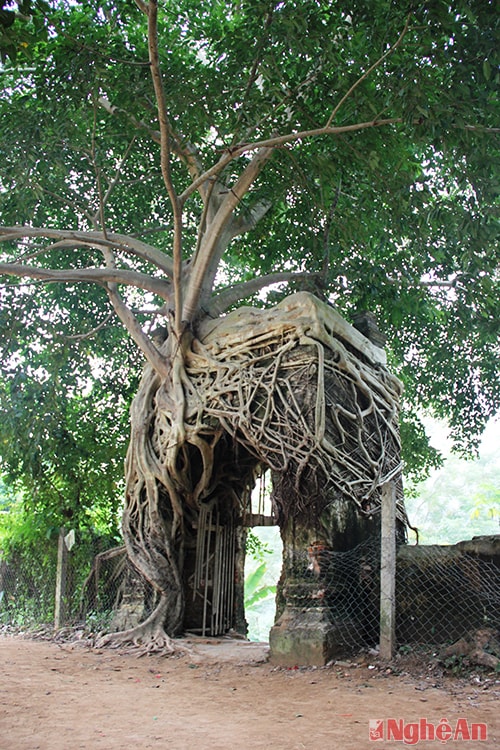 |
| The remains of the gate of the residence of Governor Lang Vi Nang. |
The ferry paused its journey upstream, the boatman skillfully guiding the travelers to the dock. It was almost noon, the golden sunlight shimmering across the river, and the meticulous boatman urged us to quickly ascend the wide steps leading to the temple. The Van-Cua Rao Temple appeared before us, majestic amidst the lush, ancient trees, exuding a profound, sacred aura that inspired reverence in visitors, prompting them to tread softly. Mr. Nguyen Thang, from the Management Board of the Van-Cua Rao Temple Relics, warmly welcomed us and shared many stories about this sacred temple. He said that many research groups and tourists have visited, all acknowledging that the Van-Cua Rao Temple possesses many rare values. Firstly, the temple overlooks a picturesque river confluence, imbued with auspicious energy; secondly, it is situated on the Con Den relic site – where, many years ago, archaeological teams unearthed numerous significant artifacts important to the development of the nation's history.
Ancient texts record that the Van - Cua Rao Temple was built in the early 14th century. Initially, it was a small shrine to commemorate and worship General Doan Nhu Hai and other generals and soldiers of the Tran Dynasty who served under Emperor Tran Nhan Tong in suppressing the Ai Lao rebels. Later, fishermen from the districts of Do Luong, Anh Son, etc., came to the temple to work, trade, and establish their livelihoods. Impressed by the temple's sacredness and majesty, they contributed to its reconstruction, transforming it into the temple we see today and incorporating the Three Holy Mothers into the worship. The sacred temple still retains its original architecture in the shape of the Chinese character "二" (two): the main hall has three bays and two gables, covered with yin-yang tiles; the gables are adorned with reliefs of two dragons facing the moon, holding silk ribbons in their beaks, in a soaring posture; the rear hall is smaller than the main hall and built in the four-pillar style…
Mr. Nguyen Thang suddenly paused his train of thought, pointing to the other side of the river, and shared some interesting information: "This river confluence area holds many rare treasures. On the other side, within the grounds of Xa Luong Secondary School, there are still traces of the gate of the mansion of District Chief Lang Vi Nang - a renowned member of the Lang Vi family who held the position of District Chief of Tuong Duong for three generations." Thus, by chance, this miraculous river confluence provided a new meeting point for our journey upstream. And history unfolded vividly before these indomitable relics of time…
Numerous research documents confirm that Tuong Duong Prefecture was one of the large prefectures in the mountainous region of Nghe An. This area was formerly called Kiem Chau, then Mat Chau during the Tran Dynasty. During the Ming Dynasty, it was called Tra Long Prefecture. During the Le Dynasty, it was renamed Tra Lan to avoid the taboo name of King Le Thai Tong (Le Nguyen Long). During the Nguyen Dynasty, Tra Lan Prefecture comprised four districts: Tuong Duong, Vinh Hoa, Hoi Nguyen, and Ky Son. In the second year of Minh Menh (1821) of the Nguyen Dynasty, Tra Lan Prefecture was renamed Tuong Duong Prefecture. The former Tuong Duong Prefecture now comprises the districts of Con Cuong, Tuong Duong, and Ky Son. The Lang Vi family, belonging to the old Lich Coc commune (now Don Phuc commune, Con Cuong district), had three generations of successive officials holding the position of Prefect of Tuong Duong Prefecture. Mr. Lang Vi Bang was the one who initiated this three-generation period of the family holding the position of Prefect.
In the 6th year of the Khai Dinh reign (1921), Mr. Lang Vi Bang submitted a petition for retirement, which was accepted by the Hue court. His cousin, Lang Vi Tai, inherited the position of district governor. In the 10th year of the Bao Dai reign (1934), the position of district governor was again held by Mr. Lang Vi Bang's son, Lang Vi Nang. During this period, Mr. Lang Vi Nang continued his father's work in governing the mountainous western region of Nghe An and made many contributions to the people. Notably, in 1941, he was awarded a certificate of merit by the King of Laos, Si Sa Vang Vong, for his contributions to the demarcation of the border between the two countries. Mr. Lang Vi Nang held the position of district governor of Tuong Duong until the August Revolution of 1945.
Looking out from the palace gate, the vast, verdant confluence of the three rivers holds the spiritual essence of the land and sky. Further in the distance, the majestic Van Temple - Cua Rao stands tall in the sunlight. The journey upstream reveals countless wonders; I wish to cherish in my heart the sacred wonder of this place where three sacred rivers meet, a place whose beauty not only shines before nature but also contributes to the creation and preservation of countless historical and cultural relics of the nation.
Text and photos:Phuong Chi


