
Who will I rely on in my old age?
(Baognhean) - She went through three marriages and had two children, but in her final years, Mrs. Nguyen Thi To had to endure loneliness. The old saying goes, "A woman's life is like twelve different harbors," but Mrs. To experienced even more than that...
I visited the dilapidated three-room, single-story house of Mrs. Nguyen Thi To, nestled in Hamlet 11, Quynh Hoa Commune (Quynh Luu District), at dusk on a day in early August...
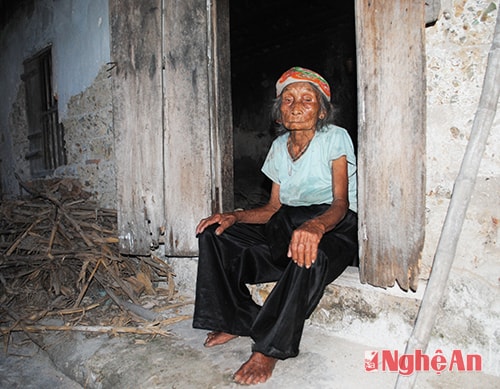 |
| Grandma Tơ stands beside her dilapidated old house. |
Three husbands, three failed marriages!
When I arrived, Mrs. To was busy scooping water from the well with a bucket to wash clothes. The space where she lived exuded a gloomy, somber atmosphere, with two low, dilapidated single-story houses built in the 1960s, their rafters and beams rotting and ready to collapse at any moment. There was nothing of value there except a rickety wooden bed where she rested and a square table where she kept her betel nut. Seeing a stranger, Mrs. To was slightly surprised and asked in her thick Nghe An accent, "Where are you from?" – "Sir, I'm from the neighboring village," I replied loudly, having heard she was deaf. When I suggested writing about her life, Mrs. To quickly hung up the clothes she had just wrung out and, with a touch of sadness in her voice, blurted out: "What is there to tell about my life? I've had three husbands, two children, and now there's no one left. For decades, I've just lived alone like this!"
Stumbling and staggering to sit by the window sill of the dilapidated kitchen, she slowly recounted her life of hardship and misfortune, her eyes clouded with age, her hair gray, and her face thin and wrinkled, reflecting the hardships and misfortunes of an old woman well past ninety. The youngest of five siblings in Quynh Hong commune, she was married off at the age of 16 to a young man from the same village. However, Mrs. To and her husband were childless at that time.Later in life, she lived with her husband until he was over 30, when he unfortunately fell ill and passed away, leaving her without any children. After mourning her husband, Mrs. To returned to live with her parents. Longing for a husband and children, at the age of 37, she married a man named Phan Thanh Nha, from Hamlet 11, Quynh Thach Commune, less than 5 kilometers from her home. Her second husband was then a soldier fighting against the French, having participated in many battles. Although their time together was short, they had two children (a boy and a girl). Living amidst war, hunger, and hardship, Mrs. To still struggled to raise her children. She thought this life would offer some comfort, but within just four years, she had to wear three mourning scarves – the remains of her husband and two children. They too fell seriously ill and passed away one after another. Grief piled upon grief, and Mrs. To was devastated. All she could do was weep for her husband and miss her son. Then she fell ill and was bedridden for months. While others who lost their husbands still had their children to hope for and care for, for Mrs. To at that time, life was nothing but darkness.
Since her husband and two children left her, Mrs. To has only known loneliness. Day after day, she diligently works to ease her longing for her husband and children, but at night, sitting by the flickering oil lamp in the quiet space, facing her own shadow, she weeps.
In 1952, more than six years after the death of her second husband and two children, Mrs. To decided to remarry. Her husband was Nguyen Xuan Phuc, from Hamlet 11, Quynh Hoa Commune. He was also a soldier who fought against the French, his wife had died early, and he had only one son, Nguyen Van Dien. From the day she married her third husband, Mrs. To treated his son as her own, caring for and loving him wholeheartedly. But once again, her marriage ended tragically. Just three years after their marriage, her third husband was discharged from the army and soon after died of malaria. Having to mourn another husband, Mrs. To had no more tears left to cry. Perhaps for her, fate was cruel, and she was not blessed with a complete and loving partner like other women. After her husband's death, Mrs. To lived with her husband's son from his previous marriage and always cared for and worried about his life and happiness. However, in 1969, due to difficult circumstances, her husband's stepson went to a new economic zone in Quynh Thang commune to start a new life, and since then, she has lived alone until now!
Nearly half a centuryin solitude
Living alone, when she was healthy, Mrs. To often went to the forest to chop firewood. Sometimes people would see her catching snails and crabs to sell for money to live on, and other times they would see her working as a hired laborer. For the past five years, her health has deteriorated and she can no longer do heavy work. Every harvest season, she uses a bamboo broom and a sack to sweep up scattered rice grains from the village roads and alleys, then takes them to the canal to wash away the sand and stones, and dries them to store and eat gradually.
At 94 years old, Mrs. To still works in her garden, tending to her corn crop. She often uses a small hoe to weed the garden and cultivate the corn plants. Each month, she receives 270,000 VND in government assistance for elderly people living alone and is exempt from electricity bills. However, living alone, she sometimes encounters awkward situations. Not long ago, while gardening, she became thirsty and dizzy, mistakenly grabbing a bottle of kerosene and gulping it down. Fortunately, neighbors noticed and called someone to take her to the hospital for timely gastric lavage. Out of compassion for Mrs. To's solitude, villagers and distant relatives occasionally give her gifts and snacks. When the 500 KV power line was being extended through Quynh Hoa commune, the power company employees, knowing of Mrs. To's difficult circumstances, visited her home and gave her 500,000 VND. For many years, Mrs. To's only companion at night is her tabby cat. She lives a frugal and meager life. Every day, she only cooks rice once and eats it all day long.
Life continued to drift by quietly and solitarily for Mrs. To. Despite numerous visits from her husband's children from a previous marriage who invited her to live with them, she consistently refused, unwilling to leave this land.
Text and photos:Duy Ngoi