
Return to Dien Trang
(Baonghean) - Thanh Phong (Thanh Chuong) in autumn is filled with golden hues: the golden color of the sun, of the ripening rice fields, of the corn fields about to be harvested...
Returning to this historical land, we sought out Mr. Nguyen Duy Tho (91 years old), one of the oldest residents of the commune, to learn more about the struggles during the Nghe Tinh Soviet Uprising. He led us to the family's ancestral temple, which 85 years ago served as a base for the Nghe An Provincial Party Committee. The temple sits halfway up the hillside; from the steps to the ancient trees and tiled roof, everything exudes an antique beauty.
The Nguyen Duy family ancestral temple is located in Dien Trang village, Thanh Phong commune. In the past, this area was quite remote, so the Nghe An Provincial Party Committee chose it as a base of operations during the Nghe Tinh Soviet period. Here, Comrade Nguyen Tiem – the Provincial Party Secretary – was given the opportunity to work in the main hall by Mr. and Mrs. Nguyen Duy Dinh – the head of the family. At mealtimes, he would eat with Mr. Dinh's family, and in his free time, he would visit families in the village. Through this, he grasped the situation, thoughts, aspirations, and spirit of the people. The lower hall was used for meetings, discussions, and drafting of struggle plans, and also served as a place for the base to report on the situation and seek guidance from the Standing Committee. It can be said that important policies and struggle plans for each period were born in this sacred place. Mr. Nguyen Duy Tho added that his father, Nguyen Duy Tuan, was assigned the task of guarding Comrade Nguyen Tiem while he worked. Every day, the farmer would hoe and clear the fields around the church. Whenever strangers approached or soldiers passed by, he would immediately signal Comrade Nguyen Tiem so that he could plan a response. At that time, Nguyen Duy Tuan was a member of the Red Self-Defense Team, and later continued to follow the revolutionary movement. His family was awarded the "Meritorious Service to the Nation" certificate. The Nguyen Duy family church was recognized by the State as a National Historical Monument.
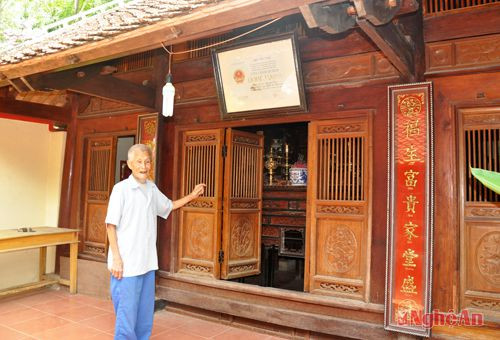 |
| Mr. Nguyen Duy Tho introduces the historical site of the Nguyen Duy family ancestral temple. |
Located next to the Nguyen Duy family church, the Nguyen Ich family church was borrowed by the Provincial Party Standing Committee to print documents. All kinds of official documents, directives, and leaflets calling for struggle were produced here. The head of the printing department at that time was Comrade Hoang Van Tam, the first Secretary of the Nghi Loc District Party Committee, who was later captured and executed by the enemy.
Not far from there is the Nguyen Ba family church. This location was chosen by the Provincial Party Committee as a place to store and preserve Party documents. It was also here, in the final days of 1930, that the Conference to consolidate the organization and implement the Resolution on Purifying the Party took place, chaired by Comrade Nguyen Phong Sac - Secretary of the Central Vietnam Regional Party Committee. The close leadership and guidance of the Provincial Party Committee propelled the revolutionary movement to a higher level, especially in the districts of Thanh Chuong, Nam Dan, and Anh Son. The masses everywhere rose up to fight, affirming their spirit of unity and unparalleled strength under the guidance of the Communist Party of Vietnam. This was a large-scale rehearsal for the earth-shattering revolution 15 years later, becoming an example for colonial countries in their struggle for national independence.
For centuries, the Dien Trang banyan tree has stood tall and majestic, as if to remind generations of the heroic years and the ever-burning flame of revolution. The banyan tree stands atop a hill, over 30 meters high and about 2 meters in diameter, with a gnarled trunk and roots that spread and cling tightly to the earth. At that time, the area around the banyan tree was quite overgrown, and the trunk had many hollows, so Secretary Nguyen Tiem and the members of the Standing Committee often chose it as a hiding place for documents. Whenever there was any activity, whether working, meeting, or resting, the comrades would immediately take important documents to the back, to the base of the banyan tree, to hide them.
Standing by the Dien Trang banyan tree, gazing into the distance, we saw the scenery in Thanh Phong as beautiful as a watercolor painting. The trees cast lush shadows, and in front stood the moss-covered tiled roofs of the ancestral temples of the Nguyen Duy, Nguyen Ich, and Nguyen Ba families. This is the "connecting point" between the past and the present, between the glorious tradition of struggle and the building of the homeland and the nation.
Cong Kien


