
Regarding the soldier with prisoner number 117793
 |
Being a patriotic and educated man, and coinciding with the flourishing Duy Tan movement led by Phan Boi Chau, Phan Khoi, as a young man, quickly embraced revolutionary ideals. In 1924, while serving as the village headman of Huu Biet, Phan Khoi sheltered and hid Ho Ba Cu (Ho Tung Mau) and forged an identity card for Ho Tung Mau under the name Phan Tai (the name of a deceased member of the Phan family). With this identity card bearing the name Phan Tai, Ho Tung Mau traveled extensively to deliver letters entrusted to him by Phan Boi Chau, continuing to encourage the Dong Du movement. After completing his mission, Ho Tung Mau returned to China to continue his activities.
In April 1927, Ho Tung Mau was arrested and imprisoned, and the matter was exposed. At the end of 1927, Phan Khoi was imprisoned for eight months in Vinh Prison by the French colonial authorities and their puppet government. Thanks to the help of his classmates, Phan Khoi was released on that occasion.
In November 1929, the French court in Vinh prepared to execute Ho Tung Mau and several revolutionary cadres in absentia. Because of his involvement in issuing identity cards to Ho Tung Mau, Mr. Phan Khoi once again faced arrest and imprisonment (1). Thanks to kind friends who secretly informed him that the order would be carried out in 3 days, Mr. Phan Khoi had no other choice but to ask his parents to take care of his wife and children and lie to his wife, "At home, farming is always a failure, there's not enough to eat. Now a friend has invested capital and is going to trade far away. You can rest assured at home and don't worry, I will send money back to you and the children." That same night, he sold three meters of garden land to Mr. Trang, a neighbor, to get money for travel expenses. At dawn the next day, he quietly left. Exactly three days later, French secret agents surrounded Huu Biet village with soldiers. Unable to find Phan Khoi, they arrested his wife and took her to Vinh for questioning, but they couldn't obtain any information because she knew nothing either. Therefore, they had to release her. Meanwhile, after leaving Huu Biet village, Phan Khoi followed Route 7 to find his cousin, Phan Hoan (who had been entrusted by the General with managing the previously reclaimed land), and sought refuge in Yen Son (Anh Son). In Anh Son, he met an old friend named Ly Khai, who invited him to his house. Thanks to his vigilance, he only stayed one night. The next day, when he arrived at his cousin's farm in the forest, Ly Khai received a warrant for Phan Khoi's arrest from the French secret agents. Wanting to gain merit, Ly Khai disregarded his friendship and sent men to apprehend him, but failed. During his time in Anh Son, Phan Khoi received secret and attentive care from his cousin. When the manhunt subsided, his cousin took his adopted son Phan Nghi's identity card and gave it to Phan Khoi to escape to the Vietnam-Laos border. On the way, Phan Khoi encountered a dead body and cleverly placed his identity card inside. News of his death quickly spread back to his hometown, and his family set up an altar to mourn him. Due to living in hiding, lacking money, and having irregular eating and sleeping habits, Phan Khoi's health deteriorated rapidly. Having no other option, he pawned his identity card, Phan Nghi's, to a lime kiln owner to find work, food, and money for medical treatment. There, Phan Khoi coincidentally met a close friend named Muc Vien from Ke Gai village, Uc Le commune, Hung Nguyen district, who was a trader. Seeing Phan Khoi's frail condition, Muc Vien informed Phan Bich's family upon returning home and suggested they come to pick him up to care for him. Phan Khoi's younger brother, Phan Chin, followed Muc Vien to find him.
The news that Mr. Phan Khoi had died and then returned alive quickly spread throughout the village. The village headman of Huu Biet immediately reported it to the French secret police. Less than a night after returning home, Phan Khoi was arrested and taken to Vinh. That was April 14, 1930. In August 1930, Mr. Phan Khoi was sentenced by the French court in Vinh to 3 years in prison for the crime of "Betraying the government," and exiled to Kon Tum Prison (2). And in prison, Mr. Phan Khoi bravely sacrificed himself. Later, Mr. Hoang Do, from Nghi Loc, a fellow prisoner of Mr. Phan Khoi, told the Phan Bich family that Mr. Khoi died on June 20, 1931 (which is the 5th day of the 5th lunar month). In 1946-1948, Mr. Ho Tung Mau sent two letters to Mr. Phan Khoi's family to encourage them, in which Mr. Ho Tung Mau called Mrs. Khoi his sister.
On November 27, 1953, Mr. Phan Khoi was posthumously awarded the Certificate of Recognition for Service to the Fatherland by Prime Minister Pham Van Dong, according to Decision No. 218/TTg, which stated: "Soviet martyr who sacrificed for the Fatherland in the revolutionary movement of 1930-1931 at Kon Tum Prison."
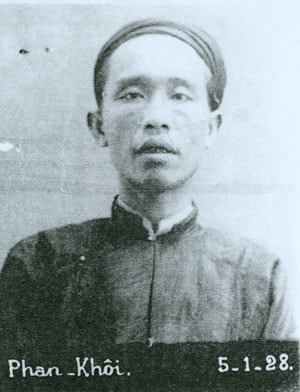
After the reunification of the country, Phan Khoi's descendants tried to piece together information hoping to find his remains to honor them, but a considerable amount of time had passed, and most of Phan Khoi's fellow prisoners had passed away. Just when everyone was on the verge of despair, a miracle occurred. In October 1988, Phan Thanh Lam, one of Phan Khoi's grandsons who was then working in the security sector, accidentally discovered among the files seized from the French colonialists, currently stored at the Ministry of Interior (or Ministry of Public Security), a file containing the name of an individual with the same name as his grandfather, from Huu Biet village. With permission from A27 of the Ministry of Interior, Phan Khoi's descendants copied the entire file, which included two photographs of Phan Khoi taken in 1928 in Vinh and another photograph with prisoner number 117793 taken in Kon Tum Prison. Sixty years later, the son finally gets to see his father's face, the grandson finally gets to see his grandfather's face; the emotion is beyond words!
Thanks to the archives and the Kom Tum Prison Museum, the descendants of martyr Phan Khoi were able to find his remains. Although only a handful of black earth and two prison uniform buttons remained, everything was brought back to his hometown for burial at the Nam Giang Martyrs' Cemetery. The family, local authorities, and all the people solemnly held a ceremony to offer incense and commemorate a son of their homeland and lineage who sacrificed himself for the revolutionary cause.
-------------------
(1) Famous people of Nghe An. Nghe An Publishing House, 1998, p. 396.
(2) Phan Khoi's file, stored at A27 Ministry of Interior (Ministry of Public Security)
Nguyen Sy Lap (Hung Dung Ward - Vinh City)


