
Regarding the custom of "wife abduction" - Part 3: A beautiful tradition that has been distorted.
(Baonghean) - When a girl is not yet in love, or even when a boy only has a crush on her, he kidnaps her to perform a wedding ceremony, creating a "fait accompli" to force the girl and her family to accept. In the highlands, this is called "wife abduction" or "wife snatching." Those who relied on power in the past and some uninformed people today still practice this, drawing condemnation from the community…
| RELATED NEWS |
|---|
A painful past
The author of this article asked an elderly woman in Muong Chai (now Chi Khe commune, Con Cuong district) about the custom of "wife abduction." According to old beliefs, once a girl has sat on the altar during the wedding ceremony at the groom's house, she is considered married. Even if she returns home, she has "lost her value" and no one will marry her anymore. This belief sometimes leads to cases of "wife abduction" within the community. A young man from the village, liking a girl, would abduct her at night or in a deserted place, bring her home for the ceremony, lock her up, and then inform her family. Often, the girl's parents would accept this custom and consider their daughter already married...
Mrs. Vi Thi Chien, an 88-year-old resident of Trung Dinh village (Chi Khe - Con Cuong), sat thoughtfully, as if reminiscing about a distant memory. Then she recounted, "In my life, I've only seen two people 'kidnap' wives." This was during the old government era, when the village headman and shamans held considerable power. One shaman in Tooc village wanted to marry his son to a girl from Chai village. However, the girl refused. The groom's family then conspired to "kidnap" her. They brought betel nuts, wine, and other offerings as part of the "wife-stealing" ritual, and then secretly went to the girl's house. Back then, girls were very afraid of being "kidnapped," so each person hid a knife under their pillow for self-defense. One person in the group, knowing this, pretended to wake the girl before the act, but in reality, it was to steal the knife. Thus, the "kidnapping" went smoothly. The girl was gagged and dragged out of the house; a group of people had prepared a hammock and carried her across the rice fields back to the village.
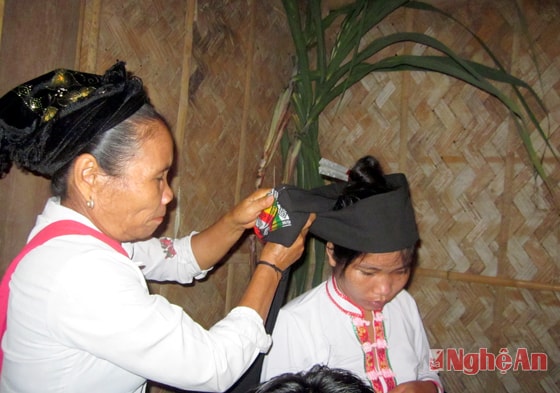 |
| A matchmaker ties a headscarf on the bride during a Thai wedding in Luc Da, Con Cuong. (Illustrative image) |
Upon returning home, the girl was locked in a sturdy wooden room. She resisted fiercely, destroying all the furniture, including two baskets of dishes, but ultimately she could not escape. A relative from the village of Toọc was asked to intervene, saying, "Perhaps fate has destined you two to marry like this; if you break up, what will you use later?" The girl reluctantly agreed.
After the girl agreed, the groom's family held a wedding. However, the couple didn't live together for long. Some time later, the wife fell ill and died. Afterward, the husband took two more wives. Mrs. Chien concluded: "Marriages like that usually don't lead to a happy family. They just use their power and influence to force the marriage..."
The elders in Dinh village (Chi Khe commune) still recount another heartbreaking story about the custom of "wife abduction." During the French colonial period, in the Muong Chai region, there was a village called Huoi Chai. There lived a beautiful and virtuous girl. This girl had been betrothed to a young man from Dinh village. According to Thai custom, once the engagement was complete, she was considered the daughter-in-law of the other family. Yet, the village headman's son still coveted her. While the girl was alone in the fields, the headman's family abducted her to be his wife. Unable to bear this injustice, the girl escaped into the forest and hanged herself.
"Wife abduction" in modern times
Stories about the barbaric custom of "wife abduction" seem like a thing of the past. Yet, it still exists in some communities today. During a field trip, we happened to hear a story from Tung Poong village (Binh Chuan - Con Cuong). Although its outcome wasn't as tragic as the two stories mentioned above, it made those who knew about it unable to accept the continued existence of the "wife abduction" custom in their community.
Today, Kha Thi Khuong (from Tung Poong village) is a mother of a three-year-old boy, but quite a while ago she was just a little girl. Having just finished 9th grade, she couldn't afford further education and had to stay home to help her parents with farm work. As she grew older, Khuong became increasingly beautiful, winning the hearts of many young men in the village.
That day, as Tet (Lunar New Year) approached, the village became bustling with young men and women who had gone away to work returning home for family reunions. The spring atmosphere filled Khuong with joy, like a little bird soaring in her heart. She also wanted to go out and enjoy the spring air. One evening, a group of young men from the village came on their motorbikes to invite her out. When she arrived at one of their houses, she saw a lively crowd inside and thought they were holding a spirit-calling ceremony. When she entered the house, Khuong heard someone call her "daughter-in-law," but she thought it was just a joke and simply smiled.
It wasn't until the groom's family forced her to sit at the ceremonial table that she realized she had been "abducted" to be their wife. She resisted by trying to leave, but the groom's family held her back. They forced her to sit at the table for the ceremony, then locked her in a dark room. She was just a young girl who had finished 9th grade, and fear overwhelmed her, leaving her unable to resist. The groom's family remained vigilant, ready to keep her there. After much thought, Ms. Khuong devised a plan: she pretended to comply with the groom's family, asked to go home to see her parents, and promised to return. Once home, she refused to come back. "How can you live with someone you don't love?" Ms. Khuong explained. Later, the groom's family sent people to beg the "bride" to return, but Ms. Khuong resolutely refused.
And so, that young girl had a rather unhappy Lunar New Year. To avoid gossip, after the holiday, she packed her bags and went south with her friends to find work. She returned almost a year later and married the man she truly loved. Now, the man who had "kidnapped" Ms. Khuong has also gotten married. The unpleasant events have been forgotten. "If only he hadn't acted that way back then, and had come to get to know me properly, who knows…," Ms. Khuong said.
Similar to the case of Ms. Khuong, after only one meeting, Vi Thi Lan (from Hieng village, Bac Son commune, Quy Hop district) caught the eye of a man in Chau Ly commune. One evening, while helping a relative with rice planting, the girl, not yet 16 years old, was stopped by a group of the man's friends who "kidnapped her to take her home as his wife." At that moment, the person accompanying her immediately called her family for rescue. It took considerable effort for the "rescue" group to bring Lan back home. Afterwards, Lan's family intended to file a lawsuit, but the man's son's family apologized and sacrificed a pig as a ritual to get them to forgive her. Lan's story happened three years ago, and she still feels very sad whenever she remembers it.
A Youth Union official in Bac Son commune said that the practice of "wife abduction" among uninformed young men used to occur in many areas of Bac Son commune and some other areas. This situation has decreased but has not necessarily ended...
"Wife abduction" is a cultural practice in the wedding customs of people in the highlands. However, there is a distortion in this custom, still referred to as "wife kidnapping" or "wife abduction," which still exists in some highland communities and needs to be fought against to eliminate it.
Huu Vi


