
About the ancient land of Bon Man
The land of Tuong Duong district was formerly part of Bon Man. This kingdom stretched across the western parts of present-day Nghe An, Thanh Hoa, and part of Son La provinces in Vietnam, and present-day Hua Phan and Xieng Khouang provinces in Laos. During the reign of Emperor Le Nhan Tong, threatened by Lao Qua, a part of Bon Man requested to be incorporated into Dai Viet, seeking protection and being renamed Tran Ninh.
The land of Tuong Duong district was formerly part of Bon Man. This kingdom stretched across the western parts of present-day Nghe An, Thanh Hoa, and part of Son La provinces in Vietnam, and present-day Hua Phan and Xieng Khouang provinces in Laos. During the reign of Emperor Le Nhan Tong, threatened by Lao Qua, a part of Bon Man requested to be incorporated into Dai Viet, seeking protection and being renamed Tran Ninh.
The Dien Chau intersection – the center of the old Phu Dien district, now a modern town with many high-rise buildings and bustling wholesale businesses. This is the ancient land of Chau Hoan and Chau Ai, still bearing the imprint of the thousand-year-old roads built by our ancestors. From this starting point of National Highway 7, I journeyed northward into the western part of Nghe An province.
The smooth road winds through Yen Thanh district, a rice-growing region in the harvest season, to Do Luong, where the sound of drums echoes endlessly. It then flows upstream along the Lam River to Anh Son, commemorating Uy Vien Hau Ly Nhat Quang - Hoan Chau Thanh To. National Highway 7 traverses Con Cuong, a picturesque area famous for the poem "The mountains are not high, the water is not deep / A landscape painting of one color, skillfully painted" by Trang Bung - Phung Khac Khoan; the road meanders along streams, winding through mountain slopes, forests, and villages at the edge of the clouds and wind. - I have been to Cua Rao, where the Nam Non and Nam Mo rivers merge into the Lam River, a river with sugarcane fields and mulberry plantations in all four seasons, its banks eroding and depositing sediment, its waters clear and muddy.
Under the moonlight, the river's surface shimmered with golden light, gently lapping against the banks. It was impossible to tell whether the golden light emanated from the heavens or reflected from the river's depths. Women, mothers and grandmothers, their headscarves and skirts draped over their children as they fetched water from the river, would sing a few melodious songs, their voices echoing praises of their land and homeland, steeped in legend.
Walking through the Tam Dinh forest of straight-lined sandalwood trees, as if arranged by some unseen hand, one sees a vast expanse of green foliage mingled with the silvery white of the trunks and the purple of the flowers (which bloom in summer); on the centuries-old trunks, countless orchids sway gracefully, playfully teasing the wind. As the sun sets, its rays filter through the leaves, painting the landscape in golden hues.
Last May, the Western Nghe An Biosphere Reserve was recognized by UNESCO as a World Biosphere Reserve, along with seven other reserves contributing to environmental protection and sustainable development. Mr. Nguyen Thanh Nhan, Director of Pu Mat National Park, proudly recounted: "Actually, the Western Nghe An Biosphere Reserve was recognized by UNESCO in 2007, but the official announcement was only made now. Over the years, Nghe An province and its departments and agencies have been actively involved in building a sustainable biosphere reserve, making good use of its proven advantages, and only officially recognized it when it was deemed worthy..."
The summit of Pù Hột is welcoming the sunrise. On one side lies majestic, pristine nature with many precious timber species such as: Pơ mu, Sa mu, Lát hoa, Đinh hương, Lim, Gụ, Táu, Sến, Kền vén, Chò chỉ, Dổi, Vàng tâm, Cánh kiến đỏ, Thông resin, Sa nhân, Đẳng sâm... along with many rare animals such as: tigers, bears, wild oxen, elephants, gray langurs; on the other side is Nga Mi commune, a cluster of Ơđu ethnic villages shrouded in early morning mist, with upland and paddy rice blending in with the colors of cultivated forests; asphalt roads stretch like soft silk into the villages, houses are built, stilt houses, health stations, and electricity grids are well-maintained. The villagers no longer cut down forests for slash-and-burn agriculture, Nga Mi has transformed, the harvests are bountiful, the people are not hungry, and the children's cheerful songs echo through the mountains, carried on the air.
Now, the headwaters of the Nam Ngam River are bathed in warm sunshine. The June sun embraces the stilt houses, sharing life with the lush, young rice fields, and the blue smoke rises from the ancient roofs in the evening.
Boats glide across Ban Ve Lake (160m deep, containing 1.8 billion cubic meters of water, with an 8,700 km2 catchment area). The water is a turquoise color due to the reflection of sunlight, trees, and islands on the lake's surface. The water here is as blue as Ba Be Lake; the only difference between Ba Be and Ban Ve Lake is perhaps that one is a natural formation, while the other is the result of human intervention transforming hydropower into electricity... "Mountains are sacred because they have spirits, caves are beautiful because they have fairies." Tham Nam and Tham Keo caves in Ban Ve Lake are dazzling: a system of stalactites in many shapes and colors—red, blue, purple, yellow—are fascinating, and inside the caves are underground streams with clear, cool water where schools of fish swim peacefully. Tuong Duong also boasts many beautiful caves such as Tham Keo (Huu Khuong commune), Tham Cung (Tam Dinh commune), Tham Cong (Tam Quang), Tham Tau (Yen Thang), Tham Ang (Xa Luong)... These palace-like caves are as beautiful as Ha Long Bay and Phong Nha, transporting viewers into a dreamlike state, as if they have become Luu or Nguyen, entering a heavenly paradise.
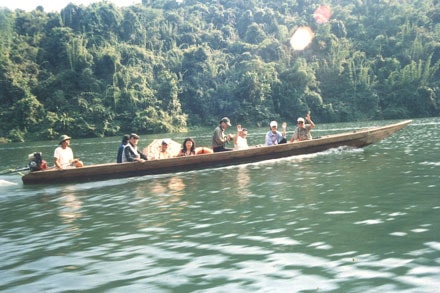
Cruising on the Giang River. Photo: HH
Regarding Hoi Xa, Mai Son commune: For a very long time, we've heard that there were still ancient fortifications there... But where are the traces of Bon Man? However, through countless historical changes, have the fortifications disappeared due to rain and wind, or are they hidden in the mountains? Mr. Vi Tan Hoi, Vice Chairman of the district, said: the district regularly conducts surveys to find relics belonging to Bon Man, thereby contributing to the restoration of cultural and historical values, and developing them for tourism. Tuong Duong has great potential and is currently focusing on building ecological and cultural sites such as: Pu Huong tourism to explore the Odu culture; Ban Ve lake tourism combined with caves; promoting cultural tourism of the Huoi Cut ethnic group in Yen Na, and the Thai ethnic villages in Thach Giam with their traditional crafts of brocade weaving, blacksmithing, and traditional musical instrument production. Next year, the district will implement a project to train 400 workers and guide people to develop tourism themselves...
The people of Tuong Duong are incredibly hospitable, always ready to share water pipes and sticky rice. The Khmu people in Ca Moong village are still very poor, but the girl earnestly invited the guest to stay and have a meal with her family because it was getting late! The fatigue from more than an hour of traveling upstream on the Nam Non River by motorboat and an hour of walking vanished completely before the warm hospitality of the girl who was both a stranger and a friend. Night fell early in Ca Moong; we drank "But Co Doong" rice wine to celebrate the new house, watched the Xoe dance, listened to the call-and-response singing of the Tom folk songs... and it lasted until dawn.
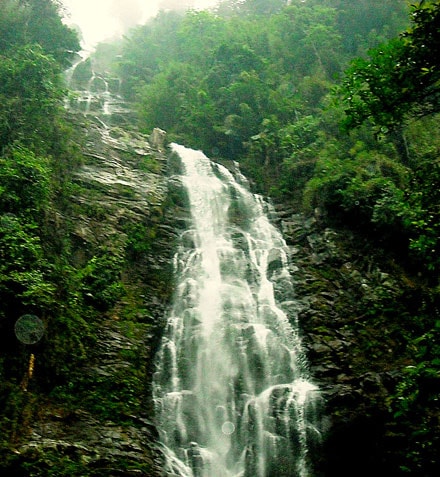
One of the beautiful waterfalls in Xiangyang. Photo: TC
I haven't explored all of Tuong Duong yet, so I still have more to do, to enjoy the local food and products, such as catfish, carp, black chicken, black pig; various vegetables, mangoes, sweet tomatoes, bitter bamboo shoots, taro, green squash, "pa poc" (a type of local sausage), "lau sa tho" (a type of raw lemongrass) with the distinctive flavors of the mountains and forests; and to learn more about the unique cultural characteristics that create the diverse cultural landscape of Tuong Duong.
Many tangible cultural heritage sites remain almost intact: houses, tools for labor and production, household items, means of transportation, folk literature, the Thai-Lai Pao script, performing arts, customs, beliefs, festivals, culinary culture, traditional crafts; discovering unique ancient customs in villages such as Chan, Mac, Cay Me, Nhan, Phong (Thach Giam commune), Xoong Con, Luu Phong (Luu Kien commune), Huoi To (Mai Son commune)...
In Xiangyang at night, the air is filled with the rustling footsteps of young men and women exchanging romantic glances; the sounds of poking the floor, the gentle strumming of mouth harps, the tapping of bamboo pipes on the floor, and the lively sounds of gongs and drums; and the chirping of insects and animals searching for mates in the night. More firewood was added, the fire blazed brightly, people, the sky, the earth, and the mountains and forests seemed to gather in harmony, and the "po" (village elders) recounted stories passed down through generations: "...In the old days, Bon Man and Tuong Duong included Ky Son district..." "...A le, A le! nham bau hom pang/ Nha la ham hing/ A le, A le! Xam xip xa pen tum la no vet/ Pet xip xa tum la no van/ A le, A le..." (Come closer, come closer/ Let me offer you/ A betel quid for you to chew to freshen your mouth/ Come closer, come closer!/ To hear clearly my story/ When we were young and hadn't met/ Now we are old and gray-haired, we meet again/ Come closer, come closer!).
Tomorrow, at sunrise, we'll head west again towards Nam Can, returning to Hoa Binh to enjoy the buffalo fighting festival, the Da Zong festival, the Sau Su festival, and the Thi Su festival of the Mong people in the spring. We'll participate in throwing the ball, shooting the crossbow, and eating new rice with the young men and women of the Thai ethnic group. We'll go to Phong village to dance the bamboo pole dance together, and attend the Van Temple - Cua Rao festival, remembering our heroic ancestors who fought against foreign invaders. We'll offer prayers for favorable weather, a bountiful harvest, good health, prosperity, and peace for the nation.
Thanh Chung


