
VFF and VPF in their relationship: Who has the upper hand?!
Yesterday, VFF Vice President Pham Ngoc Vien announced that the basic contents and regulations for the establishment of VPF (Vietnam Professional Football Joint Stock Company) have been signed by VFF President Nguyen Trong Hy and submitted to the Ministry of Culture, Sports and Tourism for approval.
According to Mr. Vien, the proposed structure of the VPF Board of Directors will have 9 members, with the VFF contributing 3 representatives, 4 other seats allocated to representatives of the Premier League clubs (the new name for the V-League), one seat representing the First Division clubs, and the remaining position belonging to a representative from society (not involved in football). After its establishment, the Board of Directors will hire a CEO, and the CEO will then make personnel appointments within the company with the approval of the Board of Directors.
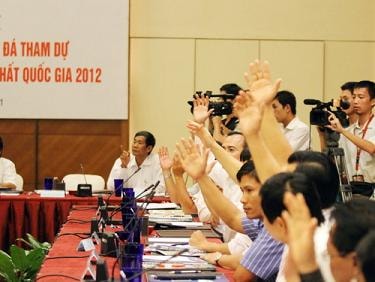
The establishment of VPF was a genuine need from V-League and First Division clubs. Photo: VSI
Regarding the legal relationship between VFF and VPF, a matter of great public interest in recent days, VFF President Nguyen Trong Hy explained: “According to the VFF charter approved by the Ministry of Interior, VFF members include: provincial and city football federations (local), professional football clubs, First Division, Second Division, Third Division, women's football clubs, futsal clubs… and the tournament organizing committee. VPF was established to perform the duties of the tournament organizing committee, so VPF will be a member of VFF.”
Regarding this matter, VFF Vice President Pham Ngoc Vien stated: “According to the regulations, VPF will be a non-affiliated member of VFF. VPF's nature is similar to a company, subject to state management by the Ministry of Culture, Sports and Tourism, and professional management by VFF. VFF is responsible for managing all professional matters of VPF, but this responsibility is not decisive as the clubs also participate. VPF's business activities comply with the Enterprise Law.”
According to Mr. Vien, clearly defining the legal role of VPF in relation to VFF is essential and has been clearly stated in the charter, because "like local football federations, although not subordinate to VFF, when participating, they must comply with VFF's charter." However, all statements by Mr. Hy and Mr. Vien have failed to clarify how VFF will exercise its management rights over VPF, whether it will rely on the 35.6% shareholding (with veto power) that VFF held when VPF was established, or on the Professional Football Regulations, the Enterprise Law, or any other mechanism.
This is a difficult problem to solve, because the highest function of VPF is to organize the league on behalf of VFF, but when VFF leaders argue that VPF must be under the professional management of this social organization, then in some ways VPF is no different from a subordinate of VFF, even though, according to VFF Vice President Pham Ngoc Vien, this management "is not decisive because the clubs are also involved."
How would this be resolved if proponents of the "innovative" business model, like Mr. Kien and Mr. Duc, insisted on making VPF operate under the Enterprise Law as a true joint-stock company, while the VFF preferred to restrict VPF to (not absolute) VFF management in terms of professional matters? In response to this question, VFF Vice President Pham Ngoc Vien only gave a very general answer: "This is an open mechanism. VPF is an independent business, and its Board of Directors already includes members from the VFF."
This response suggests that the VFF (Vietnam Football Federation) has yet to clearly define the legal relationship between itself and the VPF (Vietnam Professional Football Joint Stock Company), even though the official establishment of the VPF is likely not far off.
According to TT&VH


