The sour taste of Tam Hoa plums from Muong Long
(Baonghean) - For nearly 20 years, the Tam Hoa plum tree, originally from Bac Ha (Lao Cai), has settled in the mountainous region of Nghe An and become a local specialty. In Muong Long commune (Ky Son district), this sweet and crunchy fruit now has a sour taste when it ripens, but there are no buyers for the plums…
MEvery time I visit Muong Long, a strange feeling wells up inside me. I feel like I'm lost in different, unique landscapes, even though it's the same region. I visited this valley, often described as "like Da Lat," at the end of winter, just weeks before the Lunar New Year. From the "Heaven's Gate," I gazed out over the entire Trung Tam village. In the winter weather, there was one rare sunny day. Plum blossoms bloomed profusely in the deep valley. The whole village seemed to be covered in blankets of white blossoms, drying in the early morning sun. I remember that day, Xong Y Sua, a young girl from Muong Long 1 village, told me: "The three-flowered plums are in bloom!" She hadn't finished secondary school yet, having dropped out to work in the fields. Despite her hard work, her cheeks were still rosy and her skin still fair. "It's been 18 seasons since the blossoms started blooming. I know this because my father told me I was born in the first year the villagers planted plum trees," Y Sua confided.
I remember that time, Mr. Xong Chong Lau, Y Sua's father, told the story of the three-flowered plum tree like a fairy tale. In the old days, the Hmong people who settled in Muong Long were very hardworking. The fields expanded constantly, and the number of buffaloes and cows increased day by day. However, the people remained poor because the population also grew. At that time, the road to Muong Long was still very difficult; there wasn't a paved road like there is now. Officials had to walk to the village, and the young men and women had to walk to Muong Xen to study. To sell the peaches at the market and bring back salt and lamp oil for lighting, they had to transport them by horse. Even the rice and potatoes from the fields had to be transported by horse.
Then one day, the district officials told the commune officials, and the commune officials called the village officials to attend a training course. The village officials returned and told the villagers: "We must plant three-flowered plums to sell and escape poverty." Who knew what three-flowered plums were? Since the village official, who was also the head of the clan, had said so, they listened and did it. The Hmong people, being united, were even happier to hear that they would escape poverty. So, the villagers went to learn how to plant plum trees, and the district and commune agricultural officials delivered the seedlings directly to their fields.
The Tam Hoa plum was first planted by the people of Trung Tam village, Muong Long 1, and Muong Long 2. Now, the total area in the commune has reached several tens of hectares. The villagers realized that this land and climate were truly suited for plums. After three years of planting, without needing any fertilizer or care, the plums bloomed and bore fruit. The first season, although not abundant, was incredibly sweet. The Hmong people in the villages harvested the plums, carrying them in baskets to sell at Huoi Tu and Muong Xen markets, where buyers praised their deliciousness. Muong Long also has a market twice a month, but they don't sell plums there. The market mainly serves the villages in the commune, and since everyone grows plums, who else would they sell to? In subsequent seasons, the plum orchards were laden with fruit. The villagers couldn't harvest them all. Ripe plums fell to the ground, leaving the villagers heartbroken. Even the most diligent households, using horses, motorbikes, and carrying them on their backs to the market, could only manage a few hundred kilograms of fruit each season, with the rest left to ripen and fall to the ground. Thus, the hope of escaping poverty through the cultivation of the three-flowered plum tree gradually faded.
Until the last two years, this hope was rekindled when the paved road to Muong Long was completed. It must be said that the road brought hope not only to plum growers. With the road, peaches, potatoes, corn, and bitter greens are gradually becoming marketable goods. The market in Trung Tam village is also more bustling. Now, Muong Long has passenger buses running from Vinh City to the center of the commune, with one trip each way.
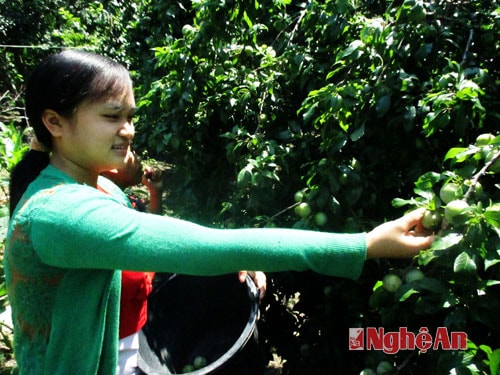 |
| Hmong girl picking plums. |
 |
| Muong Long plums, a specialty of Ky Son. |
This time, returning to Muong Long, it was a day at the end of May during a week-long heatwave. Down in the valley, the plum trees were in full bloom. I met Xong Chong Lau and his family picking plums in their orchard. After a friendly handshake, Mr. Chong Lau looked worried. He held a ripe red plum, handed it to me, and said, "The plums are sour now, sir. Sour because we can't sell them!" Then he recounted how last year, even when the plums were still green, people from the lowlands drove their cars all the way to buy them directly from the orchard. They still bought the green plums, at 6000 dong per kilogram, then 5000 dong. The villagers were very happy. In the commune, many families earned significantly more money than farming thanks to plum cultivation, notably the family of Mr. Ho Pa Chu, who earned nearly 20 million dong from selling plums. Selling at low prices, plum growers suffered losses. Just a few days after buying at high prices, traders came to the orchards and only bought plums for 1,000-2,000 VND/kg, sometimes even down to 500 VND/kg. If they didn't sell to them, who else could they sell to, since only a few people came to buy? Some households were so frustrated by the low prices that they just left the plums to rot!
Leading me on a tour of the plum orchards in Muong Long 1 village, the Chairman of the People's Committee of Xong Va Sua commune expressed his concern. This is also the common worry of plum growers in Muong Long: “The plums have started to ripen, but we haven't seen any trucks come to buy them. In a few more days, the plums will be ripe but there will be no buyers, and all we'll have to do is watch them fall all over the orchard!” Then Mr. Va Sua shared: “The Tam Hoa plum variety ripens in just a few days, turning the whole orchard red. If we don't harvest them all within a week, the fruit will fall off. The market for this specialty crop depends on traders, so it's very unstable.”
This year, the plum harvest is unprecedented. Each tree yields nearly 100 kilograms of fruit. People have to use wooden stakes to prop up the trees, yet many branches still break. Somewhere in the plum orchard, Hmong women carry baskets to pick the fruit. The men climb ladders to pick from the higher branches. The Hmong people in Muong Long don't usually take a midday break. They rush to pick plums to sell at the district market, nearly fifty kilometers away. Some have orders, but only for a few sacks. Ms. Ho Y Xua's family has over 20 plum trees; this year they have a lot of fruit, but they worry they won't be able to sell it all. Someone called to order two sacks. So she rushed to the orchard to pick them in time for early afternoon delivery to Vinh. She said, "If only people ordered like this every day, it would be wonderful." Meanwhile, Mr. Va Ba Li's orchard, with hundreds of plum trees, is almost ripe. He hopes most for a truck from a trader to come and buy the plums. Even if the price is a little low, that's fine too. Having to transport the fruit to the market every day is not worth the effort, and I can't even carry all of it, which amounts to nearly ten tons.
The plums are ripening, but no traders have come to buy them. The villagers are worried that the plums will go unsold and fall to the ground in their orchards. Many people lament: The Tam Hoa plums now taste even sourer!
Huu Vi