
Folk songs and proverbs of Nghe An
(Baonghean) - Nghe An folk songs, specifically the "ví" and "dặm" styles, are two forms of folk singing without musical accompaniment, created and passed down by the communities of Nghe An and Ha Tinh provinces during their work, production, and daily lives, becoming a unique cultural identity of the people of this region.
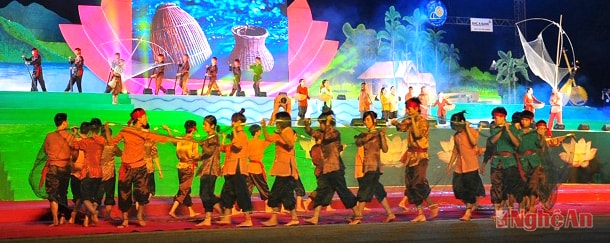 |
| Nghe Tinh Folk Song Festival. Photo: T. Hai |
The folk songs of Nghe An province, known as "ví" and "dặm," are performed in daily life, while lulling children to sleep, working in the fields, rowing boats, weaving cloth, and milling rice. The singing styles are therefore named after these forms of labor and activity, such as: Ví phường vải (Woven's Ví), Ví phường đan (Knitting Ví), Ví phường nón (Hat-making Ví), Ví phường củi (Fisherman Ví), Ví chèo non (Mountain Climbing Ví), Ví đò đưa (Boat-rowing Ví), Dặm ru (Lullaby Dặm), Dặm kể (Storytelling Dặm), Dặm khuyên (Advice Dặm), etc. These two styles of folk singing are often performed together, hence the combined name "Ví and dặm folk songs."
The lyrics of Nghe An folk songs are concise, succinct, easy to learn, remember, and sing; the content is diverse, describing life, reflecting social customs, history, love for homeland, country, and people, possessing profound educational value, expressing respect for parents, loyalty, and affection, contributing to the preservation of good customs and traditions in social conduct in villages. Nghe An folk songs are also a source of inspiration and material for contemporary musical works, songs, and operas performed on stage, in media movements, and in socio-cultural activities, which are very popular with the public, enriching the cultural and spiritual life of the community.
The folk songs of Nghe An and Ha Tinh provinces are the culmination of the creative abilities in lyrics and melodies of the communities, especially the contributions of Confucian scholars, mandarins, and patriotic intellectuals. The content, language, and songs they composed reflect the historical journey of the nation. Today, these folk songs have undergone changes to adapt to the new socio-economic landscape. Those who practice them are not only artisans, their descendants, and farmers in the villages, but also include officials, civil servants, soldiers, and police officers, both currently working and retired. To recognize the outstanding historical, cultural, and scientific values of Nghe An folk songs, the Minister of Culture, Sports and Tourism decided to include Nghe An folk songs in the National List of Intangible Cultural Heritage, and the Prime Minister also authorized the preparation of a dossier to submit to UNESCO for consideration for inclusion in the Representative List of Intangible Cultural Heritage of Humanity for the 2014 review period.
TB(Synthetic)


