
Why are students not enthusiastic about vocational training?
(Baonghean) - According to the educational and training sector's target for student placement, by 2020, 30% of junior high school graduates should be enrolled in vocational and professional training programs. However, currently, most vocational schools in Nghe An province are facing difficulties in recruiting students from this group.
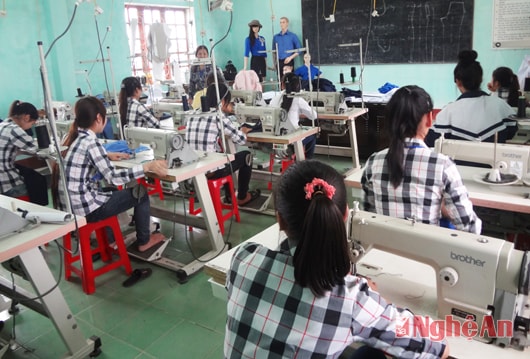 |
| Students are learning tailoring at Nghi Loc Economic and Technical Vocational College. |
After completing 9th grade at Hong Son Secondary School in Vinh City, despite having weak academic performance and the school advising him not to take the 10th grade entrance exam but to pursue vocational training, Nghiem Van Quy's family still found a way to enroll him in a private high school in the province. Nghiem Van Phu, Quy's father, said: "Previously, I was disadvantaged because I didn't finish high school, so even though my son's academic performance is weak, I am determined not to let him interrupt his education. The school encouraged him not to take the 10th grade entrance exam but to pursue vocational training. But I think vocational training isn't suitable for his age, and the family wants him to continue his education at a private school to at least get a high school diploma."
The concerns of Quy's family are shared by many parents whose children have graduated from junior high school with weak academic performance but do not want to pursue vocational training. Therefore, the student placement program after junior high school has not been as effective as desired, and the number of junior high school graduates seeking vocational training remains low. According to data from the Department of General Education (Department of Education and Training), in the 2013-2014 school year, the province had 40,462 junior high school graduates, of which 32,817 took the entrance exam for public high schools. This leaves over 7,600 students who could choose to pursue vocational training at vocational colleges. Currently, the province has 9 vocational colleges, including 4 under the Department of Labor, Invalids and Social Affairs, and 5 under the People's Committees of districts, cities, and towns. Each college enrolls 300-350 students who have graduated from junior high school. This does not include several vocational colleges that also enroll students in intermediate-level programs. However, according to information from the schools, the recruitment process for these groups is currently facing many difficulties.
The Nghe An Vocational College of Economics, Industry, and Handicrafts is one of nine vocational colleges in the province that enrolls students who have graduated from junior high school. In the 2013-2014 academic year, out of 346 students, over 230 were junior high school graduates, accounting for approximately two-thirds. However, according to Mr. Nguyen Xuan Phuong, the school's principal, enrollment from this group is facing difficulties. "To prepare for the new academic year, since the end of the 2013-2014 school year, we have held enrollment conferences, inviting all junior high school principals in the province to attend to create connections and coordination. But so far, only over 100 junior high school graduates have registered to study at the school, and we are worried that we will not be able to meet our enrollment target this year."
Meanwhile, at the North Nghe An Economic and Technical Vocational College located in Cau Giat Town (Quynh Luu District), Mr. Nguyen Van Tai – the school's principal – said: “Our school is tasked with providing vocational training at the intermediate level for students in the districts of Que Phong, Quy Chau, Quy Hop, Nghia Dan, Quynh Luu, Thai Hoa Town, and Hoang Mai Town. In recent years, in addition to vocational training, the school has also done very well in providing career counseling and job placement services by coordinating with businesses such as Lilama 7, Lilama 18, and Viet-Duc Garment Factory. As a result, the employment rate for graduates is over 90%. However, the school is facing difficulties in student recruitment. In the 2013-2014 academic year, the school's enrollment target was 450 students, of which 350 were junior high school graduates. However, only 196 students registered. This academic year, the school only set a target for junior high school graduates.” "There were 230 students, but so far only nearly 100 have registered to study."
According to Mr. Nguyen Manh Ha, Head of the Professional Education Department (Department of Education and Training), the reason why junior high school graduates are not enthusiastic about vocational training is due to the limited awareness of the public, schools, and society regarding vocational education. Many students and their families do not assess their own academic abilities, family economic conditions, and the prevailing social trends and mindset still heavily prioritize academic degrees and job positions after graduation. Meanwhile, career guidance in general schools is still limited. In addition, the current vocational and intermediate-level school system in the province is not attractive to students, and the training programs lack diversity for students to choose from. The province has nine vocational secondary schools, but the training programs are quite similar, mainly focusing on subjects like electricity, welding, automotive technology, fashion design, and business accounting. These vocational schools haven't truly collaborated with high schools to introduce their training programs, job market opportunities, and pathways to higher education (college and university). Furthermore, the current labor market is demanding of low-skilled workers; many employers still prioritize academic degrees, and very few hire graduates from vocational secondary schools. Given this reality, it's very difficult to persuade and guide students towards vocational secondary schools and other vocational training programs.
Discussing this issue, Ms. Ho Thi Chau Loan – Head of the Vocational Training Department (Department of Labor, War Invalids and Social Affairs) shared: “For students with weak academic performance who are unable to pass the entrance exam to high schools, vocational training immediately after completing the junior high school program is a superior choice. If they complete high school and then vocational training, it will take them 5 years to obtain both a high school diploma and a vocational college diploma. However, if they go straight to vocational school after junior high school, it will take about 2 years for them to obtain both a vocational college diploma and a certificate of completion of the high school program. In addition, according to Government Decree No. 74/2013/ND-CP, students are entitled to a 50% reduction in vocational training tuition fees for 3 years after graduating from junior high school. After completing vocational training, students have many options: either work to support themselves, help their families, or even become wealthy; or they can directly enroll in a regular college or university. Therefore, to help students and Parents are becoming more aware of this issue, and junior high schools need to further strengthen career guidance from the middle of the school year. Vocational schools need to review their curriculum content, actively innovate teaching methods towards simplification and solidity to facilitate students' learning and achieve high results in general education; at the same time, focus on investing in building facilities to support vocational training; strengthen the investigation and understanding of the demand for vocational training from local production facilities to provide vocational training tailored to specific needs, ensuring employment opportunities for students.”
| In 2010, the Nghe An Department of Education and Training issued Official Document No. 670/SGDĐT-GDCN on career guidance and student streaming after lower and upper secondary education. This document set a target of attracting 30% of lower secondary school graduates to vocational training and professional development programs by 2020. The document clearly stated the tasks of vocational colleges and schools: to urgently develop curricula and finalize textbooks for lower secondary school graduates; to strengthen infrastructure, technical equipment, and the teaching and management staff to meet the learning needs of lower secondary school graduates entering vocational training; and for district education departments to establish steering committees for career guidance and student streaming after lower secondary education. Principals of lower secondary schools were tasked with disseminating information about career guidance and streaming after lower secondary education to parents and graduating students. |
Minh Quan


