
Why haven't manual transmissions been phased out yet?
Many car manufacturers, from high-end to budget, still offer a manual transmission option to satisfy customers who want a pure, unadulterated vehicle.
Recently, the French automaker Renault introduced the 2018 Megane RS with a manual transmission option, which surprised many. The automotive industry is witnessing a dramatic shift, and even affordable models are now equipped with dual-clutch automatic transmissions. Manual transmissions are becoming rare.
French engineers aren't the only ones resisting the trend of automation. These days, sports cars with manual transmissions are considered strange.
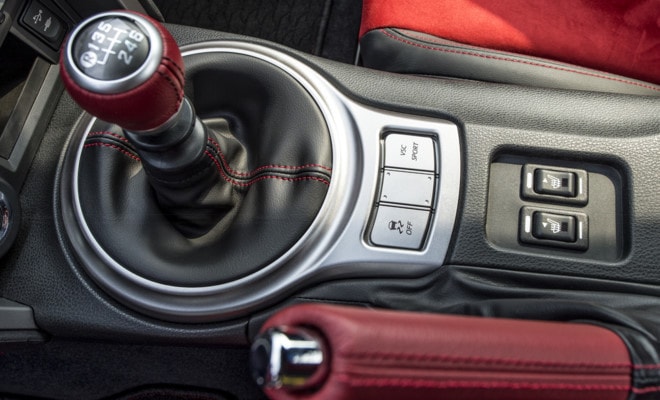 |
| Many car manufacturers still offer manual transmissions to please traditional customers. |
Most consumers believe that supercars are more efficient with only two pedals, and speed is the parameter most emphasized by sales representatives when introducing a car to customers. Most agree that "faster is better." Even Porsche, which once released a 620-horsepower 911 with a 6-speed manual transmission, seems uninterested in traditional gearboxes. The 911 GT3 is only available with the PDK transmission.
Some say Porsche has made a "stew with all kinds of vegetables," implying that all of the company's cars use the PDK gearbox. However, the German automaker still tries to please customers loyal to manual transmissions by adding a sequential gearbox option and a dual-clutch transmission on the latest 911 model.
The 707-horsepower Dodge Challenger also has a manual or "two-pedal" transmission option. The Shelby Ford Mustang GT350 and Shelby GT350R are also available in two automatic configurations, while the Chevrolet Camaro ZL1 and Corvette Z06 can both be equipped with a manual transmission if you prefer.
The British are still sticking with traditional manual transmissions in many models, for example, the 380-horsepower Jaguar F-Type still comes with a manual gearbox.
Andy Palmer, chairman of Aston Martin, told Car and Driver last year that he wanted his company to be the last manufacturer in the world to offer a manual transmission, which is perhaps the boldest statement ever made by a car brand worldwide.
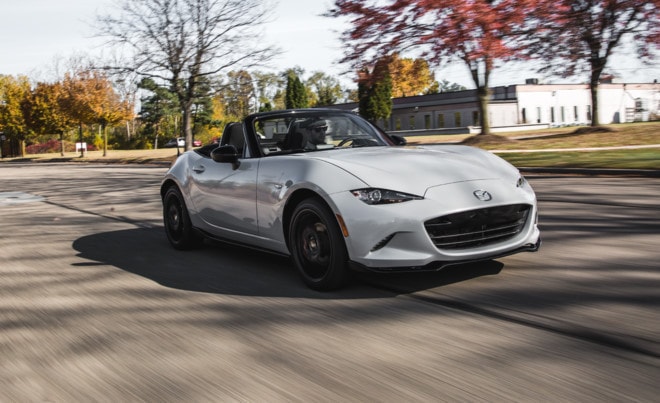 |
| The manual transmission is one of the reasons many people love the Mazda MX-5 Miata. |
In other words, the MX-5 Miata, despite having only 160 horsepower, offers more driving pleasure than controlling a 300-horsepower BMW with its superb ZF 8-speed automatic transmission. Recently, the Mazda MX-5 RF Fastback version also retains the classic manual transmission, a hallmark of the Miata. The MX-5's transmission ensures smooth, sporty gear changes with each flick of the gear lever, creating exhilarating sounds.
Although the MX-5 RF takes as long to accelerate from 0-100 km/h as an automatic SUV, it still feels much faster. Of course, that's partly due to the car's relatively light weight, but the role of the manual transmission in the driving experience cannot be denied.
Fast driving is pure, original driving, but it only feels more precise with a manual transmission. DSG, PDK, DCT, or any other type of automatic transmission may have impressive acceleration figures on paper, but real-world testing is a different story. And some automakers still want to retain the original values of sports cars, which is why manual transmissions still exist.
According to Zing


