
Encephalitis in children is becoming increasingly complex.
According to a report from the Infectious Diseases Department (Nghe An Children's Hospital), since the beginning of the year, 35 children have been hospitalized with encephalitis, presenting with high fever, coma, and seizures. Most of the patients are from mountainous regions, come from disadvantaged families, and have not been vaccinated.
(Baonghean.vn) -According to a report from the Infectious Diseases Department (Nghe An Children's Hospital), since the beginning of the year, 35 children have been hospitalized with encephalitis, presenting with high fever, coma, and seizures. Most of the patients are from mountainous regions, come from disadvantaged families, and have not been vaccinated.
At just 8 months old, Nguyen Si Nhan, from Lang Son commune, Anh Son district, has been hospitalized for over a week due to encephalitis. If his family had taken him to the hospital even a little later, the consequences could have been disastrous.
Ms. Nguyen Thi Tam (born in 1981), Nhan's mother, recounted: "About a week ago, the family noticed that Nhan had stopped eating, cried a lot, and had a high fever. We thought it was just a common cold, but unexpectedly, he had a seizure. I panicked and took him to the commune's health station. The doctors quickly transferred him to the district level. After spending a day at Anh Son General Hospital, his condition did not improve, so the doctors there transferred him to the provincial hospital for emergency treatment."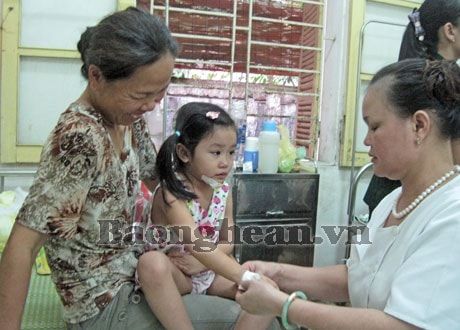
Doctors are examining patients at the Infectious Diseases Department, Nghe An Children's Hospital.
When Nhân was brought to Nghe An Children's Hospital, he had a high fever, pale skin, and continuous seizures. Fortunately, thanks to timely emergency treatment, he survived the critical period. After three consecutive days of intravenous fluids and injections, Nhân's fever subsided. Now, Nhân's condition is stable; he is alert and playing with his mother. However, continued monitoring and treatment are still necessary.
Also suffering from encephalitis, 12-year-old Luong Van Luat from Chau Thanh commune, Quy Hop district, was admitted to the hospital in an extremely critical condition, with fever, headache, stiff neck, convulsions, vomiting, and coma. Previously, he only had a mild fever, but for four consecutive days, the fever did not subside but instead rose higher, followed by convulsions. His family then took him to the commune health station and subsequently transferred him to Quy Hop District Hospital. While at Quy Hop District General Hospital, his fever remained high, leading to a coma. Seeing his critical condition, the district hospital immediately transferred him to the provincial hospital.
After being admitted to the hospital, the child was quickly taken to the emergency room. Doctors administered medication and instructed the family on how to care for the child to achieve the best results. After two days of intensive emergency treatment, the child regained consciousness. By August 9th, Luat was able to walk and talk with his parents.
At the Infectious Diseases Department of Nghe An Children's Hospital, there are currently 3 cases of encephalitis being treated. Dr. Nguyen Van Son, Head of the Infectious Diseases Department (Children's Hospital), said: “Since the beginning of the year, the department has received 35 children with encephalitis. Although the number is only slightly higher than last year, the condition is more severe, dangerous, and complex. Currently, there have been 2 deaths. Most of the cases are from mountainous and remote areas with difficult economic conditions such as Ky Son, Anh Son, Que Phong, Thanh Chuong, Quynh Chau, Quy Hop… and have not been vaccinated against Japanese encephalitis.”
Japanese encephalitis is an acute meningitis. The majority of patients are children aged 1-15, with an incubation period of 5-15 days. Approximately 1-6 days after viral infection, patients experience high fever accompanied by chills, fatigue, severe headache, nausea, and vomiting. This is followed by headache, stiff neck, seizures, and even altered consciousness, coma, hoarseness, slurred speech, and difficulty speaking. After treatment, patients may recover but may be left with sequelae such as epilepsy, screaming, and reduced motor skills.
Dr. Son added that this is a neurological infection, transmitted from animals such as pigs and birds carrying the virus to humans through insects that come into contact with the vector, mainly mosquitoes. Currently, many patients in mountainous and rural areas are contracting the disease, so there is a very high risk of infection from pigs. The hospital is investigating whether this is a contributing factor.
According to the recommendations of Dr. Nguyen Van Son, Head of the Infectious Diseases Department, Nghe An Children's Hospital: all children need to be fully vaccinated, as this is the best way to prevent disease. In addition, when a child has a high, persistent fever, the family should immediately take them to a medical facility with adequate capabilities and resources to treat the illness, avoiding a situation where it is too late, which can be dangerous and easily lead to many complications.”
Ho Lai - Mai Quynh


